


AI Agent vs Agentic AI: Which Is Better for Businesses in 2026?
In 2026, all the technology vendors are hyping AI agents and agentic AI as synonyms. Not quite the same thing. Confusion is hurting business: Businesses spend on single-task autonomous agent deployments aimed for enterprise-grade autonomy, or on full agentic AI platforms instead of simpler agent solutions that can do the same job in six weeks for a fifth of the cost.
The AI agent vs agentic AI distinction is not semantic. It dictates your architecture, your infrastructure budget, your governance needs and your reasonable aspirational delivery timeline. studies predicts that, by 2028, 33% of enterprise software applications will feature agentic AI, rising from less than 1% of apps in 2024. Deciding on the right approach is one of the most critical technology choices for a business leader in 2026.
This guide filters out all the marketing hype. At the end you'll be confident that you know what is agentic AI, what is AI agent technology, and what are AI agents in production terms, how they compare against autonomy, complexity, cost and fit and which one your business actually needs.
Understanding AI Agents: Definition and Core Concepts
What Is an AI Agent?
What is AI agent technology at the core? An AI agent is a computerized system that can sense its environment from data inputs, process and analyze the data with AI algorithms, take decisions based on predetermined goals and perform actions independently to get specific results or goals without human intervention at every turn.
An intelligent agent in AI has its origins in classical AI research, the agents were defined by four properties: autonomy which is to “act without direct human control”, reactivity that is to “respond to changes in the environment”, proactivity where AI agents act in order to achieve a goal, and social ability where AI agents can be seen interacting with other systems or people. These are the essential attributes of AI agents that are delivered by modern AI agents through the combination of machine learning, NLP, and retrieval-augmented generation.
Let's get back to the basics: what are AI agents? They're the systems handling your customer service inquiries at 1am, your support tickets, your inbound lead scoring, monitoring your infrastructure for anomalies, and creating your pipeline reports for the week and doing all these things without a human being involved in each movement.
Types of Agents in AI
What are AI agents at an architectural level? Every intelligent agent in AI can be categorized into 5 basic architectures. The most costly scoping error in AI initiatives is the choice of the wrong agent architecture, and knowing the types of agents in AI can help avoid this error. These are different kinds of types with different complexity profiles, costs and use cases.
| Agent Type | How It Works | Suitable For |
|---|---|---|
| Simple Reflex Agent | Reacts to current input using fixed if-then rules; no memory | Alert triggers, basic FAQ routing, threshold monitoring |
| Model-Based Reflex Agent | Maintains internal state model; handles partial information | Inventory tracking, predictive alerting, data enrichment |
| Goal-Based Agent | Plans action sequences to reach a defined goal; uses search algorithms | Lead qualification, support resolution, pipeline automation |
| Utility-Based Agent | Selects actions that maximize a defined utility function across competing goals | Dynamic pricing, resource scheduling, campaign optimization |
| Learning Agent | Improves continuously from outcomes; adapts without reprogramming | Churn prediction, fraud detection, personalization engines |
Most production AI agent deployments in 2026 are built on Goal-based or Learning architectures with the core of the agents being a large language model (LLM). Simple reflex agents are still useful for high volume and low complexity automation where speed and cost are more important than adaptability.
Key Qualities of an AI Agent
There are four properties associated with each intelligent agent in AI, no matter what type of agent it is:
Autonomy – the agent functions and decides on its own in its scope without needing approval from the human user for each action. They can be more or less autonomous; some agents may show suggestions that need to be authorized by humans, others may carry out fully without supervision.
Reactivity ability to continuously watch its surroundings and react to changes in the state of its surroundings. If a monitoring agent detects an anomaly and opens a ticket, then it is reactive. A smart system is different from a scheduled batch job because of reactivity.
Goal-Directedness: The agent's actions are driven by specific and measurable goals and not just by the processing of inputs and return of outputs. Commercial value of autonomous agents is their goal-directedness: they don't wait for orders to be given to them next.
Social Ability: The agent is able to interact with people and other systems, comprehending natural language, coordinating with other agents, and describing its actions. For multi-agent architectures, social ability allows specialist agents to cooperate in order to achieve complex workflows which are not possible to be attained by a single agent.
Understanding Agentic AI: The Next Evolution
What Is Agentic AI?
Agentic AI is an architectural paradigm, not a specific product or model; it's the use of one or more AI agents that can act with significant autonomy, long-term planning, self-correction and little or no human supervision to achieve complex, multi-step goals. What distinguishes the agentic use of AI - and indeed its use of any artificial intelligence - is its ability to plan, act, monitor, and adapt towards goals that none of the steps of the system could have accomplished on their own.
What is agentic AI in the enterprise context? It is a sales prospecting system that can automatically research prospects, rate them, write a custom message, set up follow-up, update its CRM and then elevate to a person if the prospect responds positively. It's a software development pipeline that reads a requirements document, creates code, writes tests, runs them, fixes failures and opens a pull request, without a developer touching anything. It's an operations system that identifies a supply chain anomaly, pinpoints the root cause, generates three possible solutions with a cost benefit analysis, implements the approved solution, and notifies all stakeholders... all within 4 minutes.
Agentic AI systems are powered by the capabilities of large language models, retrieval-augmented generation, tool-calling APIs, persistent memory architectures, and multi-agent orchestration frameworks, all of which enable systems to maintain goal-directed behavior for hours, days or weeks of execution.
Core Principles of Agentic AI Systems
Autonomous Decision - Making at Scale Agentic systems are capable of making consequential decisions – not recommendations – without needing to gain approval from a human for every decision made. This delegation of decision authority is what makes agentic systems possible at the speed and volume they're able to perform at. It also needs to be governed effectively – with autonomy defined by boundaries, auditability and reversibility.
Long-Horizon Goal Pursuit Where an agentic AI system breaks up complex long term goals into a series of short term goals, assigns them to the correct specialist agents and controls their execution over a period of time. What is missing from even the most powerful single-agent AI is this ability to break down a strategy.
Proactive Initiative Agentic systems are not instruction takers. They see the opportunities, predict the issues, brainstorm solutions and take action – producing results instead of waiting for questions. Production agentic AI is not an instrument for use, it is a collaborator, it will surface finished work.
Contextual Memory and Learning Agentic AI systems have a memory that can be retained throughout both interactions and sessions, allowing for increasingly relevant decisions over time. The learning agent embedded in an agentic AI architecture does not reset each time a session begins, instead it models its environment, its goals and its performance history.
Multi-Agent Orchestration The most capable agentic systems include several agents to solve a problem: a research agent, a writing agent, a verification agent, an execution agent and orchestrate them with an orchestrator that coordinates task routing, conflict resolution, and goal tracking. This orchestration layer is where the system is able to solve problems that are more complex than any one AI agent can solve alone.
Agentic AI vs Traditional AI: Key Differences
Agentic AI is fundamentally different from traditional AI in many ways.Agentic AI differs from traditional AI in several ways.
To compare the two, AI agent vs agentic AI, it is first necessary to define where both fit in the context of the previous wave of AI's:
| Dimension | Traditional AI | AI Agent | Agentic AI |
|---|---|---|---|
| Initiation | Human-triggered | Event-triggered or human-triggered | Self-initiated |
| Scope | Single task | Single goal | Multi-goal, multi-step |
| Memory | Stateless | Short-term (within session) | Persistent, long-term |
| Adaptability | Fixed model | Reacts to environment | Plans, self-corrects, improves |
| Human involvement | Every step | Periodic review | Exception-based only |
| Orchestration | None | None | Multi-agent coordination |
Traditional AI is a complex tool. AI agents are autonomous workers. A agentic system works like a self-managing team.
AI Agent vs Agentic AI: Head-to-Head Comparison
| Aspect | AI Agent | Agentic AI |
|---|---|---|
| Definition | Software system that perceives, decides, and acts on specific tasks | Orchestrated system of agents with high autonomy pursuing complex goals |
| Autonomy level | Bounded executes defined tasks | High plans, adapts, self-corrects across entire workflows |
| Goal complexity | Narrow, single-step objectives | Complex, multi-step, long-horizon goals |
| Learning | Task-specific model updates | Continuous, cross-domain learning and adaptation |
| Typical use cases | Customer service, lead routing, anomaly alerts | SDLC automation, supply chain optimization, autonomous research |
| Development cost (India) | ₹2.5L – ₹25L | ₹30L – ₹2Cr+ |
| Delivery timeline | 3–10 weeks | 10–36 weeks |
| Human oversight | Per-task or periodic | Exception-based |
| Infrastructure requirements | Standard cloud APIs | Vector databases, orchestration frameworks, persistent memory |
| Risk profile | Low bounded scope | Moderate-high requires governance and rollback mechanisms |
| 2026 adoption trend | Mainstream across SMB and mid-market | Growing rapidly in enterprise and AI-first product companies |
Real-World Use Cases: AI Agents vs Agentic AI in Action
Where AI Agents Deliver Best Results
Customer Support Automation: A goal-based intelligent agent handles Tier-1 support queries, routes tickets by category, retrieves knowledge base answers, and escalates to a human when confidence is low. The agent operates with bounded authority and produces measurable outcomes: 60–70% deflection rate, sub-30-second first response.
Lead Qualification: An autonomous AI agent scores inbound leads against an ICP, enriches contact records from public data sources, and routes qualified leads to the correct sales rep with a pre-populated context card. No agentic orchestration required; it is a single-step, goal-based workflow.
Infrastructure Monitoring: A model-based monitoring agent tracks system metrics, detects anomaly patterns, and triggers automated incident tickets operating continuously without human input.
Where Agentic AI Delivers Best Results
Software Development Lifecycle: An agentic delivery system reads a requirements document, generates a development plan, writes code across multiple files, runs tests, fixes failures, validates against acceptance criteria, and opens a pull request compressing what takes a development team two sprints into hours of autonomous execution.
Market Research and Competitive Intelligence: An agentic intelligence platform continuously monitors competitor activity, regulatory changes, and market signals; synthesizes findings into structured intelligence briefs; distributes them to relevant stakeholders; and flags items requiring executive attention all without human curation.
End-to-End Sales Pipeline Management: An agentic sales system prospects for target accounts, initiates contact, qualifies intent through conversation, schedules demos, sends follow-up sequences, updates the CRM, and notifies an account executive only when a prospect is ready for a discovery call.
When is it Best to Adopt AI Agent vs Agentic AI for your business?
Your decision should be dependent on four factors: Goal complexity, need for autonomy, budget and preparedness of the organization.
Opt for a single AI agent if:
- Your automation target is a single well-defined workflow
- The task is well defined with bounded decision space and success criteria are clearly specified.
- I am on a budget of less than ₹25 lakhs.
- Must be live within 10 weeks
- You have little experience using AI in your operations.
Use Agentic AI when:
- You use a lot of steps, systems and decision types in your work flow.
- The problem isn't one that needs to be solved without planning.
- You have a data infrastructure that could support persistent memory.
- Your organization has established governance for independent decision making.
- You're after 30-50% efficiency improvement at scale
A simple heuristic: If a competent human doing the action had to make more than three different decisions based on different information, agentic AI is probably the best architecture. If the task is repetitive and the criteria for the decision is set, one AI agent can suffice, and is a worthwhile saving in meaning.
Where AI Agents and Agentic AI Are Heading
Organizations using agentic AI in production report a compounding efficiency gain, with agent models growing more efficient as they are trained on additional production data, and workflows being executed 40–50% faster, McKinsey says. There are three trends that will shape the next 24 months:
Agentic AI becomes the enterprise architecture of choice. The distinction between software and autonomous agents will remain vague. Agentic layers are being integrated into existing platforms, forming an ecosystem of agents that can work together and be orchestrated by the businesses without having to implement them from scratch, such as Salesforce Agentforce, Google AgentSpace, and Microsoft Copilot Studio.
Multi-modal agents expand the problem space. Most existing AI agents and agentic systems are text and data oriented. The new vision, audio and sensor model advances are bringing agentic capabilities into physical environments, such as quality inspection, field service automation and real-time video analysis.
Governance frameworks turn into non-negotiable. Regulatory and governance structures will hold the decisions of autonomous agentic systems accountable for the way the decisions are recorded, communicated and challenged. For businesses, this means that it can become a real compliance edge to build a governance structure instead of adding it on after the fact.
The big question is not if agentic systems will be important for enterprise operations. Whether your organization creates the architecture, governance, and operational readiness to reap the benefits from it before your competitors do.
How Chirpn Builds AI Agents and Agentic AI Systems That Reach Production
The concept of an AI agent vs agentic AI is relatively simple to grasp. Most projects fail in building either or in a way that can reach production, and subsequently perform reliably in the real load and improve over time.
Based in Australia and India, Chirpn is an AI-first software engineering company that caters to startups, scale-ups, and enterprise customers across the globe. Chirpn is a certified Google Cloud Partner and uses the same infrastructure that powers Google's own agentic AI products: Vertex AI, Google AgentSpace, and Google's own product, Gemini. Chirpn's AI and ML development solutions span from AI agents that perform specific tasks to multi-agent orchestration platforms.
AutoPATH Agentic Delivery in Practice Chirpn's own AI framework, AutoPATH, runs the entire software development lifecycle as multiple parallel agentic systems, conducting requirements gathering, architecture, coding, testing and deployment all without any sequential handoffs. This is not a marketing assertion, but actually how Chirpn is able to provide production-ready systems within 45 – 60 days. This battle-tested delivery architecture benefits each and every client engagement, from building a single AI agent to an entire agentic AI platform. For an in-depth look at the build process, read Chirpn's full AI agent development guide.
Google AgentSpace and Vertex AI Integration Chirpn's Google Cloud Partner certification gives direct access to Google AgentSpace, Agent Vertex AI Builder and Agent Assist frontier tooling which most AI development companies at a similar price point cannot get. This integration can substantially cut down on orchestration engineering time and the infrastructure's cost for the client opting for agentic AI over a plain agent architecture.
GenAI + Agent Architecture Modern agentic AI systems require LLM reasoning capabilities embedded alongside classical tool-calling and memory architectures. Chirpn's GenAI solutions team integrates Gemini-powered intelligence natively into every agent system built not as an afterthought or third-party add-on.
50+ Production Deployments, Zero Abandoned Projects Chirpn has shipped 50+ products in 45–60 days across healthcare, education, e-commerce, sports, and enterprise software verticals. Every client references a live production system, not a proof of concept that stalled after the demo. For businesses evaluating the AI agent vs agentic AI decision with a real project in mind, Chirpn's team conducts a free architecture assessment that outputs a scoped recommendation, technology decision rationale, and cost estimate within 48 hours.
Conclusion
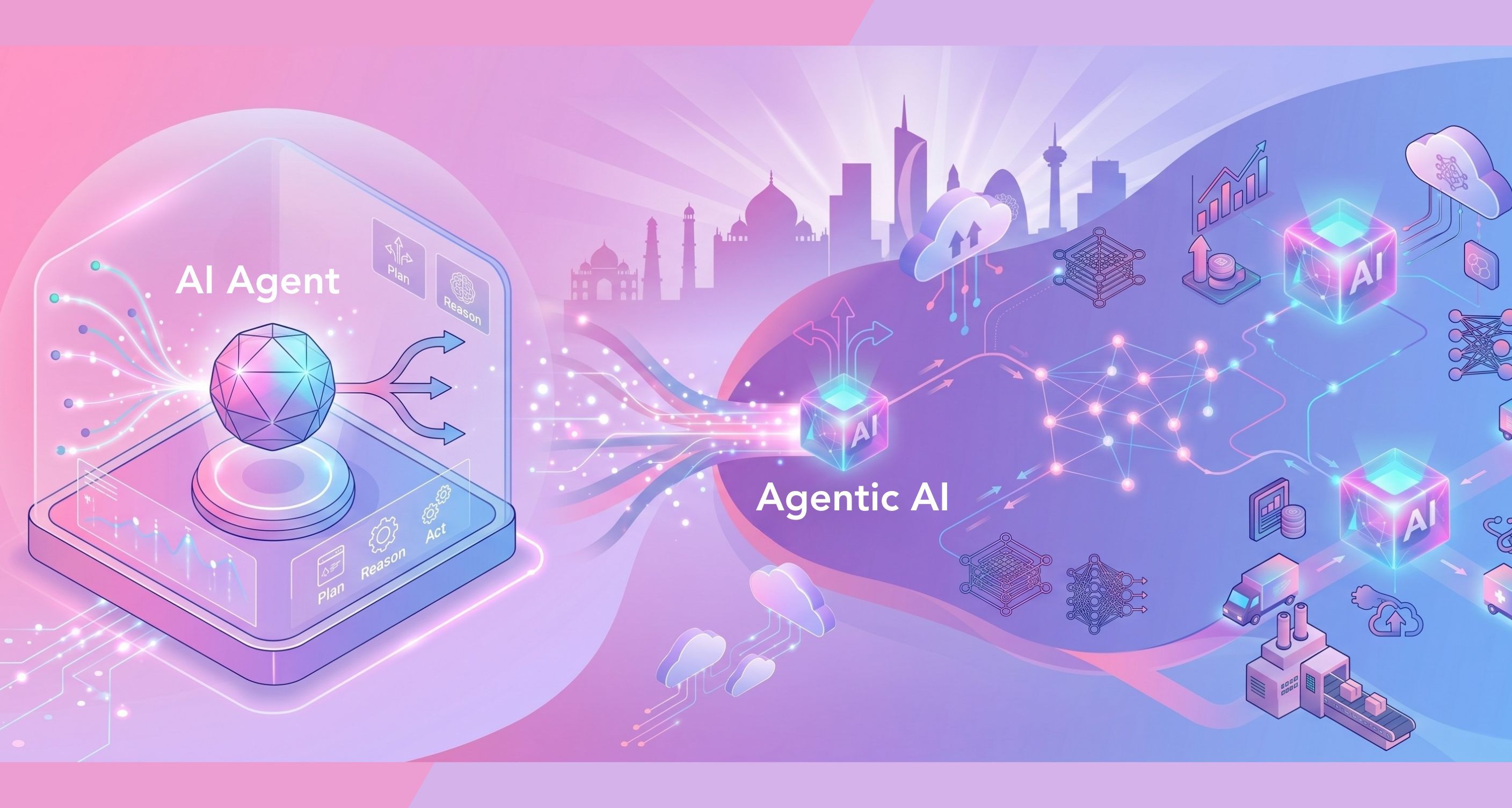
The AI agent vs agentic AI is a straightforward split, with architecture being one thing and marketing being another. The building block is an AI agent, which is a system that can perform specific tasks and is autonomous. Orchestration: Agentic AI, several agents working in concert, with strategic planning and self-correction.
They are not all better. This will rely on your workflow complexity, organizational readiness, governance mechanisms and budget. You'll find that a structured architecture assessment, not a sales pitch on a new vendor, yields the best return on your investment with AI and with compound returns.
Frequently Asked Questions
What is the difference between an AI agent and agentic AI?
The first step in knowing what is AI agent technology is and what is agentic AI is to grasp scope and autonomy. An AI agent is a particular type of software system which understands the world around them and makes decisions on their own to achieve a clear objective. Agentic AI is an architectural style of AI, comprising one or more high autonomy, multi-step planning, self-correcting AI agents that work towards complex goals. AI agents form the basis for every agentic AI system, but an AI agent alone is not agentic AI.
What are the types of agents in AI?
There are five basic types of agents in AI: simple reflex agents: react to present input only, model-based reflex agents: have internal model, goal-based agents: plan actions through a series of steps to reach a goal, utility-based agents: optimize across a set of competing actions, and learning agents: improve continuously as they act. Goal-based or learning agent architectures are the most common architectures for production deployments in 2026.
What is agentic AI and why does it matter for businesses in 2026?
Agentic AI refers to autonomous AI systems that are highly autonomous, have long-term planning capabilities, multiple agents that can orchestrate each others' actions, and a long memory that allows them to pursue complex business goals with little human intervention. It's a relevant question in 2026 because both McKinsey and Gartner numbers show that companies that have adopted agentic AI into production are seeing 40–50% faster production cycles, plus compounding gains in efficiency as the agent models improve over time.
Which is better for my business, an AI agent or agentic AI?
There is no universal “best” option. For narrow and well-defined workflows, with clear decision criteria, budget of ₹25 lakhs and time of less than 10 weeks, select a single AI agent. Where strategic planning, cross-system coordination, and multi-step execution with long-term implications are needed, and efficiency gains are worth the initial investment and governance setup, then agentic AI should be considered.
How much does agentic AI implementation cost in India?
Agentic AI systems created by Indian development firms depend on factors such as the number of agents, level of integration, the type of memory structure, governance needs and deployment size.