



The average online shopper leaves their cart behind 70.22% of the time, according to data from the Baymard Institute, as referenced in industry reports. This percentage has stayed consistent over time, particularly in a time when many stores have a strict “rules” style of storefronts. But, AI for eCommerce is starting to change all of that. It is not simply the introduction of a chatbot, it is about making catalogs or generic search systems dynamic and changing according to the individual shopper.
In this article, we will examine the impact of AI in eCommerce today and the ways in which it is making a difference. It examines the advantages of an AI shopping assistant over the traditional support bot, what AI tools for ecommerce are worth the investment and the challenges to wider adoption.
- The performance in the shopping space has been incredible, with up to 15% higher conversion rates and 25% more revenue per visitor in A/B testing.
- An impressive 95% of all eCommerce brands that use AI say they are seeing a positive return on investment and 78% are using generative AI for at least one business function.
- Predictive inventory forecasting is effective, resulting in reductions in stockouts by up to 75% in some instances.
- The biggest blocker to AI ecommerce is not about the technology itself but rather the scattered data and the difficulty of proving a concrete revenue gain.
Where is AI currently being applied to ecommerce?
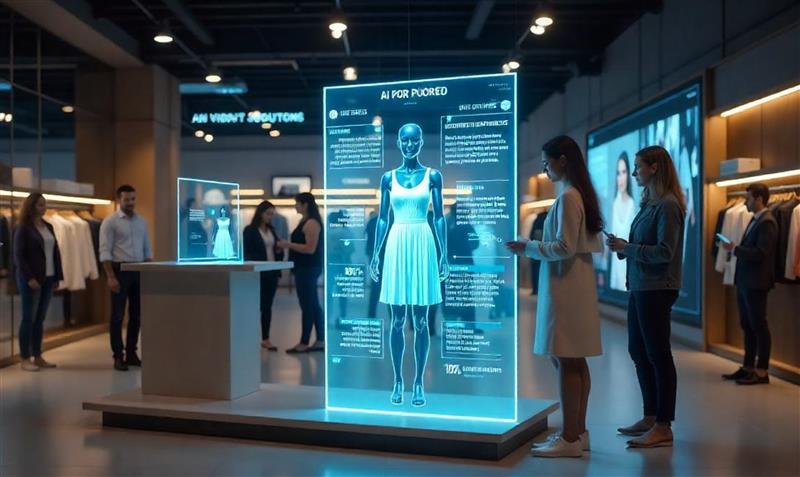
The new innovations in AI-powered ecommerce now are centered around four areas: personalized recommendations, semantic search, conversational shopping assistants, and demand forecasting. These technologies are no longer in the experimental stage, but are being used on a large scale by major retailers. Chirpn’s AI and ML development services cover all these ecommerce AI use cases.
Personalized recommendation engines build affinity profiles for each individual as he/she shops, providing a more customized experience than the usual “you might also like” feature. In one example, Yves Rocher, a skincare company, reported an 11-fold higher purchase rate with the use of AI-recommended products compared to a static recommendation, with 17.5 times more clicks. While this is just one case, it highlights the potential of effective personalization.
The introduction of semantic, intent-based search is another major change. AI search understands the shopper's intent as opposed to traditional ecommerce search, which matches keywords. For instance, if you type in something like "warm jacket for rainy commute," the results will be relevant to your needs. Personalized search experiences are one of the factors that helped furniture retailer Benson's for Beds, up 41% in ecommerce sales YOY.
What an AI Shopping Assistant is and how it works?
An AI shopping assistant is like a conversational partner, helping users navigate the process of discovery, comparison, and selection of products. This is not a support bot, who only replies to inquiries after buying. It's the difference that matters: shopping assistants are part of the buying process, support bots are part of customer service.
Typical operation of an AI shopping assistant:
- It picks up the meaning of natural language queries.
- Matches that match with real-time product attributes and inventory.
- Asks questions to clarify in order to narrow down the options
- Assists shoppers in moving through check out efficiently.
This is in line with a new trend BigCommerce is calling agentic commerce that requires AI systems to make decisions on behalf of a shopper rather than merely answering their questions. BigCommerce also reports that more than half of Americans rely on general AI tools such as ChatGPT to look into an item before visiting a retailer's website. This means that the conversation with an AI shopping guide could start even before the shopper reaches the store's door.
Which AI tools for ecommerce make the most sense in terms of ROI for ecommerce?
The most productive AI tools for ecommerce are typically one of three types: personalization engines, demand forecasting and dynamic pricing. According to the reports by BigCommerce 95% of ecommerce brands report that they derive good returns from the use of AI, while 78% of respondents are using generative AI in at least one aspect of their business.
In this context, Nordstrom's highly personalized efforts are a standout success, with conversion rates reportedly increasing by 35% and retention rates by 40%. It is important to remember that these impressive numbers are the result of substantial investments in data infrastructure, but not because they are expected to be achieved across the board.
What's interesting is that the most successful use cases are not the showiest innovations. While some of the more customer-centric features, such as augmented reality try-on, have proven to deliver good returns, Demand forecasting and inventory optimization are consistently showing a return well above average, due to their ability to use structured, clean, internal data rather than unpredictable shopper behaviour.
What is the reason behind the slow AI adoption in ecommerce?
While the challenge in adoption of AI in ecommerce is not model capability, it's the need to aggregate data from disparate sources that were not built to communicate with each other. This disintegration is identified by Bloomreach as the biggest problem retailers are facing, regardless of budget or knowledge. This is related to three primary issues:
Data Silos: Product info, customer behavior, inventory details are stored in different platforms, which don't communicate well, and leave AI recommendation engines with incomplete information.
Inadequate transparency and control: Retail teams tend to be reluctant to adopt AI systems with recommendation algorithms that they cannot fully comprehend or review, especially when it comes to pricing.
Difficulty proving incremental revenue lift. The difficulty in proving incremental revenue growth: It's hard to assess whether or not sales growth is a direct result of the AI itself, or if it's a result of other factors such as seasonal demand or marketing campaigns.
Chirpn's specific experience with data fragmentation was when working with a retail client on a set of service operations where customer data was fragmented across a number of disjoint systems. Most of the engineering work was done not to deal with the AI technology itself, but to address the underlying problems.
What's the future of AI in eCommerce?
For future developments, the next step of AI for Ecommerce is oriented toward agentic commerce, where AI will be recommending products and also make part of the transaction without human intervention, but reserve the final decision to human beings. Bloomreach imagines this transformation as a competitive advantage that leverages external AI shopping assistants to connect directly with a retailer's product and pricing information.
This shift highlights how vital structured product data is. Whether it's a retailer's own AI shopping assistant or an outside service, it can only be effective if the information and the pricing in the catalog is in a good structure. Businesses making the leap to clean, structured data are preparing to reap the rewards of this transformation, while others who have depended on more disjointed systems will be at a disadvantage, whatever type of AI tools they decide to adopt.
Conclusion
The excitement of using AI for ecommerce has moved beyond the hype stage. An impressive 95% of the brands that are already using it report real returns, with those brands that experienced the biggest gains having addressed their problem of data fragmentation prior to the implementation of AI solutions. The personalisation of the website, semantic search and AI shopping assistants are already delivering measurable results today, and agentic commerce is the next big thing to look forward to.
Chirpn's platform and product development team have managed to overcome similar data fragmentation issues, while helping retail clients. If you're thinking about using an AI-powered ecommerce business and would like to get a realistic idea of what your existing data infrastructure can do, contact the team at Chirpn and discuss a roadmap.
FAQ
What are the key AI tools for eCommerce?
AI tools for ecommerce cover personalization engines, predictive demand forecasting systems, dynamic pricing tools and visual/semantic search. According to Linnworks, “In some cases, predictive demand forecasting can cut down on out-of-stock situations by as much as 75%.
What is an AI Shopping assistant?
AI shopping assistant is a conversational tool that allows the shoppers to find and choose products in the natural way, not a customer service "bot" type of service.
Is AI effective for increasing eCommerce conversions?
Data from aggregate A/B testing demonstrate that AI-driven personalized shopping experiences can improve revenue per visitor by as much as 25%, and lift conversion rates by 15%.
How is AI not being adopted in ecommerce?
Some of the challenges include problems with data silos, limited transparency into AI model operation, and the challenge of assigning credit for AI work to revenue growth.