



Banner Background

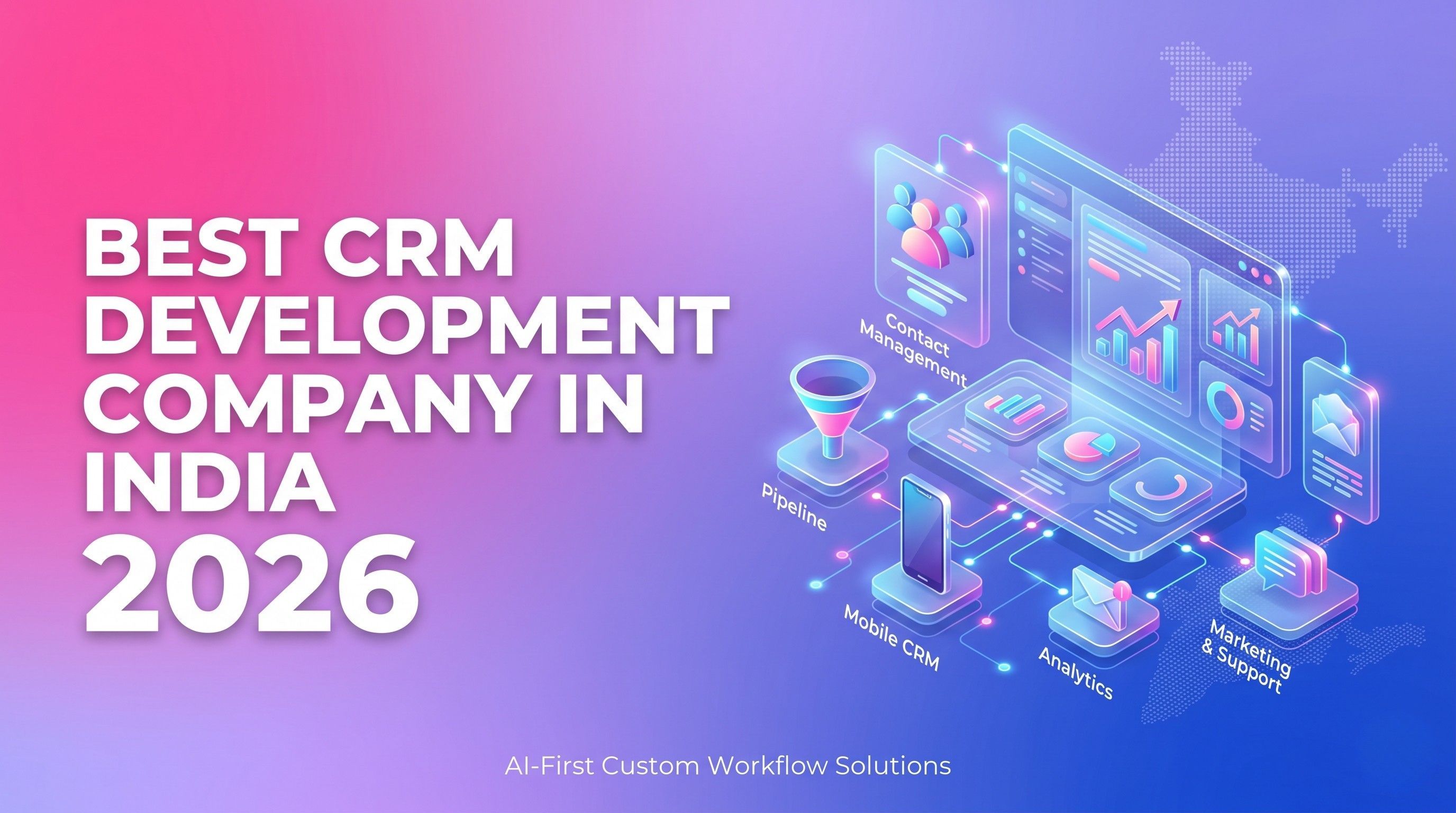
Best CRM Development Company in India 2026

  • Category

    Consumer

  • Chirpn IT Solutions

    AI First Technology Services & Solutions Company

  • Date

    May 30, 2026

Each year, thousands of expanding businesses purchase CRM software, and almost 70% say that their system doesn't truly support their team's process. The outcome: manual workarounds, low adoption and a tool to make things more difficult than they should be. Choosing the top CRM development company in India isn't just about technology, it's about your business.The decision of which CRM development company to choose in India isn't just about technology; it's about your business.

The total global CRM market is expected to reach $157 billion by 2030 with a CAGR of 13.9%, according to Grand View Research.However, the problem most businesses have is not that they don't have a choice of CRM's, it's that they don't have a custom CRM software development company in India that understands their workflow intimately enough to create something that will be put to use.

It offers you an understanding of the difference between the best and the ordinary CRM development partners, the most common problems that CRM users encounter, and how custom CRM systems differ from their off-the-shelf counterparts.

About CRM Development and CRM Company in India

What is CRM Development?

CRM development is the process of designing, customizing and implementing a CRM system to meet the unique needs of a business. It is the process of creating or setting up software to enhance the management of interactions with current and prospective customers by centralizing contact information, communication history, preferences, and purchase history. It involves database programming, workflow automation for sales and marketing purposes, integration with other applications and continuous maintenance. With the right CRM development, you can transform customer interactions, enhance satisfaction, drive sales conversions and make data-driven decisions.

What Does a CRM Development Company in India Actually Build?

A CRM software development company designs, constructs and implements CRM systems that are built to accurately reflect a business's sales processes, service workflows and data architecture. It's not the same as implementing a CRM by setting up an existing CRM system such as Salesforce but it's an authentic service depending on your requirements.

The best CRM companies in India provide an holistic solution:

Service TypeWhat It MeansBest For
Custom CRM DevelopmentBuilt from scratch for unique workflowsComplex processes, specific industries
CRM Platform CustomisationDeep modification of Salesforce, HubSpot, ZohoStandard base + bespoke features
CRM IntegrationConnecting CRM to ERP, billing, or marketing toolsAdding CRM to an existing tech stack
AI-Powered CRMCRM with predictive scoring, agentic workflowsSales teams wanting intelligent automation
CRM for Small CompaniesLightweight, scalable systems for growing teamsStartups and SMBs under 50 users


Types of CRM Development

Type of CRM DevelopmentPrimary FocusKey FeaturesBest For
Operational CRMAutomating business processesMarketing automation, sales force automation, customer service automation Companies wanting to streamline sales, marketing, and support workflows 
Analytical CRMCustomer data analysis & reportingBehavioral data analysis, 360° customer profiles, predictive analytics, trend reporting Businesses needing data-driven insights for personalized customer experiences 
Collaborative CRMCross-department collaborationContact management, channel management, partner relationship management, integrated data sharing Organizations requiring marketing, sales, and service teams to work together 
Custom CRMTailored functionalityBespoke features, specific workflow automation, custom integrations, AI-powered capabilities Businesses with unique processes that off-the-shelf solutions can't meet 
Off-the-Shelf CRMReady-to-use solutionPre-built features, quick deployment, lower cost, standard workflows [4][5]Small businesses or those needing quick implementation with standard needs [4][5]
B2B CRMBusiness-to-business salesLong sales cycle management, multiple buyer tracking, complex deal pipelines Companies selling to other businesses with lengthy purchase processes 
B2C CRMBusiness-to-consumer salesHigh-volume transaction handling, quick sales cycles, broad customer segmentation Retail and consumer-facing businesses with fast, high-volume sales 


What are Core CRM Modules?

Here is a list of Core CRM Modules and What is their Purpose:

No matter which one you select, a reliable CRM software development company ought to provide these modules:

Contact & Account Management  Full customer profiles, interaction history, segmentation and duplicate detection.

Sales Pipeline Management  Lead capture, opportunity tracking, deal stage automation, and forecasting using customisable probability models.

Marketing Automation  Campaign management, lead scoring, nurture sequences and campaign attribution reporting.

Customer Service & Support  Ticket management, SLA tracking, knowledge base and multi-channel support (email, WhatsApp, chat).

Analytics & Dashboards  Real-time sales dashboards, Pipeline velocity reports, Custom KPI views and AI-assisted forecasting.

Mobile CRM Field sales apps with offline access and native iOS and Android versions.

Refer below list of Core CRM modules and What they do:

#ModulePurpose
1LeadUnqualified prospect who showed interest (filled form, downloaded ebook) but isn't evaluated yet 
2AccountCompany or household; stores company-level info (industry, size, address) 
3ContactIndividual person linked to an Account; stores person-level info (name, email, phone, role) 
4Opportunity (Deal)Potential sale with amount, stage, and close date; unit of revenue forecasting 
5ActivityMeetings, calls, emails, tasks  anything done with a customer; operational backbone of CRM 
6CampaignMarketing initiative with measurable ROI (email blast, webinar, trade show) 
7ProductItems/services you sell; has SKU, price, category; linked to Opportunities 
8QuoteFormal proposal with line items, pricing, discounts, validity; becomes Order when accepted 
9Order/InvoiceConfirmed purchase records; Order = customer commitment, Invoice = billing record 
10Case (Ticket)Customer service/support request; tracks status, priority, owner, resolution time 

Forecast, Territory, Contract, Asset, Partner, Knowledge Base and Workflow automation are available as additional advanced modules (5-20 options). The modules form the core of the data graph: Lead to Account + Contact + Opportunity to Quote to Order.

What is the Difference Between Custom CRM vs. Off-the-Shelf

FactorOff-the-Shelf CRMCustom CRM Development
Initial Cost₹1L–5L/year (licence)₹8L–1Cr+ (one-time)
Workflow Fit60–75% match100% match
Customisation DepthLimited (20–30%)Unlimited
Integration FlexibilityStandard APIs onlyFull stack flexibility
OwnershipLicence onlyFull IP ownership
Competitive EdgeGeneric (shared with competitors)Unique to your business
5-Year Cost₹5L–30L (escalating)₹10L–1.2Cr (flat + maintenance)
Delivery TimeDays to weeks45 days–6 months

When Custom CRM Development Makes Sense

Go for a custom crm software development company in India when:


  • Your workflows deviate from the standard..
  • Good integration with proprietary internal systems is required.
  • You work in a regulated industry like healthcare, BFSI, legal where there are compliance needs
  • You have 30+ users and will need to scale.
  • You are concerned about data ownership and cost-control in the long run.

When an Off-the-Shelf Platform Works

If you have less than 20 users, have a simple sales process, require something within 2 weeks and are limited to a budget of less than ₹5 lakhs, stick with Salesforce, HubSpot or Zoho.

Complete CRM Development Cost Breakdown

1.  CRM Development Cost Matrix by Business Size

Business Size

Basic CRM

Standard CRM

Advanced CRM

Enterprise CRM

Small  (1-20 users)

₹3L - ₹8L

₹8L - ₹15L

₹15L - ₹25L

₹25L - ₹40L

Medium (20-100 users)

₹8L - ₹15L

₹15L - ₹30L

₹30L - ₹50L

₹50L - ₹80L

Large  (100-500 users)

₹15L - ₹30L

₹30L - ₹60L

₹60L - ₹1Cr

₹1Cr - ₹2Cr+


2.  Cost Distribution by Delivery Phase

Phase

% of Total

Cost Range

Key Activities

Discovery & Consulting

10-15%

₹1L - ₹10L

Business process analysis, requirement documentation, workflow mapping, technology selection, architecture design, ROI modelling
UI/UX Design

10-15%

₹1.5L - ₹12L

User research, personas, wireframes, mockups, interactive prototypes (AutoCAR), visual design, usability testing
Development

40-50%

₹5L - ₹60L

Backend (20-25%), Frontend (15-20%), Database (5-10%), API (5-10%), Mobile app optional (15-20%) 
Integration

15-20%

₹2L - ₹20L

ERP (₹2L-₹10L), Marketing automation (₹1L-₹4L), Payment gateways (₹75K-₹2.5L), Email (₹50K-₹2L), Analytics (₹75K-₹3L)
Testing & QA

10-15%

₹1L - ₹8L

Functional, performance/load, security, user acceptance testing, cross-browser and device testing
Deployment & Training

5-10%

₹50K - ₹5L

Server setup, data migration, role-based user training, documentation, go-live support
Annual Maintenance

15-20%*

₹1L - ₹15L/yr

Bug fixes, security patches, performance optimisation, feature enhancements, technical support, server maintenance


3.  Development Cost Breakdown  (40-50% of Total)

Development Area

Percentage

Cost Range

Backend Development

20-25%

₹2L - ₹25L

Frontend Development

15-20%

₹1.5L - ₹20L

Database Design

5-10%

₹50K - ₹10L

API Development

5-10%

₹50K - ₹8L

Mobile App (Optional)

15-20%

₹3L - ₹15L


4.  Integration Cost Breakdown  (15-20% of Total)

Integration Type

Cost Range

ERP Systems

₹2L - ₹10L

Marketing Automation

₹1L - ₹4L

Analytics Platforms

₹75K - ₹3L

Payment Gateways

₹75K - ₹2.5L

Email Platforms

₹50K - ₹2L

Communication Tools

₹50K - ₹2L


5.  Sample Project:  Mid-Sized Real Estate CRM  (50 Users)

Component

Investment (INR)

Timeline

Discovery & Planning

₹1,50,000

2 weeks

UI/UX Design

₹2,50,000

4 weeks

Backend Development

₹8,00,000

12 weeks

Frontend Development

₹6,00,000

10 weeks

Mobile App

₹4,00,000

8 weeks

Integration (ERP, Email)

₹3,00,000

4 weeks

Testing & QA

₹2,00,000

3 weeks

Deployment & Training

₹1,00,000

2 weeks

Total Implementation

₹28,00,000

6 months

Annual Maintenance

₹4,50,000

Ongoing


How to Choose the Best CRM Development Company in India

  • Evaluation Criteria Checklist
  • Prior to hiring any CRM development partner, check these points:

Technical Capability

  • If the software has been developed for CRM applications (not just for software), for at least 5 years.
  • Clear knowledge of the vertical you're using (HR, Finance, Retail, etc.)
  • Ability to create in-house UI/UX design (not outsourced)
  • Cloud-native development with AWS, Azure or Google Cloud.

Delivery Track Record

  • Call them case studies, or state the outcomes, but tell them it was a ‘we built a CRM for a retail customer' type of thing.
  • Client Referrals who will take a call
  • Clear project management – sprint demos & milestone reviews.

Commercial Transparency

  • Cost breakdowns by phase – not one single cost quote!
  • Determine the scope of change along with a change management process.Define scope of change and change management process.
  • Clearly established post-launch support and maintenance period.

Red Flags to Avoid

  • No live demos of previous CRM work
  • Indistinct pricing or one-off quotes (not itemised)
  • There aren't any named clients in your sector.
  • Acquiring information without providing any indications of methodology or time.

The average Nucleus Research ROI of $8.71 per dollar on CRM is influenced by the fact that the system must be aligned with the team that will use it. This match will be solely based on your development partner.

Technology Stack Considerations

LayerWhat to Look For
BackendPython, Node.js, Java, .NET
FrontendReact, Angular, Vue.js
DatabasePostgreSQL, MySQL, MongoDB
CloudGoogle Cloud, AWS, Azure
AI/MLVertex AI, OpenAI, Gemini
MobileReact Native, Flutter
IntegrationREST APIs, MuleSoft, Zapier


Why Chirpn Is India's Best CRM Development Company for Growing Businesses

Chirpn is an AI-first software engineering and digital transformation company that caters to startups, scale-ups and enterprise clients across the world. Being a Google Cloud Partner and having access to Vertex AI, Google AgentSpace and the Google Gemini models, Chirpn's frontier AI capabilities are unmatched by other vendors at similar price points for CRM projects.

What sets apart Chirpn from other CRM companies in India:

AutoPATH Framework: Chirpn's proprietary autonomous AI framework streamlines the entire development lifecycle, cutting prototype-to-delivery time to 45-60 days. Chirpn's scale is unique for the CRM software development company, as no other one has a comparable branded, artificial intelligence-driven SDLC.

With demonstrated results from named client engagements, Chirpn has introduced over 50 products and platforms in the healthcare, educational, sports, e-commerce and enterprise verticals.

AI Native: AI-Native CRM. Chirpn integrates predictive lead scoring, intelligent pipeline alerts and agentic workflow automation seamlessly from the start of the CRM architecture.

Google Cloud Partner Credentials  With Google Cloud Partner status, Chirpn provides clients with direct access to Google's Vertex AI platform, Agent Assist, and AgentSpace  tools that power truly intelligent customer relationship automation.

Leadership Chirpn's leadership team comprises graduates from IBM, Airbus, Publicis Sapient, Apple, Cisco, Intel and Western Union, bringing to the table enterprise-class thinking at startup-friendly rates.

PackageInvestmentUsersTimeline
Starter CRM₹5L–12L1–206–8 weeks
Growth CRM₹12L–35L20–1008–14 weeks
Enterprise CRM₹35L–1Cr+100+14–24 weeks


CRM Development Process

Phase 1  Discovery (1-2 weeks): Stakeholder interviews, current process documentation, pain point mapping, feature prioritisation and technology selection. Outputs: Business Requirements Document, Architecture blueprint, Project roadmap.

Phase 2 Once you and your team have finished designing the user personas, wireframes, high fidelity mockups and interactive prototypes, you review them together in AutoCAR™ prior to development to make sure they meet the needs of your users.

Phase 3  Development (4-12 weeks): AutoPATH manages the development of backend, frontend, database, API and integration in parallel sprints and provides weekly demos for clients.

Phase 4  QA & Testing (1 Week or 2 Weeks): Functional, Integration, Performance, Security, and User Acceptance Testing (UAT) prior to deployment.

Phase 5  Deployment & Training (1-2 weeks): Phased deployment, data migration from other systems, role based training and go-live support.

Phase 6 Ongoing Support: Bug fixes, Feature releases every quarter, Security patch, and Performance monitoring.

Why Choose Chirpn

Why Chirpn's AI-first approach delivers measurably faster results for startups, SMBs, and growth-stage enterprises.

1. Capability Overview

Chirpn grows in all five categories. The AutoPATH framework enables its AI-powered CRM solutions to automate the development lifecycle, reducing delivery times by as much as 40-60% relative to conventional methodologies.

2. Delivery Track Record

Chirpn has supplied 50+ products with a delivery time of 45 – 60 days. CRM projects are no exception enterprise-class results delivered by AutoPATH in start-up-friendly timelines and budgets.

3. Design & Prototyping

With Chirpn's AutoCAR™ rapid prototyping tool, sales, marketing and service agents see and approve UX flows before any line of production code is written. Adoption issues are architectural, not training problems  and they need to be solved at the design stage.

4. Development

This is because development is the biggest cost component (40-50%) and that is where Chirpn's AutoPATH framework dedicates its time to AI orchestration  running backend, frontend, database, and API streams in parallel to compress elapsed time.

5. AI & GenAI Layer

Chirpn's GenAI integration for CRM embeds the power of Gemini into your CRM dashboard, transforming raw sales data into actionable recommendations that your team can act on in the same working day.


6. Integration

Chirpn's team excels at API and systems integration in MuleSoft, REST APIs and Google Cloud-native connectors  so your CRM can talk to all the tools you use from the get-go.

7. Integration Costs

The cost of integration varies with the number and complexity of systems to be integrated, ranging from ₹2L to ₹20L. Pre-built connectors to Vertex AI, Google Workspace and AgentSpace are part of Chirpn's Google Cloud Partner status and significantly cut down on integration time.

8. What's Included End-to-End

Discovery and scoping, UI/UX design, full development, QA and security testing, deployment, user training and 6 months post-launch support are all part of every Chirpn CRM engagement.

9. Pricing Range

The cost of best crm for small companies ranges from ₹3L to enterprise-grade systems can cost more than ₹2Cr. There are no hidden fees and transparent pricing with milestones that Chirpn offers across the entire range.

10. Ongoing Maintenance

The annual cost of maintenance is around 15-20% of the cost of development. Clients of Chirpn can get a dedicated team of Core-Flex support model at their service for bug fixes, security patches, performance optimisation, and quarterly feature releases.

Conclusion

When selecting a Custom CRM development company in India, it is essential to go beyond the transactional level of price per hour and determine if they are truly familiar with your workflows, have AI built into their process (not just as a marketing claim), and can provide proof of their experience with specific client results.

Chirpn's CRM solutions are built with AI-first organisational DNA, the AutoPATH autonomous SDLC framework and Google Cloud Partner credentials to be faster to build, more intelligent to use, and better to fit your team's productivity.

Frequently Asked Questions

What is the price of custom CRM in India?

The cost of custom CRM development in India can vary significantly, from ₹5 lakhs for a simple CRM (under 20 users, essential sales features) to ₹1 crore or even more for enterprise-grade CRM solutions integrated with AI features, advanced integrations, and mobile applications. The mid-range CRM for 20-100 users ranging from basic sales, marketing, and service modules is priced at ₹12-35 lakhs. Chirpn offers a detailed breakdown of the costs before any work is done.

How long will it take to build the CRM software?

Chirpn's AutoPATH-driven development process allows a starter CRM to be introduced within 6–8 weeks, a growth-stage CRM within 8–14 weeks and an enterprise CRM with extensive integrations within 14–24 weeks. Traditional development houses that have no AI-driven SDLC typically need to spend 2–3× longer for the same development scope.

Which is the best CRM for Small Companies in India?

There is no single best CRM for small companies; it would really depend on the number of users and how complex the workflow is. If you have a small team of less than 20 users and a simple sales funnel, then HubSpot's free version or Zoho CRM will work. A custom CRM built by an AI-first company such as Chirpn has a higher potential for long-term ROI for growing companies (20-50 users) and those with custom workflows  the cost of a licence fee at scale can quickly exceed that of a custom build.

Should I go with a custom CRM or Salesforce?

Use Salesforce when your workflows are similar to a typical B2B sales and marketing process and you will need it to be up and running in weeks. When over 30% of the Salesforce base functionality would have to be tailored, when there is a requirement to integrate fully with proprietary internal systems, or when long term licence cost is a strategic issue; custom CRM development is the solution. Many fast growing companies select Chirpn's custom route as they have the possession of the IP, the roadmap and do not suffer from vendor lock-in.

What are the problems a good CRM can address?

Five critical obstacles are overcome with a properly built CRM: lack of centralized customer information across tools, manual data entry between systems, inaccurate sales forecasting because of inaccurate pipeline information, slower response time from customers, and inability to see revenues attributed. Within the first quarter of bringing Chirpn into operation, administrative overhead is cut by 30-40% and lead to close conversion rates are improved.

Share:
Abhishek Sankhla

Abhishek Sankhla

Design Lead

Related Content