

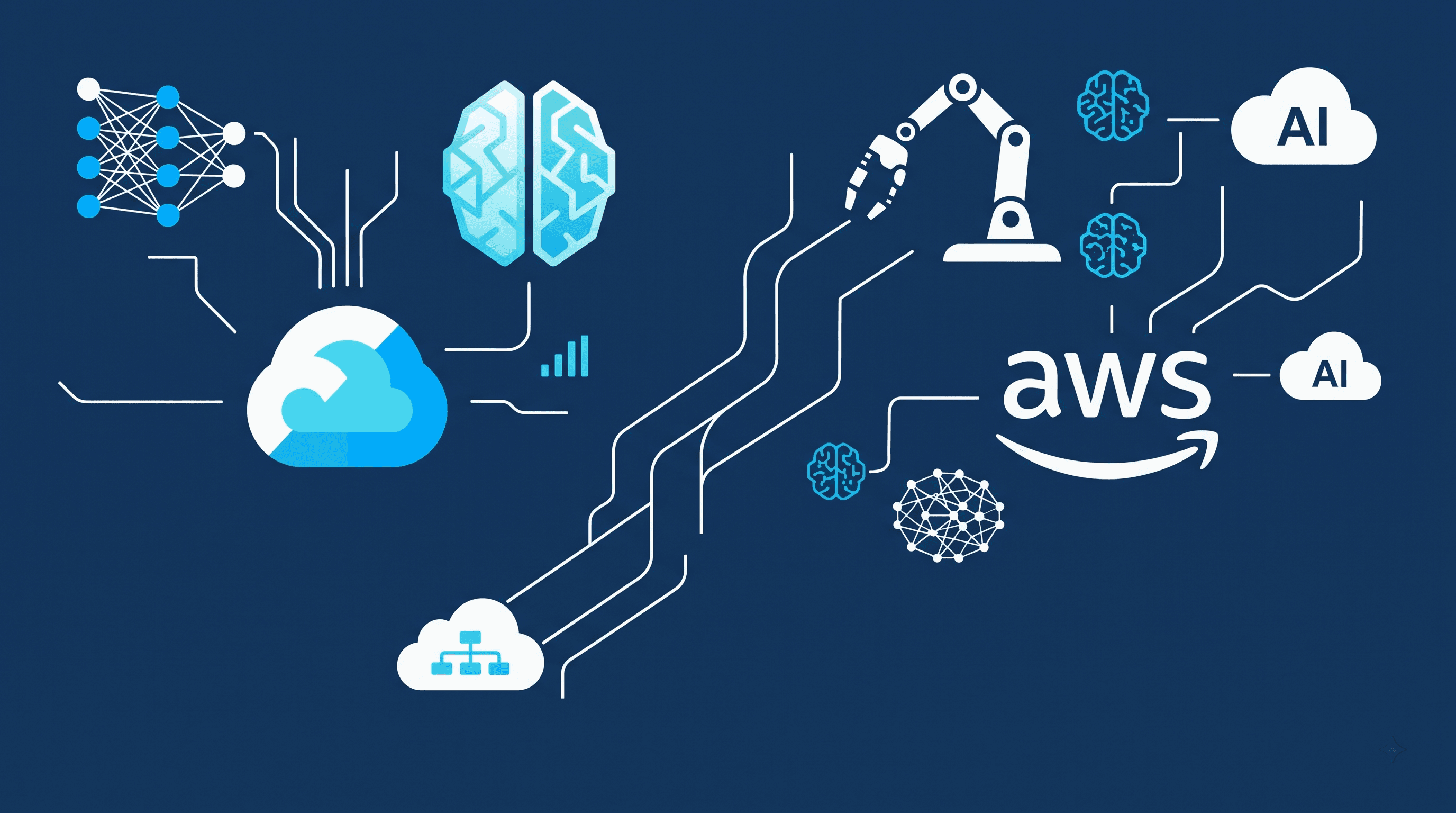
One of the most impactful technology decisions a technology company can make in 2026 is Google Cloud vs AWS for AI development. In the last 18 months, both Google Cloud and AWS have made significant investments in generative AI, agent infrastructure, and ML tooling. These two options are viable options when it comes to enterprise AI workloads. While some platforms may have more features, the right one is heavily dependent on the data infrastructure you already have in place and the type of AI workload you are primarily developing.
This comparison focuses on Google Cloud vs AWS when it comes to the most important factors that impact AI development results: the ML platform, data infrastructure integration, hardware, pricing, and the decision framework that sifts enterprise AI development workload types through platform strengths.
Market Position and AI Investment in 2026
What is the competitive situation between Google Cloud vs AWS in the field of AI development in 2026?
In 2026, AWS is estimated to hold around 32% of the global cloud infrastructure market while Google Cloud Platform (GCP) secures around 11% of the market, both companies are competing to incorporate generative AI, reduce cloud infrastructure prices, and expand their global footprint.
For general purpose cloud workloads, AWS has the largest available service catalog, most developers, and the most mature general purpose cloud stack. Google Cloud is the expert solution, best known for its data analytics, Kubernetes and machine learning capabilities, including Vertex AI, TPUs, and Gemini.
Headline market share figures do not provide a true picture of enterprise AI development. Indeed, the cloud computing market reached a whopping $119 billion in just Q4 2025, and things are set to be drastically different in 2026, even a year later. For organizations with workloads that align with Google Cloud's platform capabilities, the practical difference between the two is much smaller, especially in the context of AI-specific functions like LLM development, management of ML pipelines, and creating applications with generative AI. There's a more mature partner ecosystem for AI-native deployments on the GCP side for organizations looking to get Vertex AI consulting support.
Comparing Vertex AI and SageMaker for Core AI/ML.
Google Cloud vs AWS for machine learning development - Pros and Cons
This is where the difference between google cloud vs AWS AI development is most significant. Both platforms, Google Vertex AI and Amazon SageMaker, are well-established, enterprise-class platforms that can address the entire ML lifecycle. They aren't exactly the same, however, in architecture, and this means real-world differences in development velocity, depending on your data stack. If the organization is hiring an external Vertex AI consulting team, the first area of decision in a consulting engagement is generally this architectural difference.
Google Vertex AI (Gemini Enterprise Agent Platform) Vertex AI is designed to serve two different enterprise AI development use cases: custom ML, where you take your own code, data, and model architecture, and rely on Vertex AI for managed compute, experiments, and serving; and foundation model access, where you use Google's or third-party models through API, along with enterprise data handling and IAM controls.
The platform's differentiating advantage for google cloud vs AWS machine learning is the integration with BigQuery. This integration directly supports the data analysts, ML engineers, and Vertex AI consulting teams that all rely on GCP's IAM, billing, and governance framework.
Your data ingestion, transformation, and model training environment is the same as the same IAM model and billing structure as your Vertex AI platform, with no extra effort required to integrate the two. Training is not accomplished by moving data from one system to another. It's already in place. This reduces one class of data engineering overhead for organizations that have their analytics workloads on Google Cloud, and which need to tackle separately with Amazon SageMaker.
The solution that AWS has provided for the ML lifecycle management challenge is Amazon SageMaker. SageMaker supports model training, hyperparameter tuning, deployment of endpoints, and monitoring of models. It's comprehensive and grand, the SageMaker marketplace, the wide range of AWS ML services (Rekognition, Comprehend, Forecast), and the AWS partner ecosystem. For organizations that already have AWS resources in other areas of their AWS environment, SageMaker can be integrated with AWS Glue, AWS Redshift, and AWS S3 to create a similar data infrastructure connection, but without architectural overlap.
The verdict on Vertex AI vs SageMaker: For organizations with BigQuery or Google-native data infrastructure, Vertex AI's seamless data-to-model pipeline provides development velocity benefits that SageMaker cannot provide without extra investment in data engineering. SageMaker's ecosystem integration makes it more natural for organizations that already have S3, Redshift, and Glue in place. Vertex AI's end-to-end integration is the quicker path to get started for greenfield enterprise AI development projects without a current cloud data infrastructure.
The Power of Foundation Models and Generative AI Capabilities.
For generative AI capabilities, the best cloud platform AI 2026 comparison is one that enables the flexibility of accessing models and deployment.
Google Cloud Model Garden features over 200 models from Google's Gemini and Gemma models, third party models like Anthropic's Claude, and open models. The core of Google's Vertex AI platform is the Gemini model family, which demonstrates impressive performance in multimodal tasks. Organizations developing multimodal AI applications that process text, image, audio and video in a single context will find Gemini's multimodal ability a real architectural bonus. Multimodal is always a key differentiator that Google Cloud consulting practices tout as the primary differentiator in product building.
AWS Amazon Bedrock is fully active and offers multi-model access to foundation models such as Anthropic's Claude, Meta's Llama, and Amazon's Titan models. The Bedrock Agents were discontinued, with AWS replacing it with Amazon Bedrock AgentCore (GA October 2025) with the closure to new customers on July 30, 2026. AgentCore is a complete re-architecture runtime, memory, gateway, identity, and observability as modular concepts and can be used with any framework (LangGraph, CrewAI, AutoGen) and any model, both inside and outside of Amazon Bedrock.
The verdict on generative AI: Google Cloud's Gemini-native platform offers better integration for multimodal applications and Google Workspace, while the verdict on generative AI is that it is better suited to those domains. For organizations wanting maximum flexibility of choice or those already using non-Google models, Bedrock's multiple provider marketplace and AWS's wider ecosystem offer a similar option.
BigQuery vs Redshift: Key Differences
For data-intensive AI workloads, the data platform can effectively shape the choice between google cloud vs AWS AI development.
Google Cloud's expertise in data analytics is the same as the infrastructure that powers Google Search, Gmail, and YouTube! BigQuery provides a server less data warehousing solution with a petabyte-scale, industry-leading performance.
Google Cloud Platform has attractive features for organizations that require data-intensive workloads, machine learning projects, or consolidating onto Kubernetes. With the BigQuery-Vertex AI integration, data analysts can leverage ML models using SQL syntax through BigQuery ML, helping to reduce the barriers to ML for data analysts who lack dedicated data science staff. This is where the measurable time saved with data engineering, which is offered by Vertex AI development services on GCP, can't be outdone by any other platform without investing in a substantial amount of infrastructure resources.
Along with the other data service offerings (Glue, Lake Formation, Athena), Amazon Redshift is AWS's flagship data warehouse. Redshift's Redshift ML feature offers SQL-based ML functionality similar to BigQuery ML, but not nearly as tightly coupled to SageMaker as BigQuery is to Vertex AI.
For those organizations that are primarily data oriented with their data workloads, the integration of Vertex AI into BigQuery is the best feature to argue for using GCP vs AWS for data heavy AI deployments.
The Choice of Hardware TPUs vs Specialized AWS Instances.
For large-scale model training, especially with TensorFlow model architectures, Google Cloud TPUs provide price-performance benefits for teams. The TPU pods allow enterprise AI development teams to take advantage of high throughput training workloads without the cost of a GPU infrastructure.
AWS Trainium and Inferentia AWS has designed custom silicon for training (Trainium) and inference (Inferentia) use cases at competitive prices compared to GPU instances for specific workload types. AWS Inferentia offers cost-effective performance compared to both a GPU instance and Google's inference infrastructure for inference at scale.
The differences in the hardware are not as important as the differences in platform and data integration for most engineering teams that do not operate with hyperscale training volumes. Availability of GPUs was a key factor in 2024-2025 that is normalized across both platforms in 2026.
Kubernetes and Container Orchestration
Google Cloud's strength is its native expertise with container orchestration as it was the original inventor of Kubernetes. Google Kubernetes Engine is reported to be the most sophisticated managed Kubernetes service. AWS Elastic Kubernetes Service is a robust, but later-to-the-market service.
GKE's capability depth and native integration with AI's serving infrastructure is an operational benefit for AI teams deploying model serving infrastructure in containers. Teams that already operate their infrastructure on AWS using EKS may find the migration expense to GKE to be not worth it. One of the most "lock-in" costly areas of any cloud move involves the containerization stack, so this infrastructure lock-in risk is generally assessed early in AI architecture consulting projects.
The decision-making framework: Google Cloud vs AWS for AI Development
Google Cloud vs AWS for AI development in 2026 - What is the best option?
The GCP vs AWS for AI decision falls into four categories:
When to choose Google Cloud: If you are already using BigQuery for your data infrastructure, or if you're building a greenfield. Constructing multimodal AI applications with text, images, audio and video. You are working with your team in Google Workspace and want to make the most of Google Gemini Enterprise/AgentSpace. The fastest way from raw data to a trainedmodel with minimal data engineering overhead is required. You need a Vertex AI consulting partner with a strong GCP expertise,and you want a partner's ecosystem.
Use AWS when: Your current infrastructure, compliance standards, and partner solutions are all on AWS. You must have the widest ML service catalog and greatest partner ecosystem. Your organization is subject to a compliance regime which necessitates AWSGovCloud or AWS compliance certifications. Your team's ML engineering skills are SageMaker native!
Multi-cloud is frequently the solution. Many organizations discover that a multi-cloud approach with the optimal platform for each workload yields the greatest long-term benefits. For many start-ups, a sweet spot: launch in GCP because of the development of velocity and AI pipeline benefits and consider migration before the first enterprise contract. Multi-cloud AI consulting enables organizations to architect this split without sacrificing operational consistency where to run a workload on a platform and how to manage the data on both. The right architecture is often the key to success or failure of a multi-cloud solution, which is why it is essential to get it right when implementing the strategy.
Even when you compare platform features, the impact of the ai architecture consulting work you do for your data layer, model governance, and deployment pipeline is the best predictor of long-term outcomes.
How Chirpn is solving the Google Cloud vs AWS decision
Chirpn is a certified Google Cloud Partner and an AI development company specializing in Vertex AI and Gemini Enterprise. Ourgoogle cloud AI consulting practice demonstrates a strong delivery experience at Google cloud platform level for the entire GCP AI stack. At Chirpn, google cloud AI consulting practice encompasses the entire AI implementation lifecycle: AI architecture consulting for defining the correct data and model infrastructure, Vertex AI development services for teams creating AI capabilities on google cloud platform and production support for businesses scaling from pilot to production.
Chirpn's delivery team assists the client in the solution architecture process, rather than as a vendor selection process, in determining which platform (google cloud vs AWS AI) to implement for their organization. The AI architecture work Chirpn performs on engagement initiation sets the architecture of the cloud components, data governance across the architecture, and the type of Vertex AI consulting specializations required for the given workload.
Clients with existing Google Cloud deployments can seamlessly leverage Chirpn’s expertise in the development of Vertex AI and the deployment of Gemini Enterprise to get to production AI deployments. For customers on AWS who are looking to enable AI capabilities that are more efficient in GCP's BigQuery-Vertex AI integration, Chirpn works with clients to package the specific GCP components for their multi-cloud AI consulting projects without suggesting migration to the entire platform. The multi-cloud AI consulting strategy is especially prevalent among enterprise customers who have already obtained AWS compliance certifications and wish to use Vertex AI for particular ML workloads without giving up on their broader AWS infrastructure.
Book a free AI architecture consultation with Chirpn's Google Cloud team to get an AI architecture consulting assessment for your specific AI workload and data infrastructure.
Frequently Asked Questions
Which one is superior, Google Cloud or AWS for AI development in 2026?
There's no one best platform. For organizations developing enterprise AI development programs on existing Google Cloud data assets, Google Cloud has a structural edge on data-intensive AI workloads with its integration with BigQuery and Kubernetes infrastructure, as well as its multimodal AI features with the power of Gemini. Organizations with legacy AWS infrastructure, increased depth of AWS service catalog for ML, and industry compliance requirements have a structural advantage with AWS. When choosing between google cloud vs AWS AI, it is important to remember that you should do this based on your existing data infrastructure, rather than platform marketing claims.
What does Google Vertex AI offer that is unique and different from AWS SageMaker?
Both offer complete training, fine tuning, deployment and monitoring of the entire ML lifecycle. The main architectural difference between GCP vs AWS for AI is that Vertex AI's ingestion, transformation, and training of data share the same IAM, billing, and data governance. This integration enables faster iteration cycles for ML models using Vertex AI development services compared to BigQuery-native organizations' SageMaker-based architectures. These are architecturally separate services and involve moving data between systems; SageMaker integrates with these services: S3, Glue, and Redshift. The BigQuery integration is always identified as the deciding feature for data-intensive enterprise AI development programs by Vertex AI consulting practices.
What is the difference between Google Cloud and AWS for generative AI in 2026?
Both platforms provide access to Gemini (via Google Cloud) and Claude (via both platforms' model marketplaces). The Google cloud vs AWS machine learning for generative AI advantage is multimodal-native, meaning that Gemini supports text, image, audio and video in a single context, making it easier architecturally to build multimodal AI applications. When working with use cases involving multimodal, consulting practices are always recommending the use of GCP. AWS Bedrock offers more model options, which is important for any organization looking to seamlessly switch between foundation model providers.
Google Cloud or AWS for AI: Which is more cost-effective?
The cost of AI development using Google Cloud vs AWS varies significantly based on the type of workload being used. For SQL-native ML workloads, BigQuery ML enables data analysts to take advantage of significant cost savings compared to ML compute pricing, while running ML models at data warehouse pricing. The per-hour price of training instances on AWS SageMaker is similar to Vertex AI training pricing, when compared to compute of comparable size. At scale, TPU training can be more cost-effective than GPU training for TensorFlow-native workloads on Google Cloud. Both platforms have dedicated-use discounts, which make the on-demand pricing comparison a lot smaller. The best way to get the most accurate comparison prior to making a commitment to either platform is to get an AI-based architecture consulting assessment of your specific workload mix.