



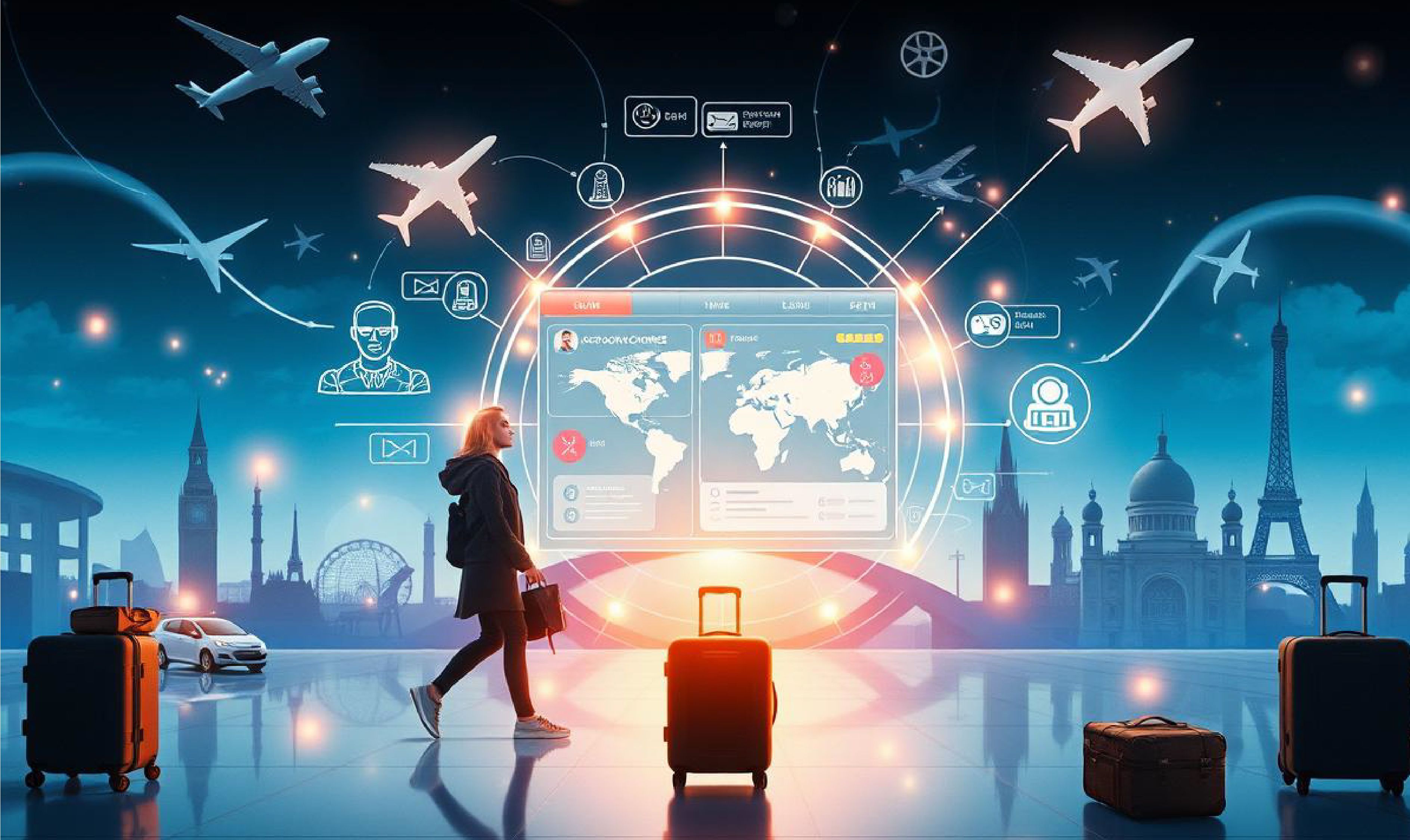

The travel and tourism industry has undergone a fundamental transformation driven by artificial intelligence. A growing share of travel companies have integrated AI across the customer journey from trip planning and booking through to in-destination support and post-travel feedback. AI trip planners, virtual assistants, and predictive tools are enabling companies to personalise the experience at scale, anticipate traveller needs before they arise, and automate high-volume service tasks that previously required significant human resource.
AI analyses large datasets to offer contextual answers, break down linguistic barriers, and deliver more empathetic service responses. This article examines how AI is reshaping travel planning, pricing, customer service, and operations across the sector.
Role of AI in Travel and Tourism Industry
AI enables highly personalised travel planning and recommendations by offering 24/7 assistance, handling enquiries and bookings, and resolving complaints in real time. It is making travel more inclusive by breaking down language barriers and ensuring consistent customer engagement across time zones and channels.
AI Travel Planners
When planning an upcoming trip, travellers face a large set of decisions: destination, timing, accommodation, local activities. AI travel assistants can work through a traveller's history, budget preferences, and stated interests to generate personalized recommendations including hotel options, local sightseeing, and timing advice. This level of contextual personalisation compresses the research phase of travel planning and improves the quality of the recommendations travellers receive.
AI Virtual Assistants
AI-powered virtual assistants provide instant, round-the-clock support to travellers. These chatbots handle a wide range of tasks answering questions about booking policies, assisting with itinerary changes, communicating in multiple languages, and detecting sentiment to provide more empathetic responses.
A traveller who messages an AI assistant at 2 AM about nearby pharmacies, for example, can receive not only the information but also an offer to contact the front desk for further assistance the system recognising from context that the enquiry may indicate a health concern.
Experience Seamless Travel Booking
AI streamlines the booking experience by making it more intuitive. Rather than requiring rigid search parameters, AI-powered booking tools understand flexible and conversational queries allowing travellers to describe what they want in natural language and receive relevant, curated results. This reduces friction at the search and booking stage, which has a measurable effect on completion rates and customer satisfaction.
AI-Based Language Translation
AI-powered language translation has moved beyond word-for-word conversion to understand nuance, cultural context, and situational meaning. AI assistants can provide etiquette tips and cultural guidance alongside translation helping travellers navigate unfamiliar social norms and customs in ways that promote more respectful and meaningful interactions. Audio and visual translation capabilities have further reduced the practical barriers to independent international travel.
Better Customer Service
Travel companies are using AI to improve customer service through dynamic pricing, sentiment analysis, and personalised response generation. AI can fetch real-time pricing data, enabling travellers to make budget-informed decisions. It can detect sentiment in customer communications flagging dissatisfaction early and enabling proactive intervention. And it can generate contextualised, humanised responses rather than generic scripted answers, which consistently scores higher in customer satisfaction metrics.
Application of AI in the Travel & Tourism Industry
Predicting Occupancy Rate
Machine learning and natural language processing algorithms can predict a hotel's occupancy rate across seasons by analysing historical booking patterns, seasonal trends, weather data, and market conditions. This enables hotels to provide accurate availability information, optimize staffing, and allocate resources to match anticipated demand. Marriott has deployed this technology to forecast future demand with greater accuracy and dynamically adjust pricing in response.
Biometrics
Airports and transport terminals are increasingly using AI-powered biometrics to improve the speed and security of identity verification. AI-driven systems analyse facial features and voice patterns to authenticate travellers more accurately and consistently than traditional document-based checks, while also adapting to changes over time and detecting potential fraud.
Los Angeles International Airport has deployed an AI-based facial recognition system for passenger screening, allowing travellers to verify their identity at a kiosk matched against an existing database. The system has meaningfully improved boarding speed and reduced manual verification overhead in the airport's operations.
AI Integration with IoT
Integrating AI with IoT sensors creates new opportunities across travel and tourism from smart airport environments that monitor occupancy and guide drivers to available parking, to connected hotel rooms that adapt automatically to guest preferences. The combination reduces congestion, improves the in-venue experience, and provides operators with real-time data to manage capacity and resource allocation.
Use Cases of AI in Tourism
Airbnb
Airbnb uses machine learning algorithms to personalise the guest experience at scale. The system analyses user data past bookings, stated preferences, local and seasonal events, length of stay, browsing history, group size, and location wishlists to generate recommendations tailored to the individual traveller. This has improved consumer engagement and created a more integrated and seamless experience across the platform.
Expedia
Expedia has launched an Alexa-enabled feature allowing users to search and book travel using voice commands. Travellers can search for flights and hotels, check flight status, access itinerary information, and request packing suggestions based on destination and weather. Expedia continues to expand the AI's ability to provide more detailed travel recommendations, with plans to integrate it with in-car systems for on-the-go travel assistance.
Hilton
Hilton uses AI and IoT to deliver a connected room environment. Guests can control room temperature, lighting, and entertainment systems through a mobile app, with AI-enabled adjustments based on occupancy and time of day. The system remembers guest preferences across stays, ensuring a consistent and personalised experience for frequent travellers.
Hopper
Hopper, a travel booking app, uses AI to predict when flight prices are likely to rise or fall advising travellers on whether to book now or wait for a better price. The system analyses billions of price points, seasonal patterns, oil prices, events, and historical trends, and also monitors competitor pricing and seat availability. Hopper's price freeze feature allows users to hold a price for a small fee, enabling them to book at a more favourable time.
Challenges
AI in travel customer service is powerful but not without limitations. Companies must navigate data quality and security risks, privacy regulations across multiple jurisdictions, and the challenge of algorithmic bias in recommendation systems. Travel is also an industry where the human element remains central to the experience. AI handles high-volume, lower-complexity interactions most effectively, while high-stakes or emotionally significant customer moments still benefit from human judgment and empathy.
The travel and tourism industry has embraced AI to improve customer experience at every touchpoint. From personalised planning and virtual assistance to predictive pricing and biometric security, AI is enabling companies to serve travellers more efficiently, empathetically, and consistently. As the technology continues to advance, the gap between AI-enabled and AI-absent travel operations will widen making adoption not a competitive differentiator but a competitive necessity.
How Chirpn Helps Travel & Tourism Enterprises
Chirpn works with travel and tourism enterprises to design and implement AI solutions across customer service, personalisation, pricing, and operations building systems that integrate with existing booking platforms, CRM, and data infrastructure. Through the AutoPATH delivery framework, Chirpn moves clients from validated use-case selection to production-ready AI in 45–60 days.