




AI technology is driving transformation across industries impacting organizations from every sector, at every stage of growth. The ten examples below cover the application areas where AI is generating substantial, measurable business value: from scheduling and customer support to fraud detection, predictive maintenance, and financial reporting.
Each example reflects a use case that is in production today, not a pilot or a projection across companies ranging from healthcare providers to logistics firms, retailers, and financial institutions.
Real-Life Examples of How AI Is Used in Business
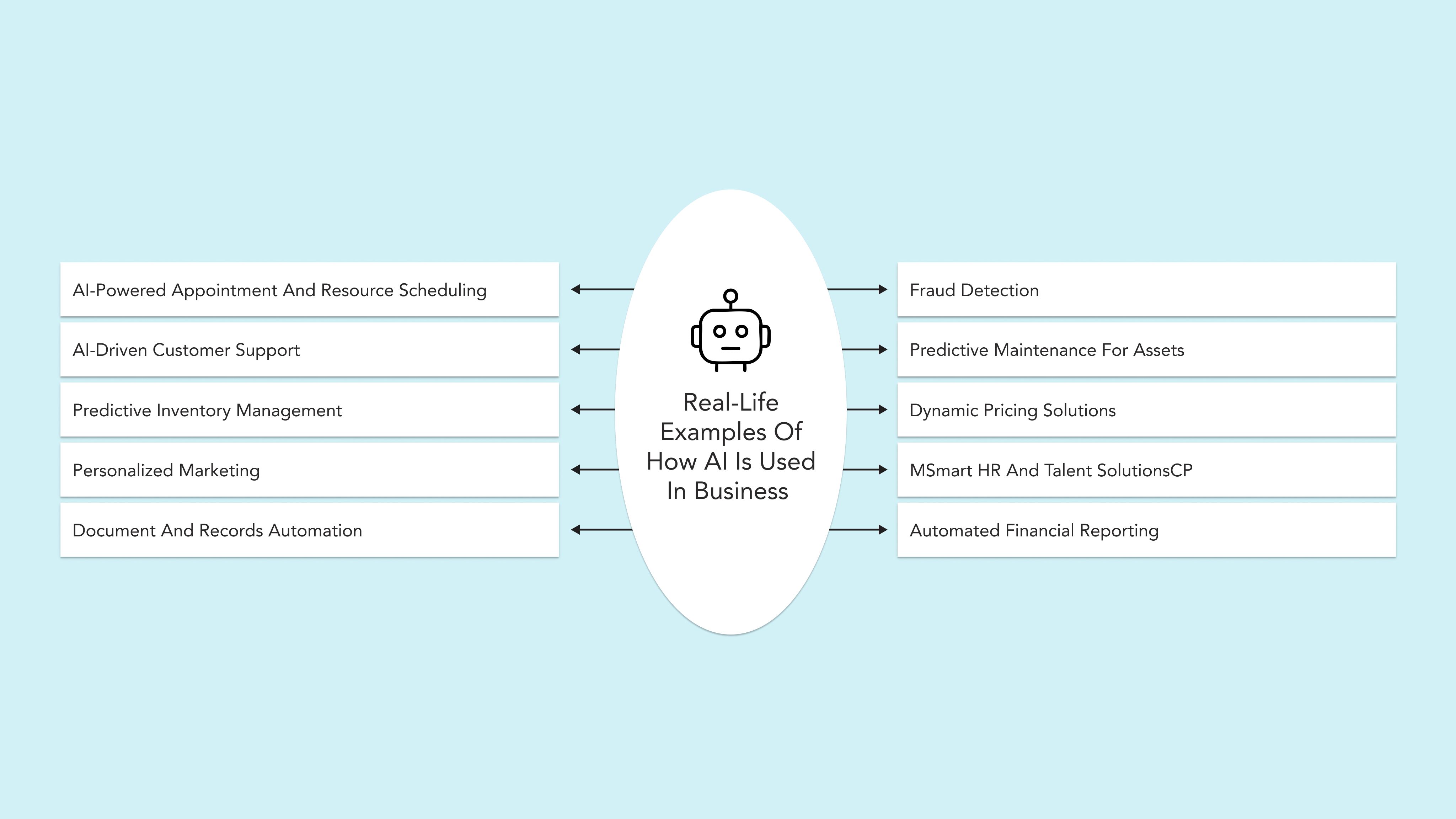
1. AI-Powered Appointment and Resource Scheduling
Efficiency in scheduling shifts, meetings, production slots, or customer appointments is foundational to how business operations flow. AI-powered systems enhance resource management by examining historical data to forecast demand and close gaps in real time. Organizations using automated scheduling make fewer errors, reduce manual calendar management, and respond to demand changes faster than fixed-schedule systems allow.
How this works in practice: incoming requests are automated and scheduled based on natural language processing; machine learning models predict booking demand and no-show rates; and rescheduling mechanisms ensure every resource is optimally utilized.
See how Chirpn designs custom scheduling solutions. Harvard Business Review has documented the operational efficiency gains from AI scheduling across multiple industries, including reduced downtime and improved client satisfaction.
2. AI-Driven Customer Support
Virtual assistants now handle customer enquiries around the clock, automating routine support tasks, FAQs, order tracking, troubleshooting and handing complex issues to human staff when unique responses are required. Chatbots tailored with industry-specific terms handle queries in finance, retail, SaaS, and healthcare with accuracy that general-purpose models cannot match on domain-specific language.
Read how Chirpn built a scalable AI support platform for a telehealth client. Gartner predicts that agentic AI will autonomously resolve 80% of common customer service issues without human intervention by 2029 driving a 30% reduction in operational costs.
3. Predictive Inventory Management
Inventory is a critical cost centre for retailers, manufacturers, and service providers. AI-powered management systems take the guesswork out of restocking by analyzing real-time consumption, seasonal demand, and supplier lead times automating orders and replenishing stock proactively before shortages affect operations.
McKinsey research identifies predictive inventory management as one of the top operational improvements for competitive businesses. Custom models built by a specialist AI development partner can be calibrated specifically for your inventory system, supplier network, and demand patterns.
4. Personalized Marketing
Companies use AI in social media promotion, targeted email outreach, and product recommendation engines. AI automates the segmentation of customer databases, crafts bespoke messages, and adjusts campaigns automatically based on engagement metrics ensuring conversion rates are maximized without manual iteration for each audience segment.
Collaborating with an AI software development company integrates these capabilities directly into your existing CRM or CMS platform so personalization operates on your own customer data rather than on generic segments.
5. Document and Records Automation
Even the most documentation-heavy businesses benefit from increased accuracy and reduced manual input when AI extracts, sorts, and files pertinent information using OCR and NLP technologies. AI works through legal documents, invoices, HR forms, and supply chain records with precision and at the scale that makes manual review impractical.
6. Fraud Detection
Anomalies and suspicious behaviors in online payments and digital transactions can be blocked before losses occur through AI-powered activity monitoring. Whether a bank monitoring transfers or an e-commerce platform watching for chargebacks, AI provides real-time risk scoring and built-in alerts that require manual action before fraud escalates.
7. Predictive Maintenance for Assets
From manufacturing equipment and agricultural machines to IT systems in data centers, unplanned downtime is expensive. AI analyses sensor data, usage patterns, and performance metrics to schedule proactive maintenance, repair, and part replacement before failures occur.
Chirpn applies these practices in our product engineering and SDLC services. Industry research including studies by GE Digital consistently finds that predictive maintenance systems reduce emergency maintenance costs and extend asset lifecycles across manufacturing, logistics, and infrastructure sectors.
8. Dynamic Pricing Solutions
E-commerce, travel, logistics, and retail sectors use AI for dynamic pricing. Algorithms monitor market conditions, competitor pricing, stock levels, and on-hand inventory suggesting and automating pricing adjustments that optimize sales and profitability. Real-time market intelligence enables margin management that static pricing models cannot deliver at scale.
9. Smart HR and Talent Solutions
AI platforms now analyze resumes, perform skills matching, and validate credentials at a scale that compresses hiring timelines materially. Algorithms match job requirements against candidate experience and filter applicants in bulk reducing the time recruiters spend on initial screening and concentrating their effort on final-stage evaluation and candidate experience.
10. Automated Financial Reporting
AI produces financial reports, analyses transactions, and scrutinizes accounts for irregularities flagging issues that require human review rather than waiting for scheduled audits to surface. Automated alerts prevent fraud and errors from compounding before they are detected. Automated financial analysis increases accuracy and provides stronger data for decisions at every business level.
Frequently Asked Questions
What are the primary business benefits of AI across these use cases?
Across scheduling, customer support, inventory, marketing, document processing, fraud detection, maintenance, pricing, HR, and financial reporting the consistent benefits are: reduced manual effort on high-volume repetitive tasks, faster decision cycles from real-time data, and measurable reduction in operational errors. The magnitude of each benefit depends heavily on data quality and implementation discipline.
What should I look for in an AI software development company?
Relevant production deployments in your industry, transparent delivery timelines, named case studies with measurable outcomes, and a structured process for understanding your specific business goals before any technology is proposed. For businesses in North America, confirm the partner is familiar with applicable compliance frameworks. Chirpn's AI and ML development services page outlines the full scope.
Is company data secure when working with AI systems?
Any credible AI partner should offer secure cloud storage, encrypted data handling, and strict privacy compliance and be able to describe their data handling practices in writing before deployment. Confirm compliance with GDPR, HIPAA, CCPA, or whatever regulatory framework applies to your industry and geography before signing.
How does AI improve marketing and content performance?
AI analyses search intent, customer behavior data, and purchase-cycle stage to segment audiences more accurately and optimize content for conversion. When integrated with a CRM or CMS, these capabilities operate on your own first-party customer data producing more accurate personalization than generic audience targeting based on third-party data.
Conclusion
Businesses that use AI strategically starting with a specific, high-value problem and building from production evidence consistently outperform those that deploy AI broadly without a clear ROI framework. The ten use cases above represent the areas where that evidence is clearest in 2025.
At Chirpn, we design and build AI systems for the use cases above from operational automation to product launches and growth scaling. As a Google Cloud Partner running all five SDLC phases in parallel through AutoPATH, production-grade AI systems ship in 45–60 days. 100+ products and platforms shipped.