





Key takeaways:
- Traditional risk management is reactive, whereas machine learning takes businesses proactive in predicting and preventing risk before it happens.
- Businesses that truly reduce risk can be distinguished from those with underutilized pilots with a structured 5-step implementation process.
- Real world benefits include a McKinsey banking engagement where they estimate $15M in credit loss savings for year one and predictive maintenance models that reduce the risk of equipment failure by approximately 30%.
- Machine learning models are best complemented with the data infrastructure and monitoring that ensure they stay accurate, and it's those businesses that do that reap the advantages.
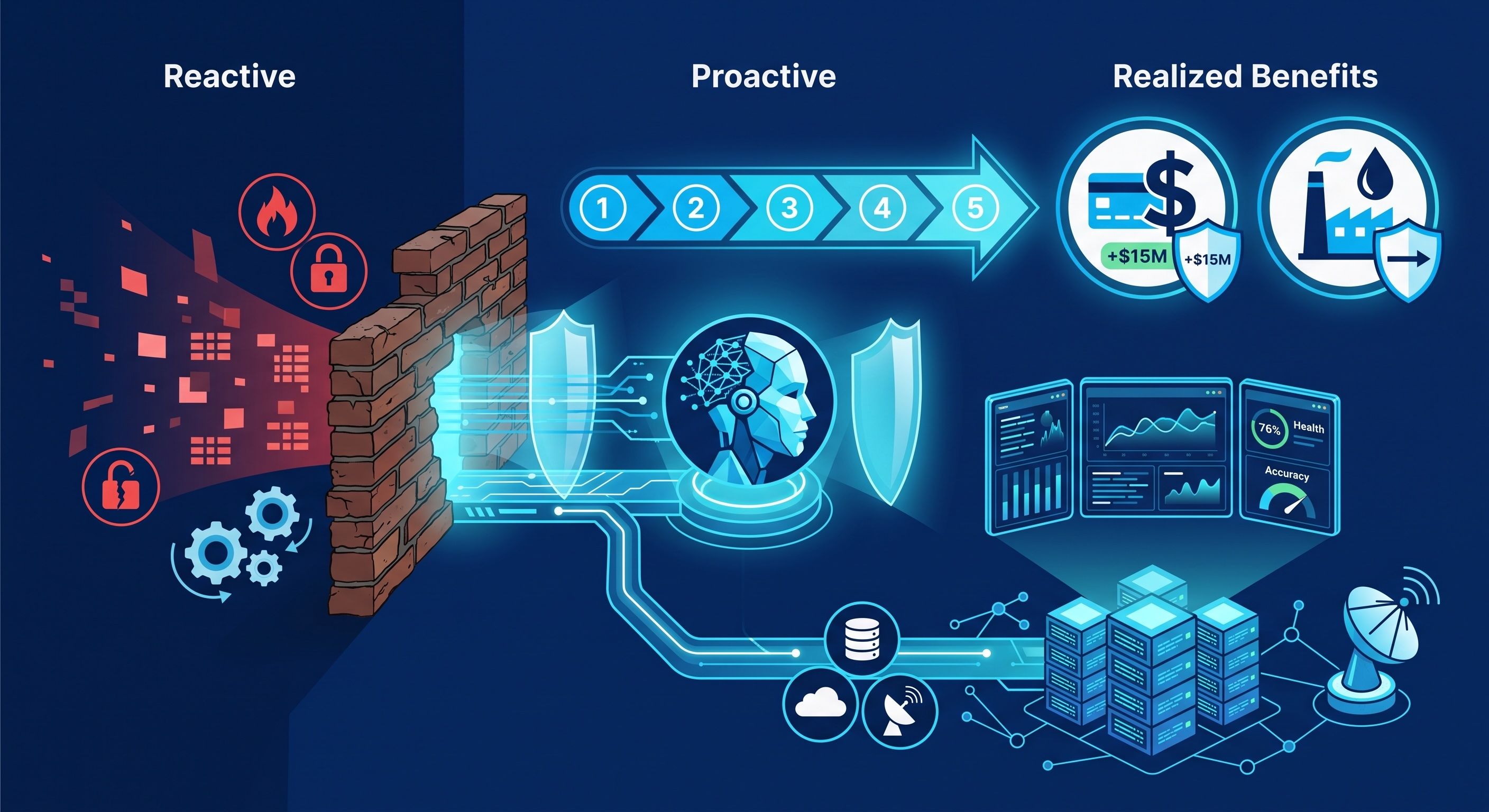
If you speak to any risk or operations leader these days, a common theme emerges. These threats that used to come in at a snail's pace: a market change, a supplier failure, a fraud pattern; they have come at a quickening pace than any quarterly review can keep up with. That's why AI and machine learning have transitioned from an experimental curiosity to a key component of enterprise risk strategy. The answer to reducing risk when it comes to machine learning for business is one simple change: moving from reacting to damage to anticipating it before it happens.
This guide helps you explore how machine learning helps businesses reduce risk by detecting threats early. It will also help you learn a 5-step roadmap for implementing AI risk detection, and some practical examples of companies making predictions that deliver measurable business value.
What exactly does Machine Learning do to risk management?
Machine learning is a subset of AI and machine learning in which the computer learns patterns in the data and gets better at making predictions as additional information is fed into it without having to be programmed with each and every rule. If applied to risk, a model does not only alert to what went wrong, it learns what is usually the root cause of a problem, and triggers a flag ahead of time.
The most common use cases of enterprise machine learning for risk include fraud and anomaly detection, credit and financial risk scoring, predictive maintenance, forecasting supply chain disruption, and monitoring and compliance with regulations, each relying on different machine learning algorithms. Though each implements a different machine learning algorithms , they all have the same benefit, they process much more data, much quicker, than a human could ever do.
This is because the nature of the business risk itself has changed. Ten years ago most operational and financial risks were not fast enough to be detected in a quarter or even a year. The risks today include a new fraud pattern that evolves in hours, a supply change that cascades in days, a credit portfolio that flows by market sentiment in real time evolve quickly, and manual review is not fast enough. That's where business intelligence tools based on machine learning close the gap.
Traditional vs. Machine Learning-Driven Risk Management
When it comes to risk management, there are two approaches: the traditional one and the one that utilizes machine learning.
| Risk Approach | Traditional Risk Management | Machine Learning to Empower Risk Management
|
| Data Handling | Review of historical reports and spreadsheets manually. | Simultaneous analysis of transactions, sensor and market data in real time. |
Detection Timing
| Reactive risks come to light when they have harmed the organization | Predictive risks identified prior to their worsening. |
| Scalability | With a restricted number of analysts and working hours | Analyse scales, across millions of data points, without additional staff. |
| Improvement Over Time | Rules that will change over time in response to changes to policy. | Regularly trained as new information and results emerge |
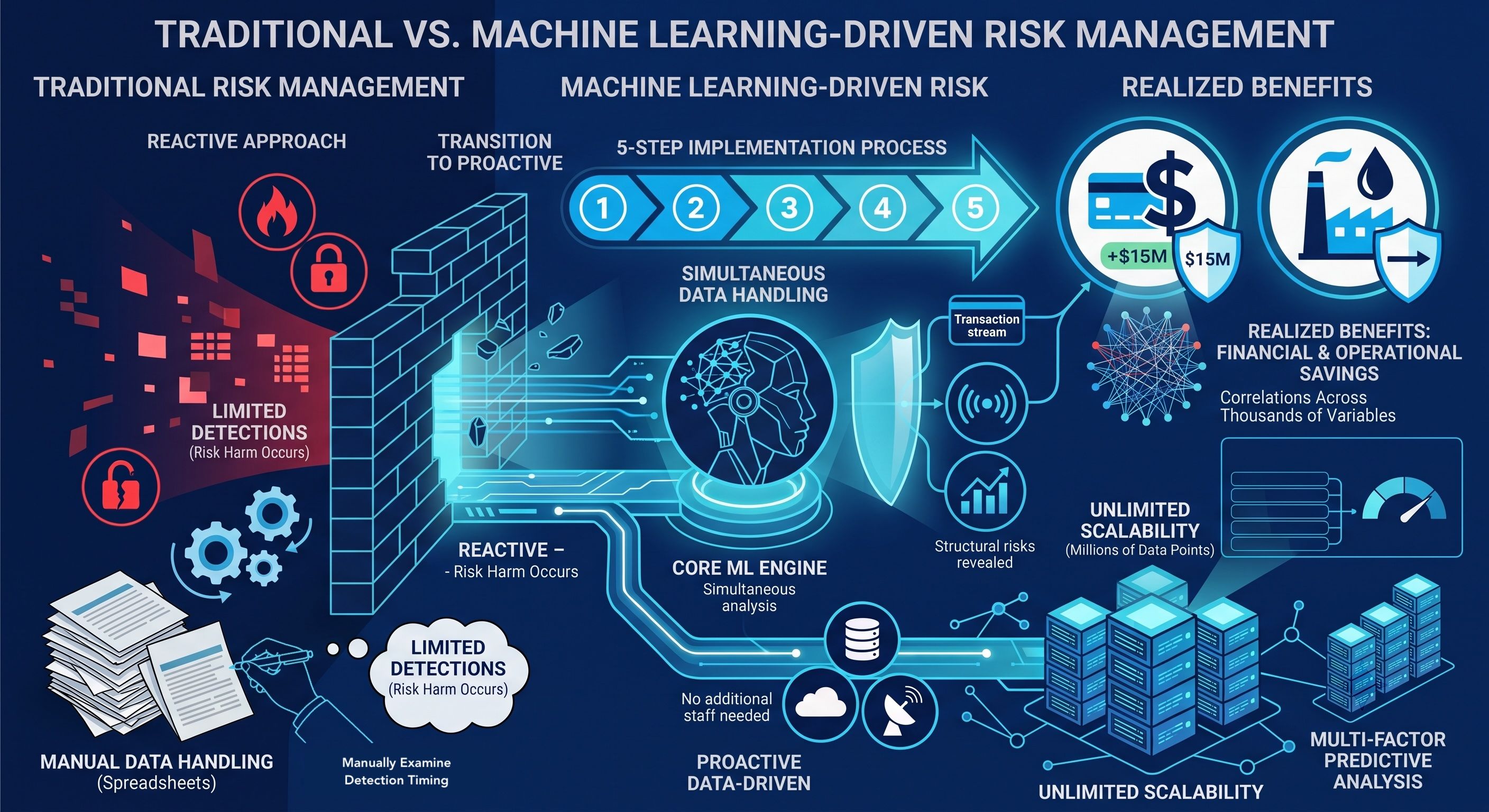
The change graphic above is not a speed change. Machine learning-powered business intelligence reveals structural risks that a manual review would never uncover correlations across thousands of variables, for instance. For example, a credit risk model can consider dozens of financial and behavioral factors in the assessment of each applicant; such an analysis would be difficult to accurately replicate manually at scale without adding additional personnel.
5-Step Framework For Implementing Machine Learning For Risk Reduction.
Companies with actual risk reduction benefits from machine learning solutions tend to take a consistent path to implementation rather than deploying a model and hoping that it works.
Step 1: Establish a clear ‘Risk Vision'.
- Pinpoint the greatest risk which is causing the highest cost to the business fraud, downtime, credit exposure or failure to comply.
- Specify a measure of success, in measurable terms, such as by reduction of losses, or by the time target is met, etc.
Outcome: A clear outcome with a measurable risk target rather than the general goal of using AI for risk.
Step 2 Identify Data Requirements
- Determine which data sources do have signals for the targeted risk
- Evaluate data quality and completeness prior to training a model on it.
Outcome: What the model can do and cannot do, given the data available.
Step 3 Assign Clear Ownership
- Integrate data science with the IT and the business function that owns the risk.
- Give responsibilities for monitoring the model after it is live (when it is in use), not during its construction.
Outcome: Cross-functional team that makes the model relevant after launch, not deployment!
Step 4: Create a Change Management Plan
- Set up the team that will be impacted by the workflow changes upon receiving ML driven alerts.
- Establish a realistic time frame that includes testing/Adjusting, and not just deployment.
Outcome: Adoption that didn't fail as a result of being unprepared, but as a result of a model teams' journey around.
Step 5: Monitor and Revalidate on an ongoing basis.
- Monitor the performance of a model relative to actual results, continuously.
- Retrain or adjust the model as the risk patterns change over time
Outcome: An accurate system that continues to be accurate under varying conditions, rather than gradually becoming less and less accurate following deployment.
Real-World Examples: How Machine Learning Can Reduce Risk In Practice
Machine learning in business risk isn't just a theory. It manifests itself in specific, measurable outcomes in the context of industries and the pattern of all four examples below is the same as described in the 5-step framework: a clearly defined risk, the right data going into the model and the right system that continues to operate after launch.
McKinsey: Credit Underwriting Risk Reduction.
McKinsey assisted a bank in a documented banking transaction to streamline its credit underwriting and build an integrated risk management structure. The outcome was a predictable $15 million in losses in the first year, and a three-year return on capital of 3% a direct, quantified benefit of disciplined risk modeling.
Visa and Mastercard: Real-Time Fraud Detection
Machine Learning models are used by global payment networks to detect fraud patterns as soon as they happen, instead of waiting for a chargeback to be filed. This level of automated, continuous review would not be feasible if it were not for the ability of the ML systems to process the volume of transactions that a manual team would not be able to review on an individual basis.
Predictive Maintenance in Manufacturing
In both manufacturing and energy industries, predictive maintenance models trained on sensor data have achieved a modest, 30% reduction in the risk of equipment failures and a 25% decrease in unplanned downtime, turning a cost that is hard to predict into one that is more predictable.
Avani Exim: Operational Risk in Supply Chain
Chirpn IT Solutions developed an operations management platform for Anvi Exim a rice export and export supply chain business to minimize the risk of operation caused by lack of visibility on the supply chain spanning from sourcing to logistics, and order fulfillment. Putting that information in one place provided the business organization with a single, reliable source of information on where the disruptions were likely to come from - making the previously reactive process proactive.
Challenges to Address Before Machine Learning Reduces Risk
Automatically thwarting risk is not a goal of machine learning models when they are implemented. A few common challenges decide whether a project achieves the above outcomes or is an underutilized pilot.
Data quality and bias: a model trained on incomplete or biased data will lead to unreliable risk_scores, no matter how complex the machine learning algorithms behind the model are.
Explainability: Risk and compliance teams, even in regulated industries, customers may need a reason for a risk being flagged, not just a risk score
Integration with legacy systems: a model that can't integrate with systems teams use every day will have a more difficult time getting adopted than integration with the legacy systems.
Continuous monitoring: As the risk patterns evolve over time, a model that lacks any monitoring after its launch will lose accuracy over time as risk conditions change; and
None of these are an excuse not to implement machine learning to reduce business risk. These are the things that a real machine learning company should be concerned with during the implementation, not afterwards, after a model goes live. Companies that ask these questions when considering vendors, not once a model has failed to meet expectations, see a smoother deployment and faster time to measurable ROI. Most of these risks can be identified at the outset of a contract by carrying out a short technical audit, which focuses on data readiness and the scope of data integration.
Where Machine Learning Development Services Fit Into This
All of the examples above needed more than just a model; they needed an AI ML company that could bring the model into a system, maintain its accuracy over time, and turn it into something the risk team could use required an AI ML development company that could integrate the model into existing systems. Keep them precise, and translate their output into something that risk management team could take action upon. Machine learning development services are created for this exact purpose.
When considering a machine learning company for a risk-reduction initiative, companies should pay close attention to the provider's handles AI/ML development end-to-end not just to the accuracy of the model in the lab, but to production monitoring, retraining and integration with the systems used by risk teams on a day-to-day basis.
How Chirpn Helps Businesses Mitigate Risk With Machine Learning
Chirpn IT Solutions specializes in creating machine learning solutions that are purpose-driven to move beyond prediction to action beyond business intelligence dying in a dashboard. Chirpn leverages an AI-powered use case development framework called AutoPATH to take an AI-driven risk-reduction use case from requirements to a production-ready system in 45-60 days, rather than a year.
Being a certified Google Cloud Partner, Chirpn offers enterprise-class infrastructure to projects of risk-reduction for mid-market organizations, and not only big enterprises with multi-year transformation budgets. The speed and depth of infrastructure is the distinguishing factor between a true machine learning company and vendors merely providing access to a generic model. The engagement above with Anvi mirrors the five disciplines described in this guide: defining a risk target, establishing the proper data foundation, and designing a system that will be useful long after it's deployed.
Looking to apply machine learning to lower risk in your own business? Talk to Chirpn.
Conclusion
Implementing machine-learning tools to lower risk is really a matter of when, and if, the business intelligence that the business currently has is actually being leveraged in advance of a problem arises. Understanding how Machine learning helps businesses reduce risk starts with using data proactively than reactively. Machine learning for business moves the focus for risk management to before the problem can cause any harm by identifying fraud, equipment failure, credit exposure, and compliance issues at the early stages.
It is the companies that used a model and were not walking away who are getting real value.Businesses that aren't walking away after deploying a model are the ones getting real value, such as the credit underwriting project at McKinsey or Anvi Exim's supply chain platform. They were able to follow a structured path to a clear risk target, the appropriate data, and a constant monitoring system, and they treated machine learning solutions as a discipline rather than a one-off technology purchase.
Frequently Asked Questions
What are the risks that machine learning can help businesses mitigate?
Machine learning does the same for companies, enabling them to mitigate risk by identifying patterns and anomalies that occur in large amounts of data in real time, so that they can take action before the risk becomes a problem the fraudster, equipment failure, credit default, or compliance violation instead of waiting for the damage to be done.
How do traditional risk management differ from machine learning-based risk management?
The traditional approach to risk management is based on a method of periodically looking at past data, which is reactive to risk. The use of machine learning in risk management continuously processes real-time data and gets better with time, making risk management a more proactive and forward-looking discipline than ever before.
Which sectors can best benefit from machine learning for mitigating risk?
Some of the distinct benefits are apparent in A. Financial services, manufacturing, supply chain and logistics, healthcare, cybersecurity, and enterprise machine learning solutions for risk reduction are now found in almost all data-intensive industries.
What is the estimated time of machine learning risk model implementation?
The timelines are dependent on the complexity of the project, but when building a project using a structured methodology (five-step) vision, data requirements, ownership, change management, and monitoring a well-scoped project can be produced in a matter of months instead of years, especially with an experienced machine learning company.
Should a business develop its own machine learning risk models, or collaborate with a machine learning development company?
For the first risk-reduction project, it is usually quicker and less risky to work with an established machine learning development company or AI ML development company than to build a machine learning development team from scratch, as a partner has already overcome the issues of data integration, monitoring, and retraining which are challenges most businesses face for the first time.
What is ROI for a machine learning risk reduction project?
ROI should be calculated against the specific risk being addressed in Step 1 of the implementation framework, whether it's saving on credit default risk, unplanned downtime hours or fewer, compliance detection time or increased productivity. When the model is live, ROIs are possible once measurable targets are set before the project begins, as in the case of McKinsey's credit underwriting engagement.