



According to the 2026 State of AI survey conducted in May–June 2026 by McKinsey, nearly nine in ten companies now report using AI regularly in at least one business function, but only 6% of the respondents qualify as AI "high performers" and attribute at least 5% of their EBIT to AI, while deeming the impact to be significant. This is because the gap between adoption and actual return is a pattern the report associates with several factors integration is consistently cited as a friction point, though the report does not establish it as the primary or sole cause. The survey defines high performers as companies attributing at least 5% of EBIT to AI and rating its impact as significant a usual benchmark when evaluating what a successful AI program actually looks like versus a company that is simply using AI in some form.
In this guide, learn how AI integration into existing business software really works, how to integrate AI into software without complete redevelopment in 7 steps, the architecture options available, and the pitfalls that make a promising pilot a stalled project.
Key Takeaways
While 88% of companies integrate AI into at least one function, only 6% experience a significant EBIT impact from AI which is where AI integration services come into the picture.
AI integration within existing software applications involves integration via APIs, middleware, or an integration platform, rather than developing the system from scratch.
High-performing companies redesign the actual workflow around an AI capability, not just bolt a feature onto the old one: Nearly three-quarters of AI high performers report fundamentally redesigning workflows, while about one-quarter of other companies.
One of the biggest reasons AI integration projects stall is because they're too widespread to begin with and are not sufficiently narrowed down or scoped to be a successful pilot that gets scaled up in production.
What Does It Actually Mean to Integrate AI into Existing Business Software?
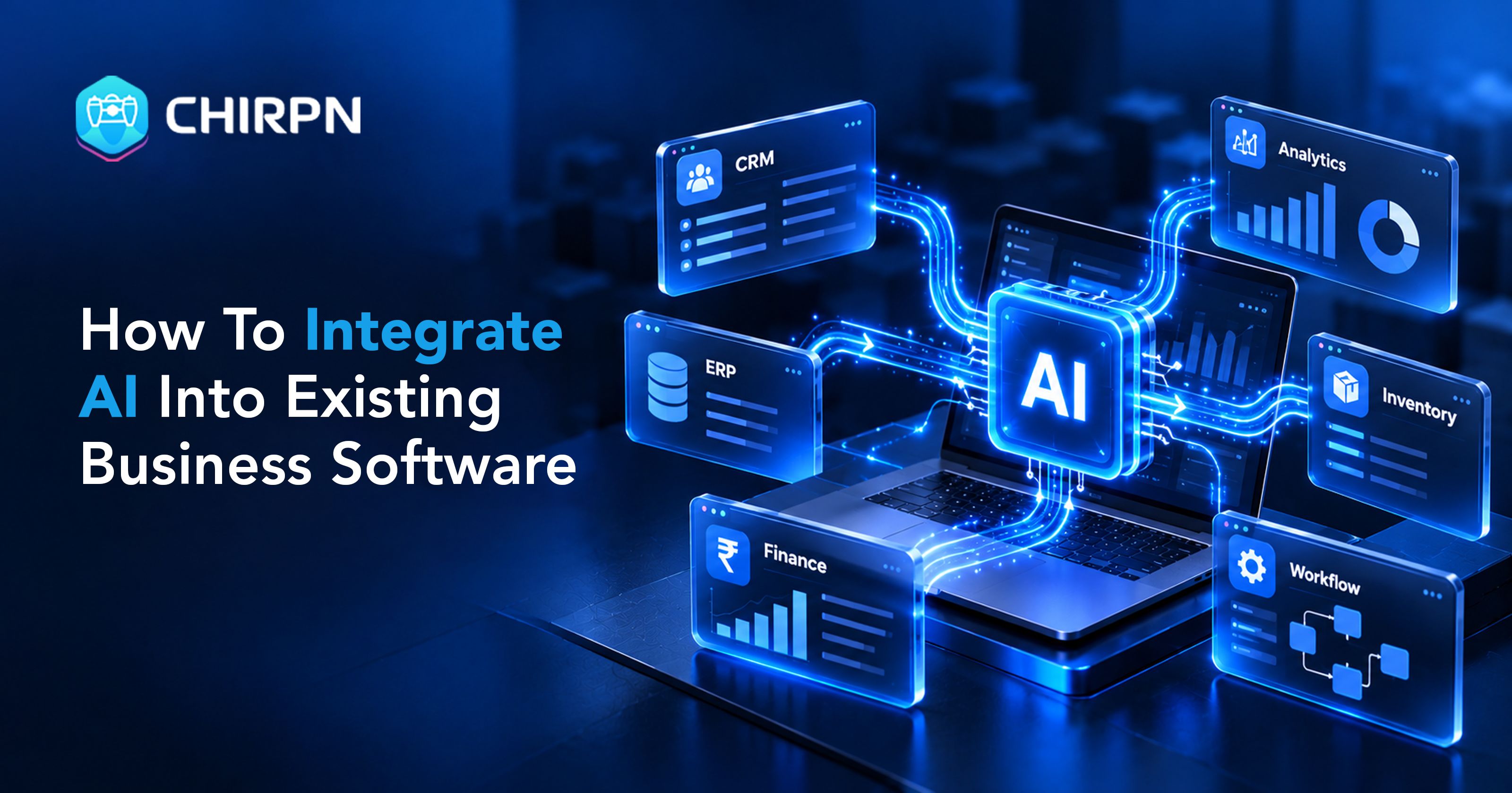
Integration of AI into existing business software involves adding an AI capability, an AI model, an AI agent, an AI recommendation engine to an already existing system, using a connection layer such as an API, or a middleware or even an integration platform. This is important because the majority of the risk of an AI integration isn't with the AI model, but whether the other 'half,' the glue between the AI model and the rest of the software, can process real production data, real traffic, and real failure modes versus just demo-level clean test data.
AI integration services, AI integration solutions, and enterprise AI integration all refer to the same kind of work, but from different perspectives; in particular, the terms used vary by provider, but fundamentally, the job is the same: To determine what can be done with the existing system, select an appropriate architecture for integration, and tie the AI capability into the framework without disrupting what is already working. An AI integration company that thinks of this as a “connection problem”, not a “replacement problem”, is solving your problem, one who thinks of it as a “replacement problem” is solving a different and oftentimes more expensive problem than the one you brought to them.
AI Integration Services vs. AI Automation Services: What Are the Differences?
AI integration services are designed to integrate an AI capability with your current systems so that the AI can access and leverage the data for reading and action; AI automation services, however, layer automated business processes on top of the connection work. The AI automation component still needs to be integrated with your current systems. The automation layer sits above the integration, not instead of it. The vast majority of AI automation initiatives therefore require integration work to be done first, and integration does not disappear once automation is running. It must be maintained and monitored for the same reasons any production integration must be. It's impossible to automate a workflow with AI if the AI does not have access to the information that the workflow operates on.
When considering AI integration, the question "should we hire an AI integration company or an AI automation vendor" is often misframed; the better framing is whether a given Vendor's AI development services have at least one of the two components: connection layer or workflow redesign on top of them, since a half-baked approach is likely to leave a coordination gap at the precise point where the project is already fragile. This is also the reason why AI integration for business is usually successful when it is a single, accountable effort, instead of a rickety collection of specialist vendors, each with one piece of the puzzle.
AI integration consulting services that end with architectural recommendations, without accompanying the actual integration and testing, leave the handoff gap mentioned above.
The Main Integration Architecture Options are as following
When it comes to AI integration projects, there are a few common architecture patterns, and the selection of which one to use depends on the number of systems involved and the extent of modification of existing software.
Approach | How It Connects | Best Fit | Vendor Guidance Notes |
Direct API integration | AI service calls a software's API, and the other way around, too | A few documented, modern systems. | Quietly used pattern confirmed that both the AI service and your target system export stable documented APIs and that rate limits and authentication methods are compatible. |
Integration platform / middleware (iPaaS) | Data is processed on a centralized platform that facilitates the connection between the AI tools and various systems. | Several systems including some that are not native to modern APIs. | Platform capabilities and connector libraries change frequently, confirm supported connectors and data volume limit directly with your platform vendor before committing to this pattern. |
Incorporating AI into current software applications. | AI is integrated within the application, through a vendor-provided AI feature or plugin. | Software that precludes the need for the vendor to develop an AI module and instead already has an embedded module. | Native AI modules vary by subscription tier and version. Verify with your software vendor which plan includes the AI feature, what data it can access, and whether it meets your data residency and privacy requirements. |
Custom connector / API gateway for legacy systems. | A purpose-built layer translates between a legacy system's older protocols and modern AI services | Healthcare, financial and manufacturing industries have legacy systems that do not provide native APIs. | Distinguish between an API gateway (protocol translation and routing at the network layer) and a custom adapter) bespoke code that maps legacy data formats to modern schemas). Both may be needed. Ask the vendor to demonstrate a working proof of concept against your actual legacy environment, not a sanitized demo before committing. |
These architecture patterns are general industry practice. The notes in the vendor guidance notes column reflect what integration platform and software vendors typically state in their own documentation. Read those notes as a starting point for your evaluation not as independent verification. Vendor reported claims about speed ease or compatibility should be confirmed against your own systems in a controlled pilot before any commitment.
Integrating AI into existing business software: 7 Step Process
1. Make sure to evaluate your current systems and data quality before selecting a use case
Before deciding on the build, verify that existing systems can support data completeness and system uptime and that existing APIs are documented or will require reverse engineering. This is the #1 most frequent pitfall in integration timelines, which often double midway through a project.
2. Select Single Narrow, Well Scoped Pilot Use Case
Don't select "add AI to customer service" but select "route incoming support tickets to the correct queue using an AI classifier. A narrow scope can be tested, communicated to stakeholders and provides you with a genuine production signal before embarking on a company-wide rollout.
3. Choose integration architecture that is suitable for your systems
Compare to your findings in step 1: a direct API connection to a modern, well documented system, a middleware, if more than one system is being connected, or a custom connector, if you are using legacy infrastructure that precedes the modern API era.
4. Create the connection layer prior to the AI logic
Before spending large amounts of money on the model or prompt logic, get the AI service reading and writing real data reliably with your chosen architecture. An AI capability that is sophisticated is rendered useless because of a connection layer that is weak, not an AI problem, but a connection problem.
5. Pilot in a restricted, supervised setting.
Before connecting to any sensitive or prediction data, complete the authorization privacy review and least privilege access set up described in step six. Security prerequisites must be in place before live data is dashed, not retrofitted afterwards. Where possible, begin a nonproduction read only or shadow environment run the integration again and representative authorize synthetic or unidentified data that reflects real production patterns, then confirm behavior meets acceptance criteria before expanding scope. Once the security prerequisites are satisfied and baseline matrices are established, pilots against a limited supervised user group. Instrument integration to capture scenarios that design did not account for wrong outputs and latency regressions against the baseline. Write operations to consequential systems should require explicit approval or a human in the loop gate until the iterate is demonstrably within the accepted threshold. Document a fallback and rollback plan before the pilot goes live and assign clear operating Ownership unnamed team responsible for monitoring, model response and incident escalation before expanding scope. It's also typically the phase where the workflow itself not just AI to requires redesigning a pattern The McKinsey research associates with companies that realize gains from AI.
6. Establish security, authorization, and compliance controls before connecting to sensitive data
Establish the foreign controls before any sensitive or production data is introduced to the integration, not after successful pilot and not only before scaling authorization and access control define which identities may call the integration under which conditions and with what level of access. Apply least privilege principles, the integration should request only the permissions it needs for its defined tasks, not broad read/write access.
Privacy and data classification: identify whether the data flowing through the integration is subject to regulatory requirements and confirm that the AI service’s data handling terms are compatible with those obligations.
Approved test environments: document which environments are approved for each data class. Sensitive or regulated data should not enter a development or shared staging environment without explicit sign off.
Encryption, Audit Trails and Data Residency: encryption in transit and at rest, audit logging for all AI-service calls, and confirmed data-residency constraints should be confirmed before the pilot begins, not added later. Retrofitting these controls after a pilot is live is more expensive and riskier from both technical and compliance standpoint than establishing them from the begining.
7. Scale deliberately and monitor continuously
Gradually roll out to more teams or use cases once the pilot has been successful, and continue monitoring for model drift, changing patterns in data, and new edge cases; AI integration is not a project that can be completed at launch – it is a system that must be monitored in the same way a production software system is monitored.
Typical Pitfalls Hindering AI Adoption Initiatives
Thinking of integration as a technical one off, not as a capability. Like API integrations, an AI connection created and never looked at will degrade over time as the systems and data patterns evolve.
Only implementing the AI feature without redesigning the workflow. The pattern that McKinsey's research associates with lower returns is bolting an AI capability on an untouched workflow.
The scaling prior to the pilot has indeed been successful. To go from one use case directly to an enterprise-wide rollout is to miss an opportunity to identify failure modes when they are still easy to correct and one of the more common ways that integration budgets are blown when no working result is achieved.
Assuming legacy systems can't be integrated at all. A legacy system that does not have a native API does not mean it cannot be integrated; it can be connected in a custom connector or API gateway, but it can take more engineering than integration with a modern system that has a well-documented API.
What are the qualities you should expect from an AI integration company?
Don't just take someone's word for it about "AI transformation" – ask them to explain their approach to the particular architecture pattern you require: direct API, middleware, or a custom connector to legacy infrastructure. An AI integration company that can articulate how it tests and validates data quality and system readiness prior to the scope of a project has typically performed this task many times before and has a good understanding of where it weakens. Do not settle for a capability claim, but demand a reference with a measurable project outcome; a case study on a vendor's website is vendor-reported information, but not independently verified. A review platform such as Clutch shows reviews written by clients which provides more independence than a vendor’s own case study note however that review platform listings are typically submitted by the vendor themselves and may not be representative of all engagements.
Frequently Asked Questions
Are there any existing software you need to rebuild to add AI to?
In most cases, No, AI integration involves integrating a new AI capability into existing software via API, middleware, or a custom-built connector, not replacing the software. But sometimes, instead of integration, a full rebuild is required, for very old legacy systems without a viable integration path.
How does AI integration services differ from AI automation services?
AI integration services connect an AI capability to your systems so that it can read and act on real data. AI automation services layer automated business processes on top of that connection. The integration is not a one time prerequisite that disappears once the automation is running, it must be maintained and monitored for the same reasons and production integration must be. The practical starting point is integration first, you cannot automate a workflow based on data the AI cannot reliably access.
What are the key factors to consider when choosing an AI integration company?
Seek out a business that, prior to suggesting an answer, clarifies how they approach auditing information readiness and current system structure. Request a specific and verifiable project result as the reference and consider vendor-reported information which are published as case studies as vendor reported.
What is the typical timeline for enterprise AI integration?
The timeline will heavily rely on the number of systems involved, if there is any legacy infrastructure that requires a custom built connector before being integrated, and the level of workflow redesign that is required as well as the technical integration. A small-scale pilot on well-defined, modern systems has a much higher pace than a many-system enterprise deployment with legacy resources. Any time frame given prior to any vendor seeing your systems should be considered a best guess only.
Why Chirpn
Chirpn's AI and ML development services, which form part of the wider Chirpn AI software development services, are designed with the following sequence in mind: AI discovery and strategy work are followed by AI product development and delivery, and, consequently, the architecture is built around an actual systems assessment instead of a default template. Separately, Chirpn's work in enterprise integration work specifically with the connection-layer portion of what's described here, as well as legacy-system integration patterns for platforms such as IBM WebSphere, Microsoft BizTalk Server and Oracle Fusion, and modern cloud integration tools more relevant to the "what if our systems are older" question that this guide throws up at you that, after all, is not an edge case for a meaningful share of mid-market and enterprise buyers.
If you're considering a project to integrate an AI and you need an evaluation of your systems before deciding on an architecture, contact Chirpn about what your stack actually requires.