


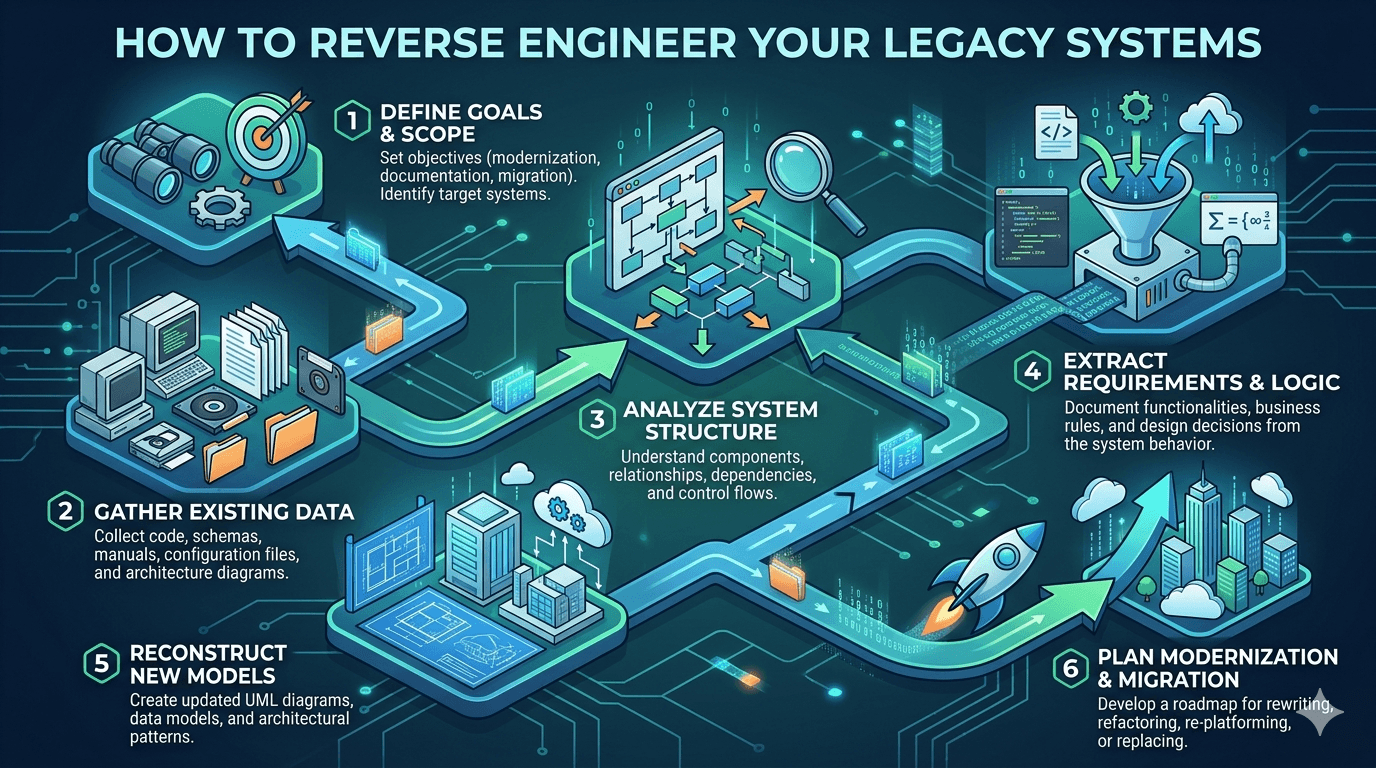

Every enterprise has systems that power the business but that nobody fully understands anymore. Legacy platforms running decade-old code. ERP systems with thirty-year-old business logic. Applications whose original architects retired years ago. These systems are not just technically outdated, they are undocumented knowledge risks.
Whether you are planning a Java upgrade, an OS migration, a cloud transformation, or an AI programme, the answer to "where do we start?" is almost always the same: reverse engineer what you have before you touch it.
WHAT YOU WILL LEARN
✓ Why undocumented legacy systems block upgrades, migrations, and AI programmes and what it costs
✓ The three approaches to reverse engineering compared Manual, AI-Assisted, and Automated Continuous
✓ Step-by-step guidance for executing each approach, including where each breaks down
✓ How to choose the right approach based on your system estate and goals
✓ What good output looks like the six components of a complete knowledge base
✓ How verified system documentation connects directly to AI model training and live retraining pipelines
✓ A 30-day action plan to get started immediately
THE THREE APPROACHES COMPARED
Most teams approach reverse engineering manually and that gap is exactly why modernization programs stall. Here is how the three approaches stack up:
Manual (3–9 months) • AI-Assisted (4–8 weeks) • Automated Continuous (days)
THE PROBLEM MOST ORGANISATIONS DON'T TALK ABOUT
Java upgrades sitting on the backlog for two years. OS migrations that keep getting pushed. Modernisation projects that stall in the discovery phase. These are symptoms of the same root cause: the system exists; the knowledge of why it works the way it does does not.
The business logic that drives your organisation exists in one place: the code. Most of it has never been written down.
AI-assisted tools have made the manual approach faster. Reports consistently find that AI-assisted documentation tools reduce the manual effort of reverse engineering by 40–60% on a one-time basis. But the staleness problem remains: systems change constantly, and a one-time documentation exercise is out of date the moment the first developer makes a change.
The approach most organisations have not yet considered is automated continuous documentation, a platform that connects to your systems, reads them alongside your version control history and deployment logs, and maintains a living knowledge base that stays current as the system evolves. This is what CogniVault, Chirpn's automated legacy documentation platform, is built to do.
GET THE COMPLETE GUIDE
The full guide covers all ten chapters in detail step-by-step instructions for executing each approach, a decision framework for choosing the right one for your system estate, the six components of a complete knowledge base, how to connect documented system knowledge to AI model training pipelines, and the 30-day action plan. Download it from chirpn.com/contact-us/ or request a CogniVault demonstration from the Chirpn AI team.
ABOUT THIS GUIDE
| Format | PDF — 26 pages |
| Published by | Chirpn AI — CogniVault Team |
| Reading time | Approx. 25 minutes |
| Suitable for | Chief Transformation Officers, Heads of Digital & Innovation, COOs, AI & Data Science Leads, IT Directors |
About CogniVault CogniVault is Chirpn AI’s automated legacy documentation platform. It reads your systems and existing documentation, reconciles them against each other, and produces a verified, always-current knowledge base — without pulling your engineers off live work. Used for infrastructure upgrades, modernization programs, and AI model training pipelines. |