


India's top product development companies are no longer competing on cost alone. They are competing on delivery speed, AI-native engineering, and product discipline, the combination that lets a software product development company in India ship a production-grade product in 45–60 days rather than the 3–6 months a comparable scope takes in North America or Western Europe.
This guide covers what product development actually encompasses, why India's market leads globally, the six core services that matter most, how AI in product development has changed delivery timelines, and what to look for in a product development consultant before you commit to a partner.
What Are Product Development Companies?
Product development companies convert business ideas into scalable software solutions. A software product development company differs from a traditional IT consulting firm in one critical way: it takes ownership of the entire product lifecycle rather than executing against a specification someone else wrote. That includes concept, architecture, engineering, QA, deployment, and continuous improvement.
Product development services are different from staff augmentation in the same way: a product development firm is accountable for outcomes, not hours. The deliverable is a working product, not a headcount contribution. The firms that do this well combine three capabilities: deep technical engineering (backend, cloud, AI), product thinking (UX, roadmap discipline, user validation), and delivery speed through structured AI-augmented SDLC frameworks.
Software product development services in India have grown rapidly as the market has shifted from cost arbitrage to value delivery. Mordor Intelligence tracks India's software services export market at $165.32 billion in 2026, with offshore software services accounting for 63.78% of that figure. The trend is away from labour-cost contracts and toward strategic innovation partnerships where Indian teams are embedded inside client product roadmaps.
Why Businesses Choose Indian Product Development Companies
The leading software product development companies in India have moved beyond cost arbitrage. They apply AI orchestration to the entire SDLC requirements, design, code generation, testing, deployment in parallel rather than sequentially. This structural change in how software is built is what compresses a 3–6 month timeline to 45–60 days. It is not faster engineers; it is a different architecture of the delivery process itself. India's software products market is projected to reach $42.62 billion by FY2031 from $14.82 billion in FY2023 (14.12% CAGR), driven by enterprise demand for AI-powered digital product development at speed.
The commercial case is clear: senior full-stack engineers in India cost $25,000–$55,000 per year (fully loaded) against $150,000–$250,000 in Sydney or San Francisco. At ten engineers, that is over $1.5 million per year in operating savings without the quality trade-off that characterised first-generation offshoring. India has 3.85 million software developers, the second-largest pool globally, and 72% of organizations already outsource some or all software development work.
The real differentiator among India's best product development companies is not the cost; it is which firms have genuinely changed how they deliver. The ones that have rebuilt their SDLC around AI orchestration produce faster timelines, higher test coverage, and better documentation as a structural byproduct not a manual afterthought.
Core Software Product Development Services
Leading product development companies organize their work across six disciplines. The best firms treat product design and development as a unified process from day one rather than adding design as an afterthought to an engineering engagement.
Requirements analysis and architecture. From fuzzy ideas to executable specifications. Discovery workshops, user journey mapping, system architecture, and phased roadmap design. The goal is to surface costly assumptions before development begins, not during QA.
MVP and product design development. Build a minimum viable product in 45–60 days, validate market fit, and iterate based on real user behavior. Product design development integrates UX strategy with technical architecture from the first sprint so design and engineering run concurrently rather than sequentially.
Full-stack platform development. Web and mobile applications, back-end APIs, real-time data pipelines, analytics layers. End-to-end ownership from UI/UX through production deployment.
AI in product development. GenAI agents, RAG pipelines, custom LLM fine-tuning, computer vision, predictive analytics. AI integration has moved from a premium feature to a baseline expectation for any competitive software product.
Cloud and DevOps. Multi-region deployment, Kubernetes orchestration, CI/CD automation, infrastructure-as-code, cost optimization. The best firms dramatically reduce time-to-deployment and ongoing operational cost through automation rather than manual configuration.
Legacy modernization. Refactoring monolithic applications into microservices, migrating end-of-life technology to cloud, and upgrading stacks without disrupting production. Essential for companies with codebases built over a decade or more.
How Product Development Companies Accelerate Time-to-Market
Three structural levers separate the fastest software product development services providers from those operating at conventional pace:
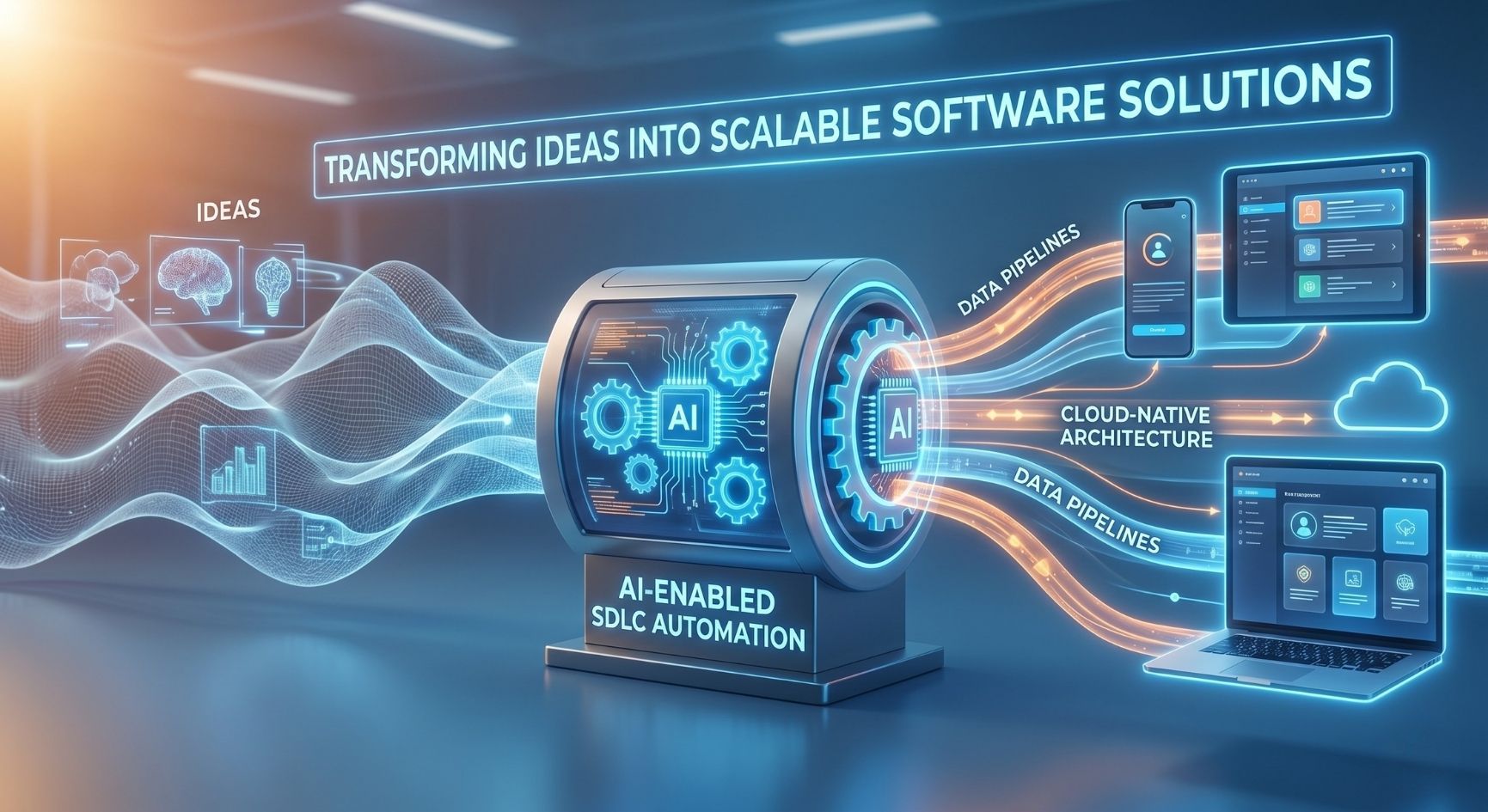
1. AI-enabled SDLC automation. Leading companies use AI-integrated frameworks that coordinate the entire SDLC: AI-generated user stories from requirement analysis, UI prototypes from design specifications, code generation for commodity components, automated test-case generation running in staging rather than production, and automated deployment pipelines. The result: complex products ship in 45–60 days rather than 3–6 months not because engineers work faster, but because the commodity stages no longer consume senior engineering time.
2. Capacity PODs. Leading companies structure teams as complementary pods: backend architect, frontend engineer, QA engineer, DevOps specialist deployable on demand. These teams carry context across the engagement, minimizing the ramp-up friction that consumes weeks on traditionally staffed projects.
3. Product discipline. The best product development companies in India operate as embedded product teams, not vendors. They resist vague specifications, question requirements that do not map to user needs, and manage scope as a strategic decision rather than a commercial negotiation. This ownership ethic is the single most consistent predictor of on-time, on-budget delivery.
Technology Stack
The strength of a software product development company is not which tools it lists but how quickly it combines them into an effective architecture for a specific problem. The table below reflects what India's leading firms actually use correctly categorized:
| Layer | Technologies |
| Frontend | React, Angular, Vue.js, Next.js, Android (native), iOS (Swift/Kotlin), Flutter, React Native |
| Backend | Node.js, Python, Java, Go, Rust; Microservices and API-first architecture |
| CMS / Web | WordPress, PHP, Django, Symfony; Headless CMS patterns |
| Cloud | Google Cloud (Vertex AI, AgentSpace, Agent Assist, Gemini), AWS, Azure |
| Databases | PostgreSQL, MySQL, MongoDB, Redis, DynamoDB; vector databases for AI workloads |
| Data & Analytics | Kafka, Spark, Snowflake, dbt; Tableau, Power BI for reporting and BI |
| AI / ML | LLM integration, RAG pipelines, Hugging Face, OpenAI, Anthropic; custom model fine-tuning |
| DevOps | Kubernetes, Docker, CI/CD (GitHub Actions, CircleCI), infrastructure-as-code (Terraform) |
Product Design and Development: The Stage That Determines Everything
Product design development the phase where requirements are validated as prototypes before production engineering begins is where most project failures are seeded. The common failure mode is treating design as a hand-off: design completes a specification, engineering begins, and misalignment surfaces in QA at maximum cost.
The firms that consistently ship on time run product design and development and engineering concurrently, using generated prototype variants to validate commercial assumptions before a line of production code is written. Ask any firm on your shortlist: at what stage do you validate the design with actual users, and what does "validated" mean to you?
How to Select the Right Product Development Consultant
The choice of a product development consultant is more consequential than the choice of technology. Five signals separate firms that have delivered from those that have pitched:
| Signal | What to ask | Why it matters |
| Delivery track record | Show me named case studies in my domain with actual elapsed time and quantified outcome | Portfolio volume does not predict delivery quality; specifics do |
| Team stability | What is the average tenure of engineers on a typical engagement? Who maintains context if a senior leaves? | Engineering team changes are the single most consistent cause of context loss and timeline overrun |
| Communication model | How do you handle async communication across time zones? Show me your standup and stakeholder sync cadence | Good async discipline replaces the need for constant real-time conferences |
| Technical depth | Can you plan for scale from day one? What cloud and AI infrastructure does my roadmap require? | A system that cannot scale from the MVP architecture produces a rewrite the most expensive outcome |
| Process rigor | Do you use continuous integration and automated testing? Show me sprint velocity and defect-trend data from a recent project | Agile discipline is more predictive of outcomes than certifications |
Where Chirpn Fits
Chirpn is an AI-native product development company built for mid-market and growth-stage buyers who need enterprise-grade software product development in 45–60 days, without multi-year lock-in. AutoPATH, Chirpn's AI-orchestrated SDLC, runs requirements, design, code generation, automated QA, and deployment as one continuous workflow compressing commodity stages so engineering effort concentrates on the differentiated logic. As a Google Cloud Partner (Vertex AI, AgentSpace, Agent Assist, Gemini), Chirpn delivers AI-native digital product development on the same infrastructure as Google's own agentic products. Full IP transfers to the client on delivery. No licence fees. No vendor lock-in.
100+ products and platforms shipped. Engineering alumni from IBM, Airbus, Publicis Sapient, Apple, and Cisco. The Core-Flex model covers post-launch monitoring and retraining.
Ready to accelerate your product roadmap? Book a discovery session.
Conclusion
India's product development companies have moved from cost-arbitrage suppliers to genuine engineering partners. The digital product development firms that lead the market in 2026 share three characteristics: AI-supported frameworks that shorten the delivery cycle without sacrificing architecture quality; senior engineers with deep knowledge of modern stacks; and product discipline where code is treated as a strategic asset rather than a cost line.
Apply the five evaluation signals above to any shortlist, including ours. The firm that answers each with specifics from named past projects is worth a discovery call. The firm that answers with portfolio volume is answering a different question.
Frequently Asked Questions
What is the average cost of product development services in India?
A 45–60 day MVP typically runs $50,000–$150,000 depending on complexity. Custom enterprise platforms run $300,000–$1M+ over 3–6 months. Software product development services in India are materially less expensive than equivalent scope in North America or Western Europe. The relevant comparison is not the headline rate but total delivered cost, including the cost of a longer timeline and a potential architecture rewrite. Any quote produced before a discovery process is a guess.
How do Indian product development companies handle time zone differences?
Most firms structure 4–6 hours of overlap with US and European working hours. The best partners use documentation-first and async communication for non-urgent items, structured standups for daily sync, and weekly stakeholder reviews to keep sponsors informed without requiring constant real-time availability. The test is whether they initiate communication proactively or wait for you to follow up.
What happens after launch? Do they provide post-launch support?
Leading product development companies include monitoring, bug fixes, feature iteration, and infrastructure management in their post-launch scope. Best clarify this before signing, not after go-live. Some firms operate the product through an initial period and then transfer operations to your team (Build-Operate-Transfer); others provide ongoing managed support. Confirm which model applies and what the SLA looks like before any contract is signed.
Can Indian firms handle regulated industries such as healthcare and fintech?
Yes, but verify specifics: HIPAA compliance (healthcare), PCI-DSS (payments), SOC 2 (data security). Ask for documented compliance workflows and audit evidence, not claims. The firms with genuine regulatory experience can show you how compliance is built into their engineering process, not added at the end.
What is the difference between product development and staff augmentation?
A product development company is accountable for outcomes and delivers full functionality against agreed scope. A staff augmentation vendor supplies people. The best product development consultant you can hire is the one who takes ownership who pushes back on vague specifications, manages scope as a strategic decision, and remains accountable after the product launches. Augmentation vendors are the right choice when you have a defined engineering team that needs additional capacity; product development firms are right when you need someone to own the outcome.
How does AI in product development change delivery timelines?
AI in product development compresses the stages that historically consumed most of the calendar: requirements decomposition, UI prototype generation, commodity code generation, test-case automation, and deployment pipeline management. When these stages run in parallel through an AI-orchestrated framework rather than sequentially by separate specialists the elapsed time from brief to production drops from 3–6 months to 45–60 days for comparable scopes. The architecture quality does not drop; the commodity effort does.