

Remember when every software application was an enclosed space in its own little world? Your email client, your spreadsheet, your CRM, all living in complete isolation. Then APIs changed everything. Your calendar could talk to your email, your CRM could sync with your marketing tools, and entire ecosystems of connected software emerged.
We are at a similar inflection point today but this time it is about agents. Intelligent agents need to collaborate not just within a single application but across entire business ecosystems: different frameworks, different vendors, different cloud environments. The question that determines whether that collaboration is possible is: how do these agents communicate?
The Current State: Agents That Cannot Talk to Each Other
Right now, when you interact with an AI agent through any application, it typically operates in isolation. It can call the APIs you have pre-configured, access the data sources you have connected, and perform the actions within its immediate environment. But it cannot discover new capabilities, negotiate with other agents, or coordinate across systems that use different protocols without custom integration code written specifically for each connection.
Consider a realistic enterprise scenario: a sales intelligence agent that analyses CRM data, a financial agent that models deal profitability, and a compliance agent that checks contract terms against regulatory requirements. Each delivers value independently. None can pass context to the others without bespoke integration work at every boundary. The result is three isolated AI systems that collectively require more coordination overhead than they save.
This fragmentation is the agent communication problem. It is the constraint that prevents multi-agent architectures from delivering on their commercial promise at scale.
Three Protocols Defining How Agents Will Communicate
Three open standards have emerged as the primary protocols for agent communication in 2025–2026. Each addresses a different layer of the coordination problem.
Model Context Protocol (MCP) Agent-to-Tool Communication
Introduced by Anthropic in November 2024, MCP standardises how AI agents connect to external tools and data sources CRMs, databases, APIs, file systems through a consistent JSON-RPC interface. Before MCP, every tool integration required custom code. MCP standardizes the connection layer so agents can discover and use tools without bespoke wiring for each.
MCP is the most mature of the three protocols; it has significant adoption among enterprise AI platforms and is already the standard for tool access in production agentic systems. Chirpn's MCP deployments use this layer for all tool connections in multi-agent workflows.
Agent-to-Agent Protocol (A2A) Agent-to-Agent Communication
Introduced by Google in April 2025, A2A defines how AI agents communicate with each other peer-to-peer across different frameworks, vendors, and platforms. Where MCP handles agent-to-tool connections, A2A handles agent-to-agent coordination: task delegation, result sharing, and context passing between autonomous systems.
A2A is designed to be model-agnostic and vendor-neutral. An agent built on Gemini can delegate to an agent built on Claude, pass the relevant context, receive the result, and continue its workflow without custom integration at the boundary. This is the protocol that makes genuine multi-agent orchestration across vendor boundaries possible.
Agent Communication Protocol (ACP) Open Standard for Interoperability
Introduced by IBM's BeeAI project under the Linux Foundation, ACP is an open, vendor-neutral standard that defines RESTful, HTTP-based interfaces for agent task invocation, lifecycle management, and both synchronous and asynchronous messaging. ACP's design is explicitly enterprise-oriented: capability-based security tokens for fine-grained authorization, formal task lifecycle management, and interoperability across cloud and edge environments.
Where MCP focuses on tool access and A2A focuses on peer-to-peer agent communication, ACP focuses on the broader enterprise integration layer making agents accessible as services within existing enterprise architectures, with the security and governance properties that regulated industries require.
How MCP, A2A, and ACP Work Together
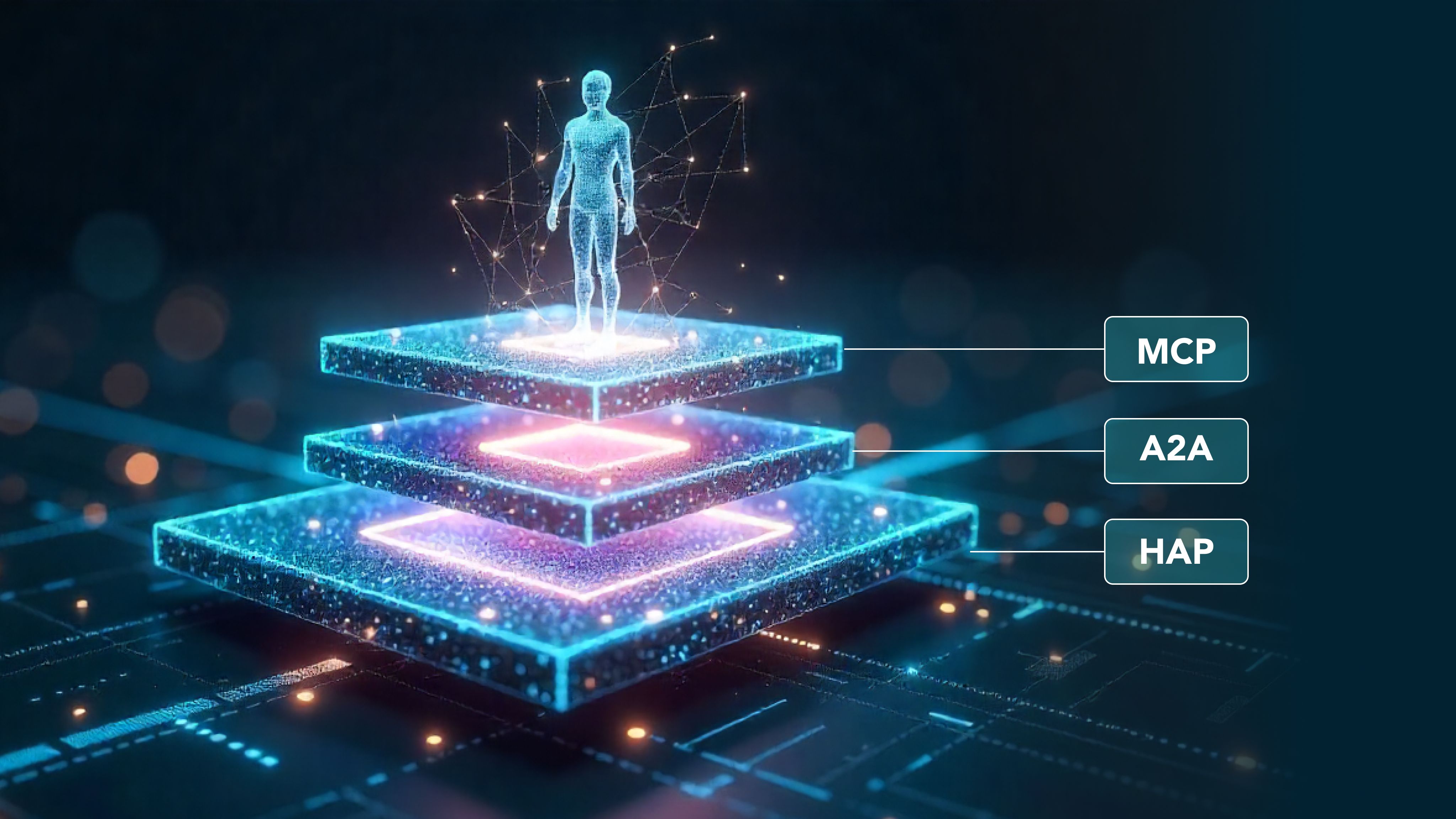
The three protocols are complementary, not competing:
- MCP handles the connection from an agent to the tools and data sources it needs the agent's reach into external systems
- A2A handles the communication between agents how they delegate, coordinate, and share results across vendor and framework boundaries
- ACP handles the enterprise integration layer how agents are exposed as services, authenticated, and managed within existing enterprise architectures
A complete multi-agent system in 2026 typically uses all three: MCP for tool access, A2A for inter-agent coordination, and ACP for enterprise service integration. The combination is what enables agents to work across the full enterprise estate not just within a single vendor's platform.
Why Every Application Needs to Consider Agent Protocols Now
Gartner estimates that 40% of enterprise applications will embed agentic AI by the end of 2026. An application that cannot communicate with agents through a standard protocol will not be able to participate in the multi-agent ecosystems that enterprise buyers are assembling. The practical risk for software product companies: applications built without agent protocol support will need expensive retrofitting as the standard matures or will be displaced by alternatives that support it natively.
The analogy holds: just as applications that did not expose REST APIs were progressively isolated from the connected software ecosystems that emerged after 2010, applications that do not support MCP, A2A, or ACP will be progressively isolated from the agent-connected ecosystems emerging now. The window for building this in by design rather than retrofitting it later is open but it is not indefinite.
Security and Governance in Agent Communication
Multi-agent systems introduce security and governance requirements that conventional API security does not fully address:
Agent authentication. When an agent delegates a task to another agent, the receiving agent needs to verify the identity and authorization of the delegating agent, not just the end-user. ACP's capability-based security tokens provide the mechanism; implementations must enforce it.
Encrypted communication. All inter-agent communication both tool calls via MCP and agent-to-agent messages via A2A, should be encrypted in transit, with mutual TLS as the minimum standard for production deployments.
Audit trails. Every agent action, delegation, and tool call should be logged to a shared context that is auditable after the fact. In regulated environments (healthcare, financial services, legal), this is a compliance requirement; in all environments, it is the architectural decision that makes debugging and governance tractable.
Least-privilege access. Agents should access only the tools and data they need for their specific sub-task not the full tool set available to the overall system. This limits the blast radius if an agent misbehaves or is subject to a prompt injection attack.
How Chirpn Builds Multi-Agent Systems on These Protocols
Chirpn is a Google Cloud Partner building production multi-agent systems on Vertex AI, AgentSpace, and Agent Assist infrastructure that natively supports both MCP and A2A. AutoPATH, Chirpn's AI-orchestrated SDLC, treats agent protocol design which tools agents can access, how they authenticate, which actions require human approval, and what the shared context log captures as a first-class architectural concern defined in the discovery phase, not added during testing.
The four security principles above agent authentication, encrypted communication, complete audit trails, and least-privilege tool access are requirements in every Chirpn agentic deployment, not optional refinements. They are what makes MCP-based agentic systems deployable in the regulated environments where the commercial opportunity is largest.
Related reading: MCP: The Architecture Powering AI Agents (A062) · How Chirpn Uses MCP to Orchestrate AI Agents (A067) · Chirpn's AI and ML development services
Frequently Asked Questions
What is the difference between MCP, A2A, and ACP?
MCP (Anthropic, 2024) standardizes agent-to-tool connections on how an agent accesses external data sources and APIs. A2A (Google, 2025) standardises agent-to-agent communication, how agents delegate tasks and share results across different frameworks and vendors. ACP (IBM/Linux Foundation) standardises the enterprise integration layer in how agents are exposed as services, authenticated, and managed within existing enterprise architectures. A complete multi-agent system typically needs all three.
Why do AI agents need new protocols rather than standard REST APIs?
REST APIs are static and pre-configured; an application must know exactly what another application can do before calling it. AI agents need to discover capabilities dynamically, preserve context across multi-step workflows, adapt when intermediate steps fail, and coordinate with other agents that may be built by different vendors using different frameworks. Standard REST APIs cannot provide dynamic capability discovery, context preservation across agent boundaries, or vendor-agnostic inter-agent coordination which is precisely what MCP, A2A, and ACP are designed to deliver.
Is my application at risk if it does not support agent protocols?
Yes progressively. Gartner estimates that 40% of enterprise applications will embed agentic AI by the end of 2026. Applications that cannot participate in multi-agent workflows through standard protocols will require expensive retrofitting or will be replaced by alternatives that support agent communication natively. The analogy to REST API adoption (2010–2018) is instructive: firms that built API-first were part of the ecosystem; those that did not were progressively isolated from it.
What security considerations apply to multi-agent systems?
Four: agent authentication (verifying which agent is delegating a task), encrypted communication (mutual TLS minimum for all inter-agent messages and tool calls), complete audit trails (every agent action logged to a shared, auditable context), and least-privilege tool access (agents access only the tools they need for their specific sub-task). These are not optional in production deployments particularly in regulated environments where a complete audit trail is a compliance requirement.