





As businesses grow, they adopt complex processes for compatibility. Yet, these systems falter without proper data exchange. Enterprise application integration harmonizes diverse systems and boosts operations. It enables seamless communication, unleashing the full potential of a company's technology.
Businesses can streamline their operations, improve data accuracy, and scale better by integrating various applications. This is an essential integration to have in place for the purpose of consolidating into a cohesive digital infrastructure key human capital management (HCM), e.g. customer relationship management (CRM) and enterprise resource planning (ERP) systems.
Understanding Enterprise Application Integration
Enterprise Application Integration (EAI) unifies processes for seamless information exchange. EAI eliminates system barriers by creating connections and bridging technological divides. It can mean connecting your internal applications with clients’. It brings incompatible systems together to remove data silos. The goal is to enhance information sharing and automate business workflows.
Businesses now see EAI's crucial role in unifying HCM, CRM, and ERP systems. This integration model's growing adoption shows its ability to boost cohesive digital infrastructures.
Benefits of Integrating Enterprise Applications
Improve business efficiency
Integrating enterprise applications streamlines workflows and automates business processes. This reduces errors and saves time.
Better data accuracy
Enterprise integration software connects applications in real-time, ensuring accurate data flow. It connects departments, processes, and people. These solutions lead to better decision-making for a company’s management.
Enhance scalability
Teams use EAI to navigate business growth with flexibility. This allows businesses to stay agile and integrate new systems without disrupting operations.
Patterns of Enterprise Software Integration
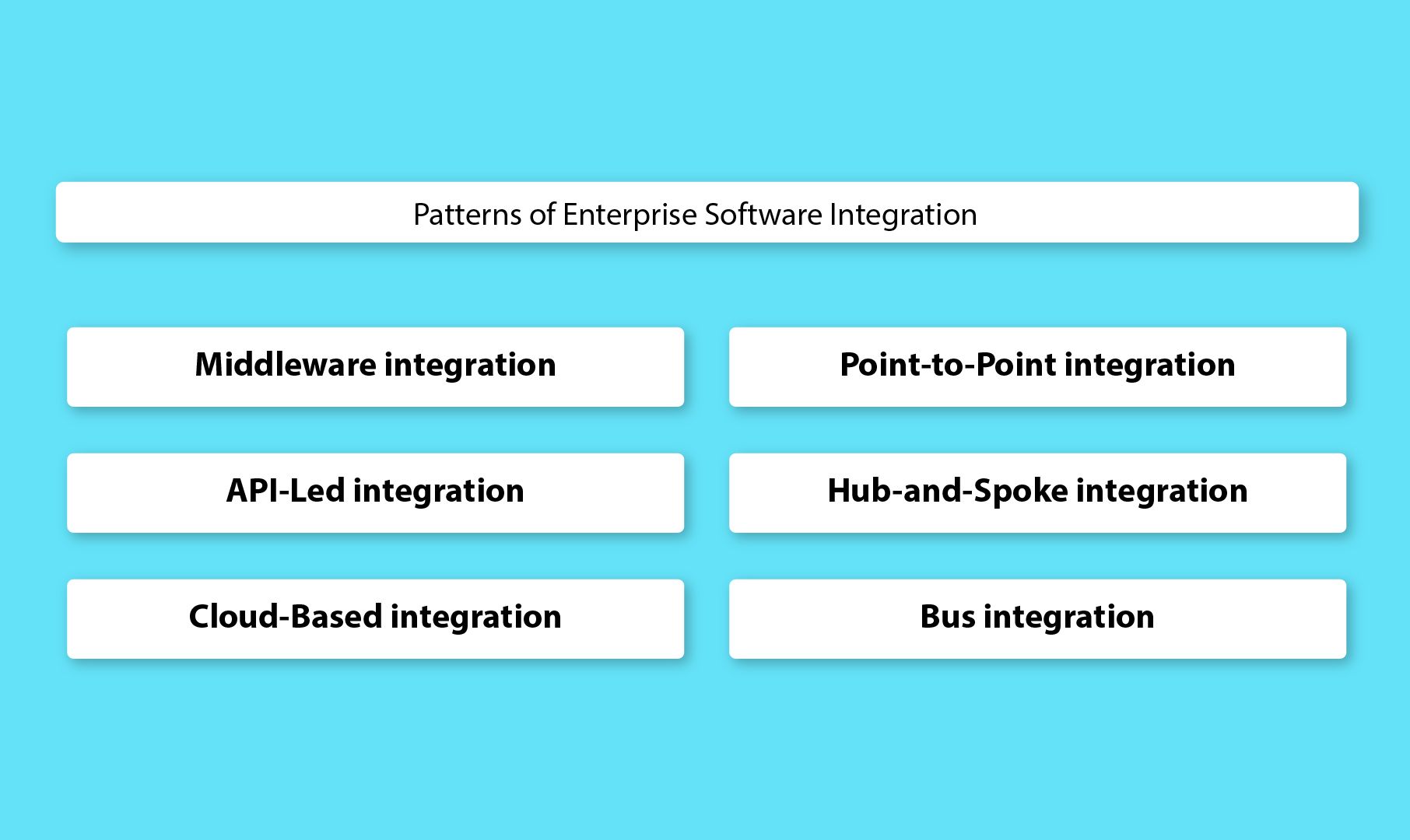
Enterprise software integration patterns such as point-to-point, hub-and-spoke, API gateways, and enterprise service bus (ESB) are the most common. However, they are not the only methods for EAI. How to choose the correct process? It depends on factors like complexity, scalability, and security requirements.
Point-to-Point integration
Point-to-point integration connects individual applications using custom-coded connectors. It becomes inefficient when handling large systems.
Hub-and-Spoke integration
Hub-and-spoke integration uses a central hub to manage data exchange between connected applications. Developers need to configure the data flow.
Bus integration
A unified channel connects varied apps, directing and reforming data. This bus integration technique unlocks operational synergies and fosters organizational cohesion.
Middleware integration
Middleware integration uses middleware software to connect different applications. The platform serves as a central hub, orchestrating information exchange across the enterprise.
API-Led integration
API-led integration uses APIs (Application Programming interfaces) to connect applications. Each application exposes its functionality through APIs, enabling seamless data exchange.
Cloud-Based integration
Cloud-based integration solutions use cloud-based platforms to connect applications. They include pre-built connectors and tools to help with integration.
Read more: Enterprise SaaS Solutions
iPaaS
iPaaS, a cloud solution, streamlines integration across business systems. It has pre-built connectors that support real-time data synchronization, operations, and collaboration.
On-premise Enterprise Application Integration
In-house EAI offers robust connectivity within a company's IT framework. Yet, high upfront costs, ongoing upkeep, and growth limitations pose hurdles.
Best Practices for Enterprise Application Development
Having clear business objectives

Ask these questions first: Which departments need efficiency boosts? What processes need improvement? Define clear objectives and targets. This helps EIA bring your business the most value long-term.
Rolling out the blueprint
Before starting the integration process, have a blueprint. It should answer questions like, "What will be the integration process?” or "What are the security concerns?” The strategy should outline everything for optimal efficiency and performance.
Implementing standardized protocols
Standard protocols ensure interoperability across different applications. These protocols facilitate seamless integration and data exchange between systems.
Choosing an integration platform
This decision is critical for the integration's success. Should you choose a centralized platform or middleware? It will depend on the platform’s robustness for routing messages and orchestration.
To integrate enterprise applications, pick a platform that supports on-premise and cloud apps. This will streamline your efforts and allow for business scalability.
Not compromising on data quality
Data accuracy needs rigorous validation during EAI. Businesses must verify consistency and reliability across all integrated systems. This ensures seamless information flow and prevents costly errors. Also, have data governance policies to define data ownership and standards. Without these, businesses may get erroneous insights, impacting decisions.
Following compliance regulations
To avoid legal issues and protect sensitive data, enterprise apps must follow regulations. Failure to meet these standards risks dire consequences for businesses. Conduct regular audits to ensure ongoing compliance.
Performing continuous monitoring
Continuous monitoring of enterprise applications is essential. Implement real-time monitoring tools to track application performance, security, and user activity. These insights can address potential issues before they impact users.
Choosing the Agile Software Development Process
Iterative development thrives in Scrum and Kanban processes. Continuous feedback loops drive quick adjustments. This flexible approach responds to evolving business needs, ensuring relevance and efficiency.
Using AI, Machine Learning, or IoT
AI and ML in EAI can create more intelligent and responsive systems. These technologies enable better decision-making and enhanced predictive capabilities.
Blockchain in EAI offers security, transparency, and data integrity across integrated systems. Its decentralized nature makes it ideal for seamless and secure data exchange.
Top Enterprise Integration Platforms in 2024

IBM WebSphere MQSeries
IBM WebSphere MQSeries is middleware that facilitates communication across diverse platforms. It ensures secure data transfer, allowing asynchronous communication and decoupling of applications.
BizTalk Server
This tool by Microsoft facilitates seamless communication between disparate corporate systems, which is a prerequisite for EAI.
Oracle Fusion
If the goal is to integrate service-oriented architecture or work on business process management (BPM), then Oracle Fusion is the best comprehensive middleware.
Workato
Workato is a cloud-based tool that automates workflows and supports many connectors for popular SaaS applications, databases, and on-premise systems.
Cloud Elements
Cloud Elements uses APIs to connect clouds and on-premise applications. It provides one API to link separate connections and reduce complexity.
In a business, ensuring data consistency and removing redundancy is critical for better decision-making. All of this will be possible with Enterprise Application Integration (EAI). Chirpn IT Solutions is known for its innovative AI-first approach. The team develops custom software using advanced technologies like AI and ML.
Conclusion
Chirpn’s advanced enterprise integration solutions are instrumental in reengineering business processes through facilitating smooth communication and data flow between different systems. Chirpn does not only increase operational effectiveness using cutting-edge technology like AI, ML, and blockchain but also drives innovation and scalability.
The dedication of Chirpn to achieving the best is revealed in their careful integration approach right from understanding client needs to coming up with a robust scalable solution. The fact that they have expertise in platforms such as IBM WebSphere, Microsoft BizTalk Server and Oracle Fusion shows that they can handle complex integration problems.
Chirpn has a complete range of services specifically designed to cater to various industries that want to unlock their full potential. Find out more about Chirpn’s integration solutions at chirpn.com and experience how your business can change through the implementation of its enterprise platform or API integrations.
Frequently Asked Questions
How can enterprise application integration benefit various industries?
EAI can solve interoperability issues in banking, retail, healthcare, and manufacturing. It can combine core banking systems and CRMs, enhancing the customer experience.
Retailers can connect sales and inventory systems through EAI to ensure smooth transactions. Integrated quality systems streamline manufacturing, minimizing errors and waste. These systems boost efficiency, cut costs, and ensure consistent product quality.
What challenges might arise when implementing EAI?
Implementing EAI brings many challenges. These include complexity, cost, data security, compatibility, and change management.
How can organizations ensure successful EAI implementation?
Businesses can successfully implement EAI by creating a plan, picking the right integration pattern, and maintaining thorough documentation and monitoring.
Can you explain Enterprise Service Bus (ESB)?
An ESB is a middleware that allows data transformation and routing and provides standardized communication, which means flexible and scalable integration.