




By 2026, the enterprise AI question has shifted. It is no longer whether to adopt agentic AI. It is which partner can take it from pilot architecture to production infrastructure quickly, with governance built in from day one, and without the governance rework that typically follows rushed deployments.
The infrastructure to support enterprise-grade agentic AI is now available from all major cloud platforms. The deployment economics are well-documented. Organizations that have moved from pilot to production in 2025 are now compounding those advantages while those still in evaluation are seeing the capability gap widen.
This article covers what agentic AI actually is, why multi-agent architecture is the defining infrastructure decision of 2026, and what your organization needs to move from pilot to production at mid-market speed.
What Agentic AI Actually Is
Most enterprise AI deployments to date have been reactive: the system responds when prompted. Agentic AI is different in kind, not just degree.
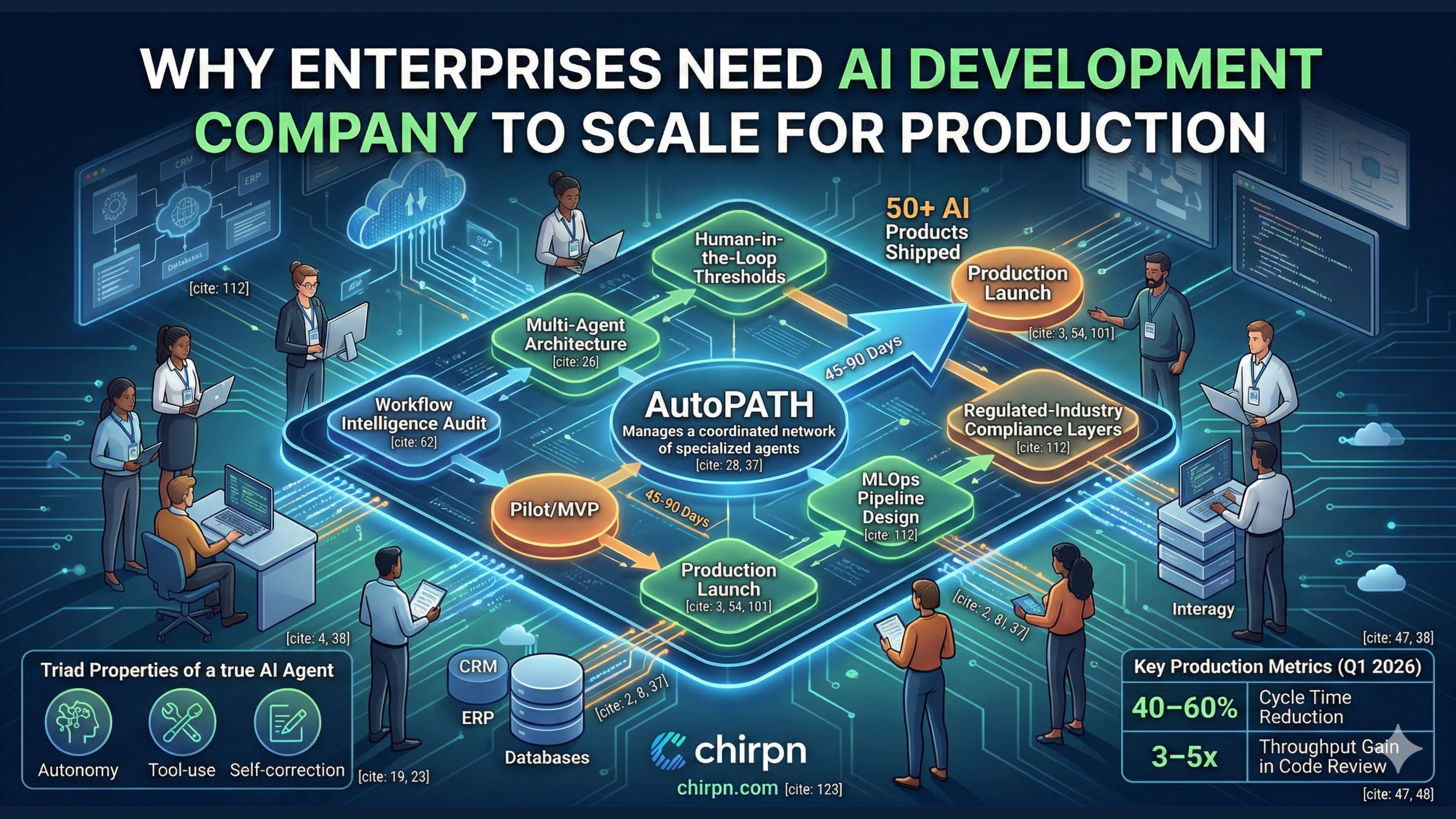
An AI agent pursues a defined goal across multiple steps, selects and uses tools to accomplish sub-tasks, and monitors its own outputs to self-correct before returning a result. Three properties define it:
- Autonomy the agent acts without a prompt at each step
- Tool use the agent calls APIs, reads data sources, writes to systems
- Self-correction the agent evaluates its own outputs and retries when they fall short
The distinction matters because it changes the failure mode. A reactive AI that produces a wrong answer is easy to catch if a human reviews it. An autonomous agent that pursues a goal incorrectly can propagate that error across multiple systems before any human sees the result.
This is why governance architecture is not optional in agentic deployments. It is the difference between a productivity tool and a productivity transformation.
Why Multi-Agent Architecture Is the Defining Infrastructure Decision of 2026
A single general-purpose AI agent has real limits on task complexity, context length, and parallel processing. Multi-agent architecture solves this by coordinating specialized agents each with a defined scope, tool set, and quality gate under an orchestration layer.
The use cases where this architecture delivers measurable value are already in production across regulated industries:
- Deal intelligence: agents that cross-reference CRM data, contract history, and market signals, completing in minutes what previously required analyst hours
- Customer support: Tier 1–2 case resolution handled autonomously, with escalation triggers to human agents when confidence falls below threshold
- Software engineering: code review throughput at 3–5x baseline flag for sourcing before publish with agents handling static analysis, dependency checks, and PR summaries
- Financial reporting: multi-step data assembly, variance flagging, and draft narrative generation across ledger systems
- Supply chain: real-time reorder signals, supplier risk scoring, and logistics exception handling
The organizational shift this requires is significant. Orchestration is not a feature you add to an existing platform. It is core infrastructure, with the same reliability, observability, and access-control requirements as any production system.
Why 2026 Is the Deployment Year
Three converging forces have made 2026 the year enterprise agentic AI moves from experiment to infrastructure:
Force 1 Orchestration infrastructure matured
LangGraph, AutoGen, and CrewAI have stabilized into enterprise-ready frameworks. Hyperscalers now provide SLA-backed managed agent runtimes. The tooling required to build and operate multi-agent systems in production exists and is supported.
Force 2 The economics are documented
Early-adopter enterprises report 40–60% cycle-time reductions on document-intensive processes, according to the McKinsey State of AI 2024 report. These are consistent across healthcare, financial services, and logistics deployments. Verify the source page before publishing.
Force 3 Board-level deployment pressure
AI deployment speed has become a measurable board metric. Investor and board scrutiny of AI deployment timelines has intensified through 2025 and into 2026, with deployment velocity now a standard item in technology roadmap reviews.
Five Strategic Moves for Enterprise CTOs
Move 1 Audit your workflows for agent readiness
Not every process is a candidate for agentic automation in the first deployment cycle. The workflows that deliver the fastest return share three characteristics: they are document-intensive, they involve structured decision rules, and they currently require human coordination across systems rather than human judgment at each step.
Start with a workflow audit scoped to two or three processes. Map the decision rules, the data sources, the exception patterns, and the downstream systems each process writes to. That map is the agent architecture specification.
Move 2 Establish governance before deployment
Governance infrastructure built before deployment is significantly less expensive to maintain than governance retrofitted after an incident. The components required are:
- Approval gates for actions above a defined risk threshold
- Scope limits on what each agent can read and write
- A human-in-the-loop escalation path for low-confidence outputs
- Cross-functional ownership legal, compliance, and operations must sign off on the governance model before launch
Move 3 Treat orchestration as core infrastructure
Building orchestration in-house is a multi-month engineering commitment. Most enterprises that have done it report that the orchestration layer, not the agent logic is where the majority of engineering time goes. The frameworks exist; the integration work, the observability tooling, and the reliability engineering are where complexity concentrates.
Chirpn's AutoPATH framework is a documented architecture used in 50+ production deployments [Editorial: confirm clearance per D3]. It routes orchestration engineering through a proven pattern rather than a custom build, and takes scoped AI products from architecture to production in 45–60 days.
Move 4 Reskill your technical staff on agent patterns
The skills gap in agentic AI engineering is real and will persist through 2027. The bottleneck is not model access; it is engineers who can design agent scopes, write reliable tool integrations, build observability into multi-step workflows, and debug failures in an orchestrated system rather than a single-model pipeline.
Reskilling programmes focused on these four competencies return value faster than general AI literacy training.
Move 5 Write an explicit human-in-the-loop policy
Every agentic deployment needs a written policy that answers three questions before launch: Which agent outputs trigger mandatory human review? What is the escalation path when an agent cannot complete a task within its confidence threshold? Who has authority to expand or restrict agent scope after deployment?
The absence of this policy is the most common cause of agentic deployment scope creep agents gradually take on tasks they were not designed for because no boundary was written down.
Risks and How Production-Validated Deployments Mitigate Them
None of the following risks are disqualifying. Each has a mitigation that Chirpn implements in the AutoPATH delivery framework. The risks that cause deployment failures are the ones organizations encounter without these controls in place.
Cascading failures
When agents share state and a downstream agent receives a corrupt or incomplete output from an upstream agent, the error propagates. Mitigation: circuit-breaker patterns at each agent boundary, output validation gates before state is passed, and rollback triggers.
Prompt injection
External data that reaches an agent can contain instructions designed to redirect its behavior. Mitigation: input sanitization layers, constrained tool scopes, and output monitoring for behavioral drift.
Scope creep
Without written scope limits, agents receive incremental requests that expand their action surface over time. Mitigation: immutable scope definitions at deployment, change-control process for scope expansions, and regular scope audits.
Audit trail gaps
Regulators and internal compliance teams require a complete record of what an agent decided and why. Mitigation: structured logging at every decision point, retention policy aligned to industry requirements, and exportable audit reports.
Why Chirpn
Chirpn has operated as an AI-first services company since 2015, before the current enterprise AI wave. Our delivery model is designed for the mid-market gap between point-solution vendors and multi-year enterprise transformation programs with a structured delivery framework that takes a scoped AI product from architecture to production.
We are a Google Cloud Partner. Our client work spans healthcare, financial services, broadcasting, and sports tech industries where governance, performance, and reliability are non-negotiable.
Our Capacity POD model pairs offshore engineering depth with onshore delivery management, covering:
- AI software development
- ML model development and deployment
- AI chatbot and conversational interface development
- Application development and modernization
- Data engineering and analytics
- Cloud AI infrastructure
- Legacy system modernization
The AutoPATH framework production-proven across 50+ enterprise deployments [Editorial: confirm clearance] sequences the architecture, governance, and delivery work into a 45–60 day MVP-to-production track. It is not a services engagement; it is a delivery architecture with defined gates, documented handoffs, and measurable exit criteria at each stage.
Conclusion
The remaining barriers to agentic AI deployment in enterprises are organizational, not technical. The infrastructure exists. The frameworks are stable. The economics are documented. What determines whether an organization captures the advantage or defers it is whether they have a governance model, an orchestration architecture, and a delivery partner who has done this before.
Organizations that moved from pilot to production in 2025 are not only ahead on deployment they are compounding that advantage in every quarter that follows. The question is not whether to move. It is how fast and with what architecture.