



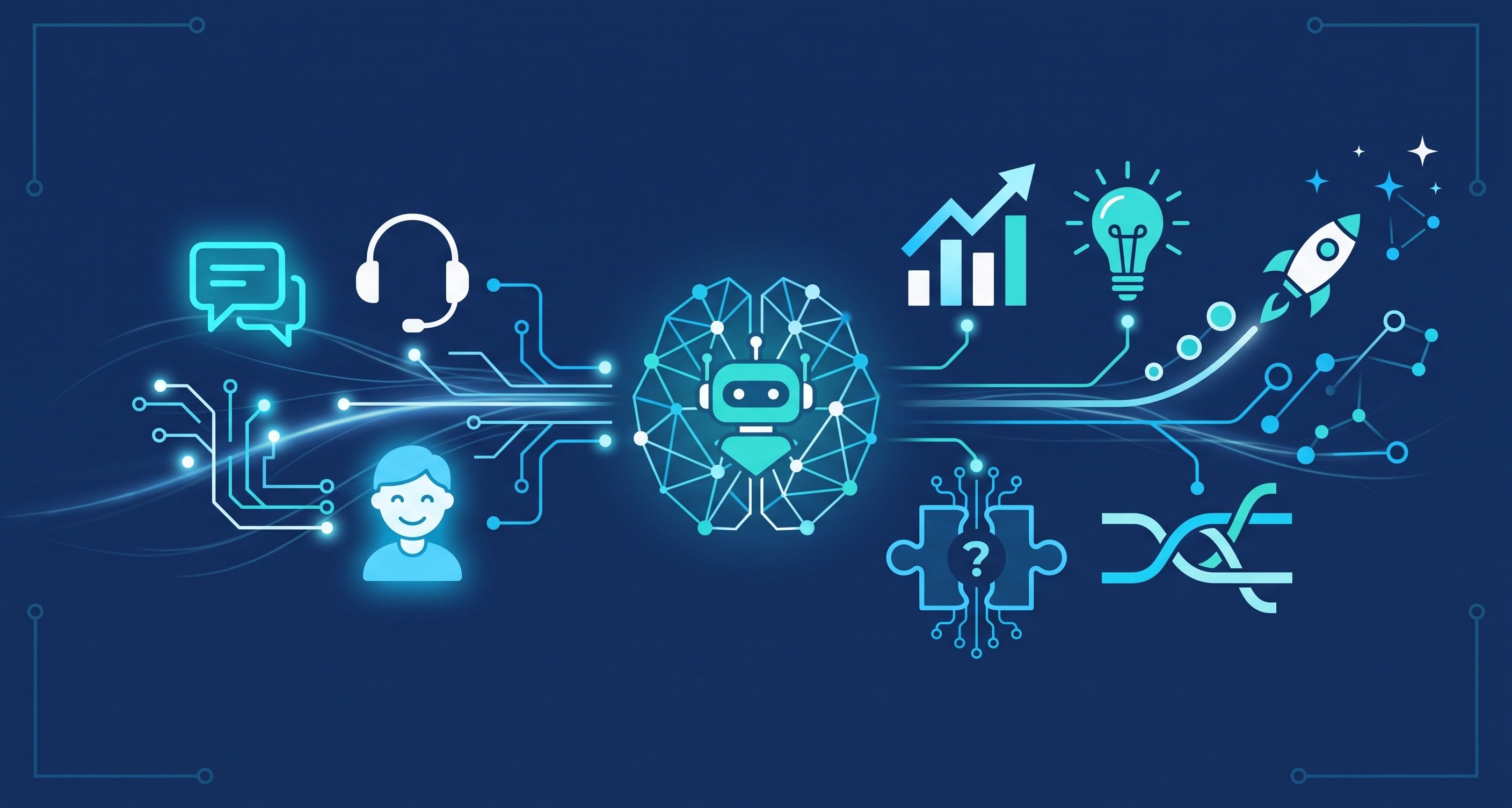

Customer expectations have shifted faster than most support teams can keep up with manually, this guide to AI for Customer Service: Benefits, Challenges, and Future Trends helps to distinguish between the facts and the generic hype about this subject. What businesses are choosing to do today is not whether or not to implement AI customer service solutions, but how to implement it. The real question is if that adoption is helping to get measurable results or if it's just another tool no one is fully utilizing.
In this guide, we'll explore what AI in customer service really offers, using real, measurable numbers instead of the vague promises that are common to all the content about this topic, and supported by research, as well as real challenges that companies must begin to plan for.
What is AI in Customer Service?
AI customer service is the application of natural language processing, machine learning and, increasingly, “agentic” AI to interpret what customers are saying and to help solve problems and assist human agents well beyond the basic scripted AI chatbot for customer service that made the category popular.
Modern systems are integrated with a CRM team to customize interactions, real-time sentiment analysis, and for agentic systems, to independently act such as finding a billing mistake, fixing it, and informing a customer without the need to contact an agent to handle the ticket. This is a significant advancement from the first generation of AI powered chatbots for customer service that were able to respond to a finite set of questions but couldn't reason through a new situation or provide action across multiple systems for a customer.
Benefits of AI in Customer Service
These benefits of AI in customer service are not hypothetical but real, according to a study conducted by the IBM Institute for Business Value that documents the performance of companies that have been using AI for customer service for a while, compared to those in the early stages of experimentation.
1. Higher Customer Satisfaction
Organizations that are either running AI in their CX or optimizing their customer service with AI achieve 17% higher customer satisfaction on average, thanks to improved, faster, and more personalized customer service. This gap just gets larger as time goes on, as the growing AI system continues to learn from each interaction, but the business that is still using static scripts and manual review does not.
2. Reduce Cost Per Contact (CPC)
Conversational AI directly engaging with external customers is associated with a 23.5% drop in cost per contact, as repetitive inquiries are addressed without taking time from the agent.
3. Measurable Revenue Impact
The same study reveals that conversational AI contributes to a 4% average growth in revenue every year, proof that AI customer service solutions affect the top line, not just in the customer service budget. This revenue benefit usually happens when the customer can be resolved faster to prevent churn or AI identifies an upsell or retention opportunity during a customer support conversation that otherwise a rushed human agent might overlook.
4. Higher Agent Satisfaction
Today's mature AI adopters say they have 15% higher human agent satisfaction scores as AI takes over repetitive tasks and brings up pertinent context, allowing agents to engage more with complex, higher-value interactions.
5. Proactive: not just reactive support
AI-powered customer service isn't just about solving problems after they happen, it's about solving them before they even occur, by picking up on early warning signs like changing sentiment, usage patterns, or recurring issues.
These are numbers for organizations that have an established AI in place, and not just a chatbot added to a support page. That is important to note for the challenges that follow.
The Obstacles Of Adopting AI In Customer Support
All of the above are genuine advantages provided that AI customer service is used in a proper manner. There are a number of common problems that will make or break that success, whatever the scale or type of business.
1. Data Quality and Integration
The data in the CRM, combined with past interactions, are what power AI customer service. Inconsistent, often inaccurate responses, result from the fragmented or incomplete data that undermines the personalization the technology should provide. That is why a true implementation project usually begins with a data audit, rather than a model selection decision; the model itself is not usually the problem; it's the data that was never properly connected that is.
2. Striking The Right Balance Of Automation And The Human Touch
Companies can fall into the trap of automating basic transactions and neglecting the more complex, emotionally charged ones. The best ones incorporate AI to manage high volume while prioritizing more complex and irritated customers to human agents as fast as possible, rather than the last resort.
3. Cost Or Implementation Timeline
You might have a huge initial investment when implementing an AI system, especially if it needs to be custom-built to integrate with current support infrastructure, and without carefully defining the use case for the AI system and quantifying its benefit.
4. Data Privacy And Trust
With hyper-personalization requiring businesses to use more behavioral data, as AI powered chatbots for customer service manage more sensitive account and payment details, it's crucial that there is transparency in data practices and clear customer consent.
The Future of AI in Customer Service
As the research indicates, there are some trends emerging as to where AI in customer service will head next and businesses with a multi-year customer support plan should use them as a guide and not as predictions since AI technology is already being rolled out in production at a rapid pace.
1. Agentic AI with Full Workflows
Instead of having these answers pre-programmed, agentic AI reads an account, figures out the correction, and communicates it to the customer without waiting to be prompted each step of the way. This is the most evident advancement from just an AI chatbot for customer service to an active one that can perform multiple tasks within internal systems, and not just provide a conversational response.
2. AI as a Real-Time Agent Copilot
Beyond its role as a customer-facing tool, Generative AI is now a partner to human agents, offering real-time suggestions for responses, summarization of previous interactions, and identifying follow-ups.
3. Hyper-Personalization at Scale
Future systems will respond to real-time sentiment and context from customers rather than simply past purchase information, a kind step up from the rule-based personalization of today.
4. Proactive, Predictive Support
How machine learning will be used to flag new problems before a customer even complains about unusual usage patterns, negative sentiment changes will make customer service from reactive to preventative.
Real-World Example in action: AI customer service infrastructure
The benefits outlined in this guide are highly dependent on the infrastructure that supports the customer facing AI system; this is evident in the way that Chirpn approached delivery.
Roar Sport: Customer-Facing Booking Support
Chirpn IT Solutions developed the sports venue booking system's API gateway, which seamlessly links the booking platform with venue and payment data in real time, making booking confirmations, availability checks and customer support queries immediate or instantaneous or seamless.
Peak booking times are simply when a venue platform is under the most stress when multiple customers are simultaneously seeking availability, making payments, and asking for support.
Exactly at that moment when customers needed a quick answer most, Roar Sport's own customer-facing interactions remained at an optimal speed thanks to reliable and real-time API performance. The same rule applies to all of the statistics in this guide. AI customer service solutions rely on the infrastructure that pushes real-time into them, from a booking application's API stack to a support application's CRM integration.
How AI/ML Development Services fit into this picture?
To make these benefits come to life, not yet another underused AI chatbot for customer service, but a proper integration with the existing CS and CRM processes requires AI/ML development.
Companies looking at a provider for this type of work should ask specifically how the provider addresses the challenge of data integration described above in this guide, and how they will deal with the human handoff points which can make automation seem impersonal.
How Chirpn Helps Businesses Adopt Ai Customer Service
Chirpn IT Solutions develops AI customer service solutions based on a real customer service process and system of a business, not a chatbot that is of one size fits all. Within 45-60 days, Chirpn delivers a system from requirements to production that is managed using AutoPATH, an AI-powered development framework, allowing the company to begin measuring the impact of real customer satisfaction in just one quarter.
Chirpn is a certified Google Cloud Partner with access to Google's enterprise-grade infrastructure, Vertex AI and Google Agent Assist, that don't come with an enterprise IT budget. The Roar Sport example given above shows that reliable infrastructure is what makes reliable customer-facing AI and support systems actually hold up under real usage, not just in a demo.
Conclusion
AI for customer service: benefits, challenges, and future trends comes down to all the data in this guide. The businesses that are reaping rewards are the ones that approach AI as infrastructure and use it wisely, rather than a chatbot they switch on and forget to maintain. While a 17% increase in customer satisfaction and a 23.5% decrease in cost per contact may seem like a given with AI, it isn't. It's a result of a mature, well-integrated implementation.
The future of AI in customer service is headed towards a more independent, more personalized and more proactive service. The companies who solve the data, integration, and handoff problems first will reap the benefits of that future, not wait for it to catch up with them. There's no reason to expect that gap to narrow by itself as more mature implementations compound their advantage with each interaction they learn from and as businesses start that further back with each passing year.
Frequently Asked Questions
What are the main benefits of AI in customer service?
Based on IBM Institute for Business Value research, the primary benefits are increased customer satisfaction (17% higher at the enterprise level of AI adoption), reduced cost per contact (23.5% lower at the enterprise level of AI adoption), measurable revenue impact (average 4% increase), and increased agent satisfaction (15% increase).
What are the major issues with AI for customer service?
Data quality, CRM integration, automation vs human interaction for more complex and sensitive interactions, initial investment cost and time for implementation, and data privacy and customer trust as AI systems access more personal information.
Is AI taking the place of human customer service agents?
No. AI is becoming a real-time partner to human agents, suggesting responses, summarizing interactions, and taking over repetitive tasks, instead of replacing them. According to IBM's research, organizations that integrate AI with human agents achieve increased levels of agent satisfaction, rather than job loss.
How is an AI chatbot for customer service different from AI with an agent?
A traditional AI chatbot for customer service is a scripted chatbot that responds to certain questions. Agentic AI reads a higher-level objective and autonomously handles the actions required to achieve it, analyzing data and taking actions across systems and only engaging the human when it's needed.
What is the timeframe and cost of AI Customer Service solutions?
The timelines depend on the scope and the project can be produced in weeks to a few months depending on the project scope and a good development partner (not from scratch).