




Gartner's July 2024 press release indicated that at least one-third of generative AI projects would be dropped by the end of 2025 after successfully piloting the technology; Gartner cited inadequate data quality, outdated risk controls, cost increases, and lack of business value as the major reasons for the project drop. That window is now closed and the release doesn't indicate that the number landed on 30% but the list of four reasons is the list of four reasons that cause many AI implementation projects to fail today. The next wave also showed a continuing trend.
June 2025, Gartner reported that over 40 per cent of agentic AI projects would be discontinued by the end of 2027, as the technology becomes more expensive and less beneficial to the business, and that most current agentic AI projects would be in the experiment and proof of concept (PoC) phase. (According to Reuters and Gartner, June 2025). The bad news in both predictions is that the causes are the same: They are predictable and predictable problems can be planned out of a project before it begins.
This guide about AI implementation failures why POCs don't scale addresses the question of specifically why enterprise AI proof of concept projects don't go to production at the pace people think, what the differences are between a pilot and a scaled implementation, and how to scope an implementation up front so that it doesn't fall into the “abandoned 30%” category.
Key Takeaways
- A major concern that is on the rise is poor data quality, the lack of a risk framework in GenAI initiatives and cost rises and business value uncertainty are cited as reasons for failure to succeed in projects (at least 30%, Gartner projection July 2024).
- The two are different in the following ways: clean demo data vs messy real data, a few users vs a lot of thousands, no need for governance vs real compliance audit.
- The most valuable lesson to take from a failure statistic such as Gartner's is that the reasons behind why AI projects fail are often one of a small number of specific, and correctable, failures in the process, not "fundamentally broken ideas".
- The right AI development company will not have the expectation that the gap between the pilot and the production would just materialize during the pilot stage if it’s a successful pilot, but instead, they will design the gap from the beginning.
What Are the Main Reasons for AI Proof of Concept in Enterprise to Fail to Scale?
Not only has the core AI functionality ceased to function, but there is a regular, identifiable list of why AI implementation projects don't scale from the pilot to production. The proof of concept has intentionally been designed with certain conditions that are intended to show that an idea can be realised: curated data, limited number of users, no burden on governance, no scaling requirement, if scaled, there is a requirement for the conditions to be replicated with the real data. The most prevalent reason for this abandoning pattern, Gartner explains, is skipping the retest, and to believe that a successful pilot automatically means successful rollout.
The data used by the pilot was “cleaner” than production data.
A proof-of-concept typically is constructed with a curated dataset specifically selected for it being clean and representative of the easy cases. The production data is dirtier because it contains duplicated records, missing fields because the prototype used by different teams working on the data did not share their prototypes, and the edge cases that didn't occur in the pilot but do in the messier data, and once that messier data arrives at the pilot and the AI ability doesn't perform as well.
2. The governance and compliance review was not included in the pilot.
In production rollout scenarios, where much of the data coming across the wires is real customer data, there are a number of components that are less likely to be included in the security review, audit trail, data-residency checks, etc. than in a pilot where the number of internal users is limited. Requirements discovered after the pilot has been declared a success translates to re-architecting work which should have been planned for as part of the project from the outset.
3. There is a business case, but it was assumed it was validated.
Many pilots are greenlighted based on the technology demo, but not because a business problem and a measurable business outcome was first defined. If the validation is not there, it's unclear to the decision-maker whether or not the investment in scaling up is warranted and that is what Gartner is referring to as "unclear business value.
4. There was underestimation of cost and infrastructure needs.
A pilot's infrastructure footprint is intended to be minimal. When taking a pilot to production, costs of compute and data-pipelines can grow by orders of magnitude, and it is not uncommon for a project to be stuck in the middle of deployment without finishing to completion.
5. The team that has constructed the pilot is not the team who owns production.
Pilots are typically built by a small specialist team, often a vendor, or an internal team who will hand it over to another team for production rollout. Institutional knowledge of why some things should be done goes astray, and it's a recurrent error, regardless of the type of AI model.
What is the difference between AI Proof of Concept and Production
| What Changes | Proof-of-Concept | Production |
| Data | Curated, cleaned sample | Full, messy real world data |
| Users | Small internal group | Complete customer base, frequently from outside |
| Governance | Minimal or none | Auditing, security review, compliance |
| Infrastructure | Small, often temporary | Designed to last for sustained load in real service |
| Ownership | Typically operated by a special crew team | Usually a whole other team, sometimes the same team |
Each line in this table represents a situation in which a project could get stuck if it has not been planned for, ahead of the pilot's beginning, but not after it has been labelled a success.
Generative AI Use Cases: Why Some Scale and Some Don't
The risk of slowdown after the POC with generative AI use cases tends to follow a similar pattern to the degree to which the gap described above was planned and implemented up front. A narrow focus internal tool like a document-summarization bot for one team is easier to move from pilot to production, since its data, users, and governance requirements aren't scaling as much. By comparison, a customer-facing generative AI feature typically has a much larger real customer data set, a much greater real compliance risk, and a much larger and more dynamic user base, which is why there is a disproportionate number of customer-facing GenAI initiatives in abandonment statistics such as Gartner's.
The takeaway: When considering generative AI use cases to pilot first, consider a project where the production environment isn't that different from the pilot environment. It is a stretch to say that a pilot requiring the "almost" complete redesign of itself to get into production was the wrong place to start in the first place.
Why the Gap between Pilot to Production Matters So Much?
The pilot-to-production gap outlined above is no technical footnote, but rather an ever-important component of how artificial intelligence in business is actually being adopted. The list of exposed projects expands as more departments, outside the IT realm, introduce their own AI pilots, ranging from customer support to finance to operations. Although the two scenarios seem completely different on the surface, both marketing and finance teams have the same set of questions about data-quality, governance, and ownership described above.
This is also one of the reasons why a universal AI approach is generally not as successful as a well-defined, repeatable process for each project. Businesses that go through the same fast-track checklist outlined in this guide for all pilots, regardless of department or use case, will experience a lower rate of abandoned-after-POC projects as the common pain points will be identified before the projects become costly.
How To Select an AI Implementation Partner That Plans For This?
The most telling indicator of a competent AI development company or AI consulting company is if they view the gap between pilot and production as a planning process to be addressed BEFORE the pilot is going, or a surprise to deal with after. When talking to a potential partner, specifically explain the difference between the scope of their proof of concept versus their production plan for the same project. If the answer given here is vague, it is one of the easiest indicators that production readiness hasn't been considered.
AI implementation consulting that just covers strategy and the build phase is handed over to a different vendor, there is the same potential for handoff failure as mentioned in point 5. A partner with true enterprise AI consulting won't vanish after the demo, but will remain involved from the pilot scoping phase to production deployment. When considering whether to hire AI developers in-house or seek outside expertise, consider if your internal team has already addressed the data-governance and infrastructure-scaling issues listed above in a previous project; if not, it's the kind of gaps AI implementation services from an experienced partner will fill.
Questions to Ask Before You Commit To a Pilot
There are some specific questions, asked before even a pilot starts, that hit most of the above points of failure. If the pilot has not been designed to test a specific business metric, then what is it testing? If there is a specific business metric being tested, then what threshold does it need to meet to be considered successful and thus scalable? You can ask whether the pilot's data is representative of the production data or if it was intentionally cleaner as this is one of the most frequent explanations for why results don't stick after production. If the project is still in a pilot phase, and you're not sure who is responsible for it, it's at that moment that you should decide, not after the handoff fails.
This Guide was developed using evidence from the following sources:
| Claim | Source | Date | Type | Verification |
| 30% of GenAI projects will be scrapped after POC by end of 2025.30% of GenAI projects will be cancelled after POC by end of 2025. |
| July 29, 2024 | Analyst prediction | Primary source read directly |
| By the end of 2027, more than 40% of Agentic AI initiatives will be abandoned. | Gartner press release | June 25, 2025 | Analyst prediction | The news agency Reuters and The Star independently verified this. |
| Chirpn's pilot to production approach is something to consider. | Chirpn AI/ML services | Current page
| Vendor-reported | Not independently validated |
Conclusion
Most enterprise AI pilots that fail are failures not due to the technology itself. They are destined to fail because the pilot was an idea in a production environment that doesn't get: clean data, a few users, no governance review, and a production team that won't be using it down the road. The list of generative AI agents and generative AI predictions from Gartner is consistent and helpful because the same few reasons are cited as the predictions for generative AI and agentic AI. In the case of known project breaks, a pilot can be planned around these points.
There are three habits that make all the difference. Before building, decide on the business metric and the scaling point. Test on data that is similar to production data, rather than a cleaned up sample. And determine who's responsible for the project from Pilot to Rollout – no knowledge lost in a handoff. If an AI proof of concept is a demo yet to be productionized then it is not a success.
Why Chirpn
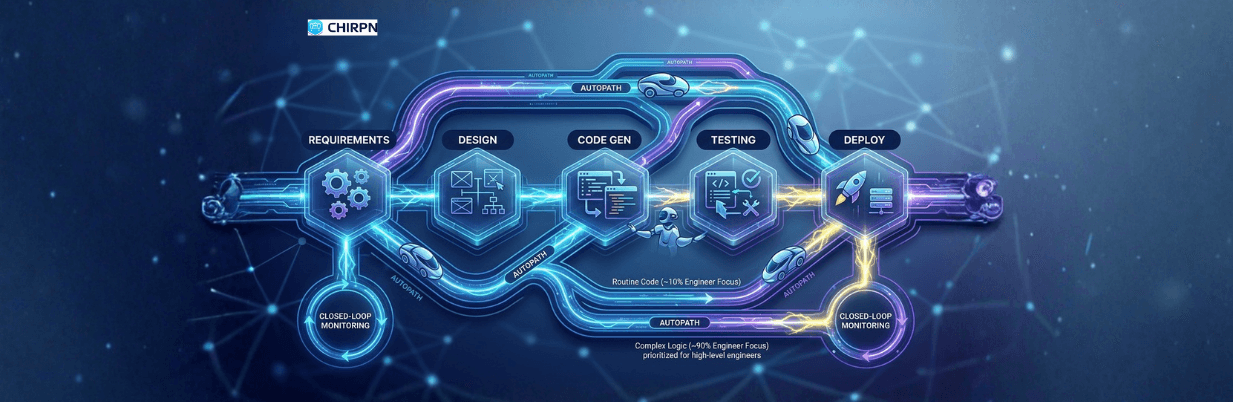
Chirpn's AI & ML development services combine AI Discovery & Strategy with the AI Product Development & Delivery process under one accountable engagement to prevent handoff failure, as the team who scopes the pilot becomes the team who brings the project to production instead of sending it to another team after the demo is successful. Chirpn's AutoPATH framework is focussed around validating scope and data readiness before committing to a build, targeting the points of failure that it directly addresses – the clean versus messy data, governance requirements, business case validation, and realistic infrastructure planning points above.
The above claims relating to Chirpn's process are vendor-reported, based on information published by Chirpn and consistent with the evidence standard used in this guide.
If you're weighing in on implementing AI and need a partner that is prepared to tackle the production gap from the beginning, discuss how it will address your specific project with Chirpn.
Frequently Asked Questions
What are the reasons behind the lack of production of AI proof-of-concepts?
The conditions that enabled the pilot to be successful do not easily translate to production most fall through because when they made the cut in the pilot the governance requirements were minimal, and most of the pilot participants were a small user group, and most of the pilot conditions are clean data. Poor data quality, insufficient risk management, cost growth and lack of business value are Gartner's own research as the top reasons for abandoned generative AI projects.
What's the difference between an AI consulting company and an AI implementation consulting partner?
AI consulting company focuses on AI strategy and use case prioritization, on the other hand AI implementation consulting covers the build and production rollout. The best arrangement is to have both under a single accountable partner, as that is another common cause of failure with the pilot to production handoff mentioned above.
What are some questions to consider before you hire AI developers for a production AI build?
Get specific responses about how they would bridge the gap between pilot and production circumstances, data quality, governance needs, scaling of infrastructure in advance of the pilot, rather than at the time of the pilot. One team which can respond in specific terms to your project and not in general industry terms is indicating genuine production experience.
How could you scope an AI proof-of-concept so that it's going to be scalable later?
Identify the pilot-to-production transition business metric you wish to validate and the threshold you believe would constitute a valid metric for scaling the project; test against data that is reasonably representative of production and not a "perfect" sample and determine in advance who is responsible for the project in the transition from pilot to production. If you can answer these questions before you begin projects will not fall into the 'abandoned after POC' category.