



The CEO of a logistics company has data from around the world. The CRM shows a 15 percentage point increase in customer churn but not the reason. The company invested in predictive analytics software, and six months later it sits unused. It cannot integrate with the back-office ERP, and the sales team trusts their own judgment over a recommendation from a model they cannot explain.
This is the pattern that defines most failed AI investments. It is not difficult to spend money on an AI development company. It is difficult to get a measurable return. The differentiator is not the technology, it is the approach.
Most businesses hire vendors to build an AI project. Effective leaders hire partners to build an AI-enabled business capability. A vendor delivers code. A partner delivers a system that integrates with existing operations, scales with the business, and produces a clear, defensible return.
Quick Takeaways: Your AI Partner Selection Checklist
A genuine strategic AI partner demonstrates all of the following before signing:
Deep integration expertise. Demonstrable knowledge of API, CRM, and ERP systems not only ML model development.
Business-first mindset. Focused on P&L, customer lifetime value, and operational chokepoints not just technical stack.
Mature MLOps strategy. A defined process for monitoring, drift detection, and retraining deployed models.
Verifiable vertical case studies. Named clients, specific problems solved, measurable outcomes not logos on a slide.
Data governance. Clear approach to GDPR, HIPAA, and sector-specific compliance from day one.
Cultural and communicative alignment. An engagement model built for C-level partnership, not just developer output.
Scalability mindset. Built for the three-year roadmap, not just the 90-day pilot.
Why AI Projects Fail at Scale
McKinsey's State of AI 2025 finds that while 78% of organisations now use AI in at least one business function, fewer than 10% have achieved enterprise-wide impact. The failure mode is consistent: companies select AI development partners based on technical credentials, familiarity with TensorFlow or Python, model benchmarks, demo performance when the decisive criterion is enterprise integration capability.
An ML model is inert without data. Enterprise data lives across dozens of disconnected systems CRM, ERP, supply chain management, marketing automation. A model that cannot pull from these systems, produce coherent insights from them, and push those insights back into the tools your team actually uses will not be adopted, regardless of its accuracy on a test dataset.
The gap is not a talent gap, it is a strategic gap. An algorithm-focused partner solves the modelling problem. A business-first partner solves the transformation problem.
5 Pillars of a Strategic AI Partnership
1. Deep Enterprise Integration Expertise
A genuine enterprise AI partner examines your API documentation and integration architecture before discussing model selection. They have traceable expertise in the enterprise platforms your business actually runs: Salesforce, Microsoft Dynamics, SAP, NetSuite and they design for data flow from the start, not as an afterthought.
If the partner cannot describe, specifically, how they connected an ML model to a legacy system on a previous engagement, what the integration challenges were, how they resolved them, and what the production data flow looks like they have not solved this problem before and will solve it on your project at your expense.
2. A Business-Outcome, Not Technical-Output, Mindset
The distinction between a vendor and a partner is most visible in the questions they ask before proposing a solution.
Vendor questions: "What is your data format?" "Which cloud platform do you prefer?" "What is your development budget?"
Partner questions: "What is your current customer acquisition cost?" "Which business KPI are you trying to move?" "What is the operational bottleneck this system must resolve?"
The business-first partner begins with a specific, measurable business goal and works backward to the technical architecture. This guarantees the solution is built for a purpose and that the partner will be accountable to a business outcome, not a model performance score.
3. A Mature MLOps Strategy
Building an ML model is approximately 20% of the work. Keeping it accurate and valuable in production MLOps is the remaining 80%. Ask every candidate partner to walk you through their MLOps pipeline. A credible answer covers four specific components:
- Monitoring: Live tracking of model performance against production data
- Drift detection: Automated identification of when input distributions have shifted enough to degrade model accuracy
- Retraining: A defined, automated process for updating the model on new data without manual intervention per cycle
- Governance: Model versioning and data lineage documentation for audit and compliance
A partner who cannot describe this process has not built production ML systems that are still performing 18 months after go-live.
4. Robust Data Governance and Compliance
Engaging an AI development partner means giving them access to your business data potentially including customer records, financial data, health information, or operational IP. A partner operating at enterprise scale should have ISO 27001 or SOC 2 certification, a clear data handling policy for third-party AI providers, and sector-specific compliance expertise for your industry (HIPAA for healthcare, FINRA for financial services, GDPR for European data subjects).
If the partner raises compliance as an issue only after you raise it, their enterprise maturity is limited to the depth of your question.
5. A Scalable, Consultative Engagement Model
The right partner provides not just engineers but a delivery team, solution architects, business analysts, integration specialists, and an engagement manager who can operate as a strategic advisor at the C-suite level. Ask specifically about the team structure on your engagement: who is the day-to-day technical lead, who is the strategic contact, and who handles change management with your internal teams during and after deployment.
Your 5-Step Framework for Vetting an AI Development Partner
Step 1 Define your "why": Before issuing an RFP, articulate the business challenge in one sentence with a measurable success criterion. "Reduce customer churn from 15% to 8% within 12 months of deployment" is a business goal. "Build a churn prediction model" is a technical specification. Partners respond very differently to each.
Step 2 The strategic interview (10 questions that matter): The questions below are designed to distinguish genuine production capability from demo-stage experience. Ask all ten; listen for specifics, not generalities.
- Walk me through a case where your client's data was dirty or incomplete. What specifically did you do to address it?
- How do you measure the business ROI of this engagement not model accuracy, but the business metric you were hired to move?
- Describe your MLOps pipeline. How do you detect and respond to model drift post-deployment?
- Give me an example of integrating an ML model into a legacy CRM or ERP. What were the specific integration challenges?
- What is your approach to data privacy and industry-specific compliance for our sector?
- How do you handle user adoption and change management when deploying AI into a team with existing workflows?
- Who is on the team assigned to our engagement, and what is my strategic point of contact?
- How do you decide between a custom model and a pre-built API and what are the trade-offs for our specific use case?
- Which parts of our business process do you recommend we do not automate with AI?
- How are you preparing for agentic AI architectures, and how does that affect our three-year roadmap?
Step 3 The technical deep-dive: Your VP of Engineering or CTO should sit with the partner's solution architects to review data flow, API endpoints, cloud infrastructure design, and MLOps tooling. If the partner cannot conduct a detailed technical conversation at this level, they are not an enterprise-class delivery partner.
Step 4 Run a paid Proof of Concept: Never commit to a multi-year, multi-hundred-thousand-dollar engagement without a scoped PoC (4–6 weeks). This tests communication, problem-solving, integration capability, and team chemistry on a narrow, well-defined problem using real data.
Step 5 Review the Master Services Agreement: Confirm IP ownership (all code and model weights should transfer to you), data governance terms, and the conditions under which you can scale the team up or down. An MSA that does not give you full IP ownership at completion creates a long-term dependency.
Quantifying the Force Multiplier: Measuring AI ROI
The question every board asks is: what is the return? The table below illustrates the business-impact delta from strategic AI partnerships across common enterprise use cases. These are illustrative benchmarks your partner should help you build a version of this table specific to your business before any contract is signed.
| Metric | Before (Manual Process) | After (Strategic AI Partnership) |
| Operational efficiency | 30 hours/week on manual data entry for sales reports | 2 hours/week 93% reduction in manual work |
| Cost reduction | $1.2M annually in inventory deadstock due to poor forecasting | $300K in deadstock $900K annual saving |
| Revenue generation | 15% customer churn; 5-day lead response time | 8% churn; under 1-hour lead response. 7% retention lift, 40% sales velocity increase |
| Strategic value | 0% of management time on long-term strategy | 15% of management time reallocated from reactive firefighting to strategic growth |
When measuring AI ROI, include the full value equation: cost of the engagement, cost of the internal time invested, value of time saved in production, revenue unlocked by improved decisions, and risk avoided through better fraud detection or compliance monitoring. The partners that produce the results in the table above are the ones who agree to be measured against these metrics before the project begins.
How Chirpn Approaches This Selection
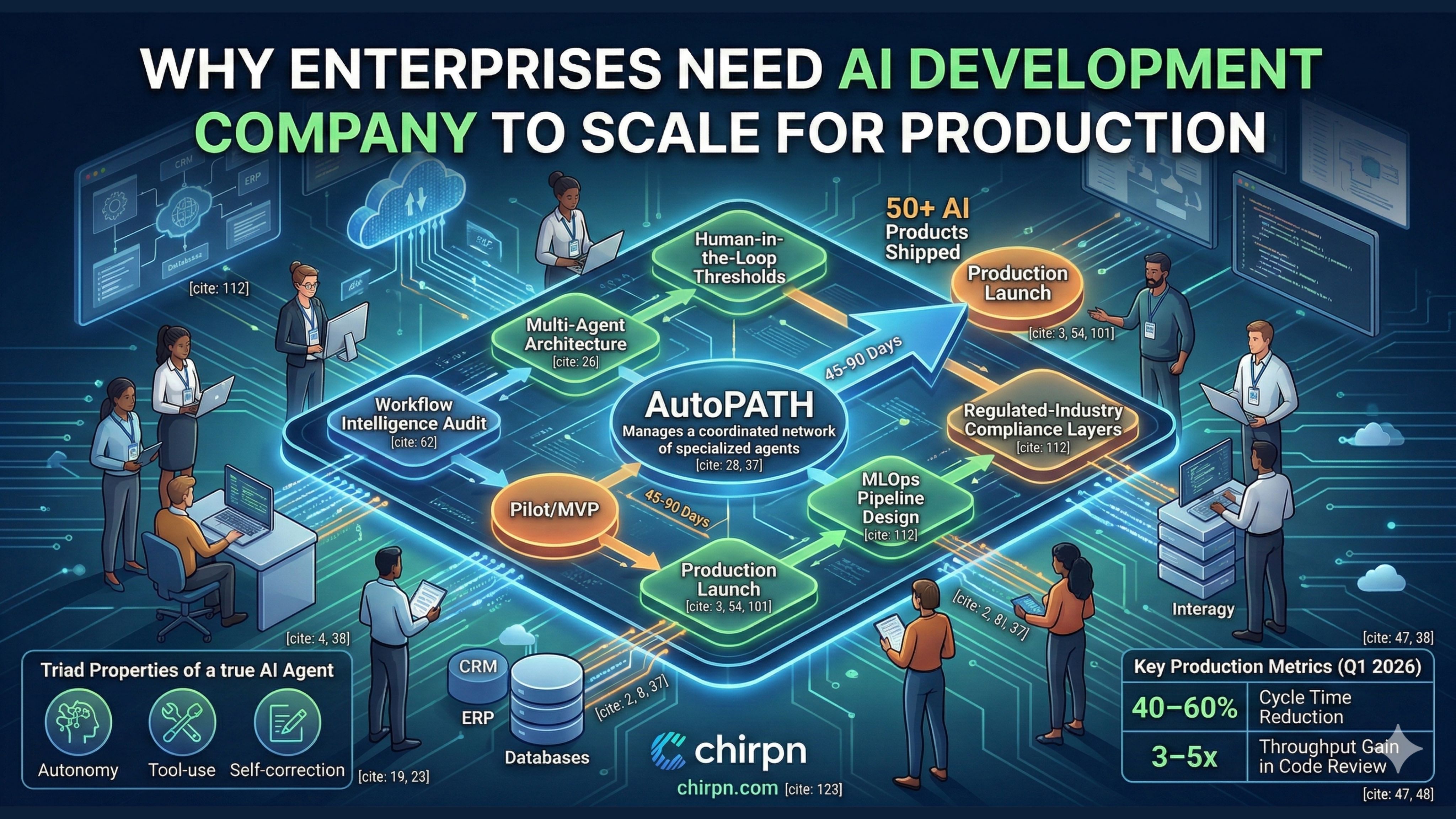
Chirpn is building production AI systems. AutoPATH runs requirements, integration design, model development, QA, and deployment as parallel, AI-coordinated workstreams which is how production systems ship in 45–60 days. The Core-Flex post-launch model provides ongoing monitoring, drift detection, and retraining. Capacity PODs deploy senior dedicated teams, solution architects, ML engineers, data engineers, integration specialists with domain expertise from day one.
Ready to scope your AI partnership? chirpn.com/contact-us/
Frequently Asked Questions
What is the difference between an AI development company and a data science consultancy?
A data science consultancy analyses your data and delivers strategic insights typically a report or a standalone model. An AI development company is an engineering and integration partner: they build and deploy scalable AI systems that connect directly to your business processes, and they maintain those systems post-launch through MLOps. The critical difference is what happens after the model is trained.
How much do custom AI development services typically cost?
A focused Proof of Concept one use case, real data, defined acceptance criteria typically costs in the range of $30,000–$80,000. A full production system with enterprise integrations, MLOps pipeline, and post-launch monitoring typically ranges from $150,000 to $500,000+, depending on integration complexity and compliance requirements. The right partner is transparent about cost structure before the engagement begins and aligns their commercial terms to delivery milestones.
What should I look for when evaluating AI developers?
Beyond Python and TensorFlow familiarity, look for full-stack AI capability: data engineering (building and managing data pipelines), API integration (connecting models to business systems), cloud architecture (designing on Vertex AI, AWS SageMaker, or Azure ML), and business logic (translating model outputs into decisions that change a business metric). The most common hiring mistake is selecting for model-building skill when the project primarily requires integration skill.
Why is enterprise AI integration so critical for ROI?
An AI model is only as useful as the data it can access and the systems it can inform. Enterprise data lives across disconnected CRM, ERP, supply chain, and marketing systems. A model that cannot pull from these systems in real time and push its output back into the tools your team uses will not be adopted. Non-adoption is the most common reason AI investments fail to produce ROI not model accuracy.
How do I find the right AI development partner for my industry?
Ask for named, detailed case studies within your vertical not logo lists. Ask specifically how the partner addressed industry-specific regulatory requirements (HIPAA for healthcare, FINRA for financial services, FERPA for education) in prior engagements. A partner with genuine vertical experience can describe the specific compliance constraints they designed around, the data governance decisions they made, and the outcome they delivered. Generic answers are the tell.