



A survey of 56 leaders of AI initiatives at U.S. retailers released by the National Retail Federation (NRF) found that 77% spent 5% or less of their total technology spending on AI. How AI Is transforming the retail industry is not a story about lagging interest as 39% of the retailers surveyed will allocate more than 10% of their tech budgets to AI within three years, yet it's not a story of lagging interest; it's a story of growth. It is a tale of budgets and execution, and of ambition finally being met, across all corners of the AI in retail industry right now.
In fact, a 2026 McKinsey study found that many retailers are "still working on scaling up AI to achieve a tangible financial return," and that there is increasing disconnect between intent and impact. This guide explains what the verified data actually reveals about the use of AI in retail industry today: where AI in shopping is proving effective, where the budget/ambition divide is evident, and what's next.
What AI in retail Actually Mean
From product recommendations and pricing to inventory management and in-store security, artificial intelligence in retail has a wide variety of applications in the retail industry. Artificial intelligence in retail extends beyond just e-commerce, playing a crucial role in the retail environment as well. AI retail solutions are becoming more and more integrated with both predictive machine learning and generative AI, the latter utilizing predictive machine learning to predict future demand and the latter for conversational shopping solutions and content for marketing.
This is important to note, because retailers are not selecting between these two types of AI. The best AI retail stores have both predictive and generative features, such as a recommendation engine that knows what a person likes to buy based on their past purchase patterns, and a virtual assistant capable of answering a shopper's question in a natural language response. Whether someone is online or in a store, this combination is what AI in shopping is evolving into more and more in the real world.
Where AI For Retail Is Already Working
These are just documented, current, real-world examples of how AI and retail are collaborating, and not a glimpse into the future.
1. Personalization and Product Recommendations
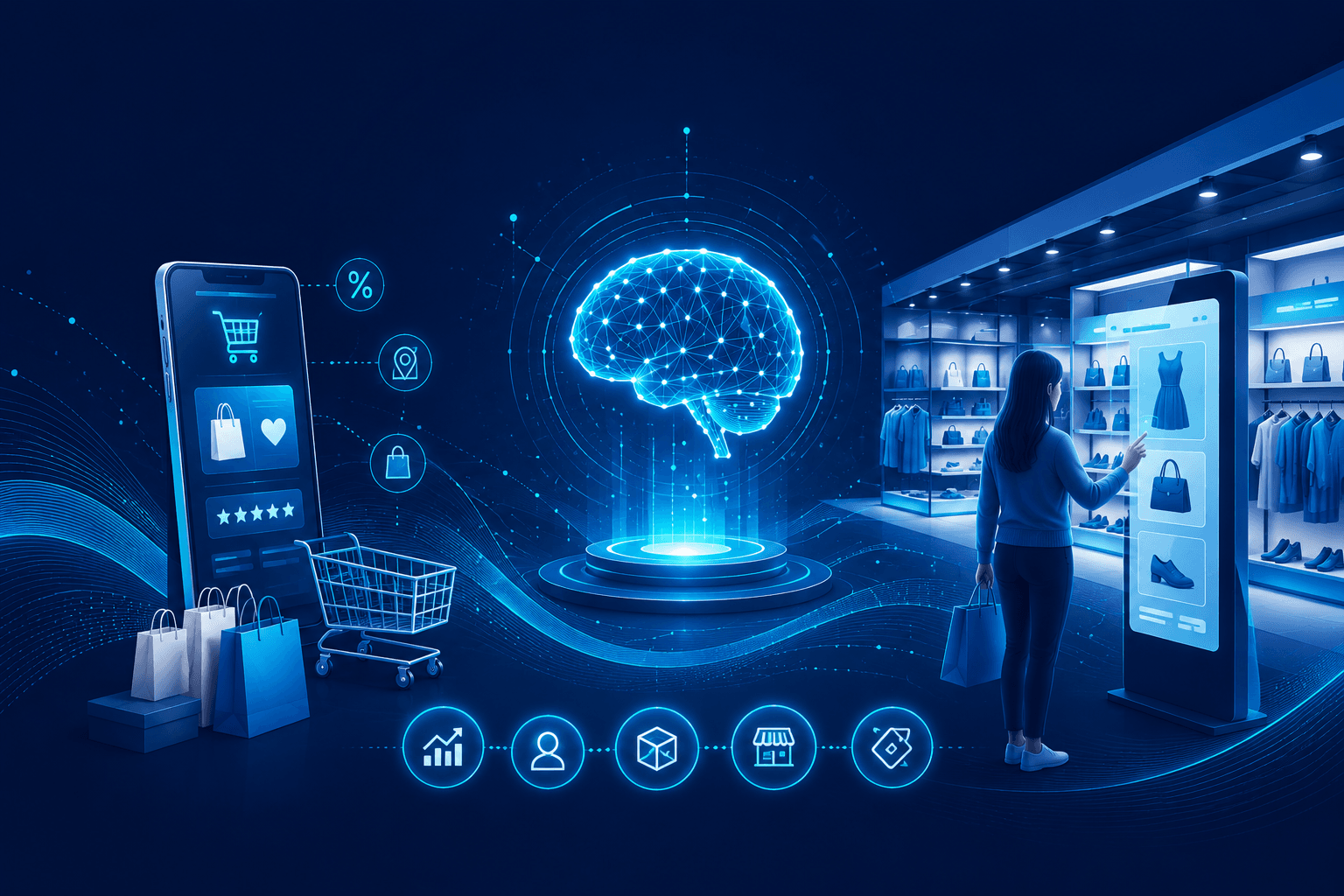
Recommendation engines and personalized promotions are so far the biggest and most developed category of retail AI, deciding which products the shopper sees first, whether at home on the internet or and this is quite new on a kiosk on the street in the shop.
2. Marketing content and campaign efficiency
The case of their use in retail marketing campaigns is among the few use cases with a number directly attached to it, in terms of impact, which is even more concrete than the few other retail use cases cited.In the realm of retail, the impact of generative AI copilots is one of the few use cases where the number actually means something specifically about cutting agency spend by approximately 15% and improving conversion by as much as 40%, according to McKinsey's retail research.
3. Inventory and Demand Forecasting
Predictive models based on sales history, seasonality, and market signals are being used to eliminate the days of manually forecasting products that are either short in stock or overstocked, adding up to the value of the retail margin a use case that grows with each day a model has real sales data to learn from.
4. Loss Prevention and Fraud Detection
As organized retail crime has embraced technologies themselves, AI-driven pattern detection is becoming more popular to flag unusual transaction or inventory-shrinkage patterns in real time, providing a reduction in a cost center that has become more complex in retail.
The Verified Data Behind AI in Retail Industry
| Finding | Source |
| The use of Gen AI marketing copilots reduces agency spend by approximately 15% and increases conversion by up to 40%. | “Rewiring Retail in Europe: The AI Imperative,” by McKinsey.
|
| 77% of retailers spend 5% or less of their technology budget on AI, while 39% think that it will account for more than 10% of tech spend within the next three years. | NRF Center for Digital Risk & Innovation survey of 56 U.S. retail AI leaders, 2025 |
| 86% of retailers already have AI governance policies in place | NRF Center for Digital Risk & Innovation, 2025 |
| 72% of customers still shop in physical stores, 41% of consumers use AI assistants for product research, 33% for product reviews and 31% for product deals. | According to a survey of 18,000 consumers around the world conducted by NRF and IBM, January 2026. |
The data from NRF and IBM's research, which surveyed 18,000 consumers worldwide, reveals a certain narrative: AI has become a far more integral part of the shopping experience than it has yet become the replacement for in-store visits for most consumers, even if it is helping them when they begin their research, compare products or hunt for a great deal.
The Retail AI Budget-Ambition Gap
This consistent trend is seen in all the statistics in this guide. NRF's survey revealed that 77% of retailers are spending 5% or less of their tech budgets on AI, and 86% already have in place formal AI governance policies showing that most retailers are investing responsibly in AI at scale, before their budgets have reached that level.
It's a story that's different from a straight adoption headline. Retailers aren't shunning AI, but they're carefully managing its use while investment continues to creep up, and that's a trend that McKinley discovered in its report: While financial impact is easier to create in its initial use, it is difficult to scale. A retailer with governance that doesn't have a large budget is not late; McKinsey's research indicates that most retailers in the industry are still in the middle of a sequence.
Retail AI challenges Still Need to Be Taken Care Of
Budget Allocation Lagging Strategic Intent
According to this report, the current primary hurdle to adopting AI in retail stores is frequently resourcing, not technical feasibility or leadership commitment, as 77% of retailers are spending 5% or less of their tech budgets on the AI.
Governance Without Full Deployment.
86% of retailers already have an AI governance policy in place, and that's a pretty high bar to set but governance that is in place before you scale AI systems up into your day-to-day retail business must be reviewed as you progress.
Bridging Online Research to In-Store Purchase
As AI plays a growing role in pre-purchase research (41% of consumers), 72% of purchases are still made in stores, an AI retail system presents a unique integration challenge for retail stores: bridging the gap between the AI in the research process with the AI in retail stores experience.
The Future of AI in retail
With verified data presented in this guide, several trends are emerging as to where AI and retail are going next.
The scaling up of budgets to governance
As 39% of retailers predict AI will account for more than 10% of tech budgets in three years, and governance policies are already being adopted, it's likely that the next few years will see retailers start to invest in AI as they have long wanted.
Agentic Commerce Emerging
AI assistants are doing more and more product research, comparison and deal-hunting on behalf of the shopper, which means that the shopping process is happening earlier – now more of a purchase decision is being made before a shopper even gets to checkout, which means the AI shopping strategy has to account for that.
Deeper Integration Between Digital Shopping and Physical Retail
With 72% of purchases still occurring in-store, the ones getting the most value will be the ones who leverage AI-driven online discovery to actually deliver it offline, rather than using them as two separate initiatives.
Where AI/ML Development Services Fit Into Retail AI Solutions
In practice, the most common way to bridge the gap between retail AI vision and tangible outcomes is for a retailer to harness AI/ML development capabilities that integrate seamlessly with the SOP, inventory and CRM systems in use rather than outstanding AI or ML tools that are not connected to the retail processes it was designed to enhance.
When companies are considering a partner to supply AI for retail, they should directly question the provider about integration capabilities with existing retail systems and the provider's ability to maintain accurate model performance following the launch, two things that are most likely to differentiate a viable AI retail solutions from a pilot project that will never go to production.
How Chirpn Can Help Retail and Commerce AI Projects?
At Chirpn IT Solutions, we construct AI-powered systems that are built around a specific business goal and metric. Even though Roar Sport is a sports venue booking platform and not a traditional retailer, Chirpn built the API gateway that connects Roar Sport's real-time availability with payment processing, the same consumer-facing transaction infrastructure that powers retail checkout and inventory systems.
Chirpn's AI-driven development framework, AutoPATH, helps Chirpn transform a project from requirements to a production-ready system in 45-60 days. Chirpn is a certified Google Cloud Partner, with access to Google Cloud Vertex AI and Google Agent Assist, that brings production-grade AI infrastructure to retail and commerce projects that demand to integrate seamlessly with existing operational systems, rather than be a standalone pilot.
Conclusion
How AI Is Transforming the Retail Industry comes down to the gap between ambition and budget is clearly defined by the verified data: 77% of retailers spend 5% or less of their tech budgets on AI, yet 39% anticipate this budget to increase by more than double in three years, and McKinsey's own research indicates there's a growing chasm between adoption and tangible financial results on a large scale.
Those who are closing that gap intentionally investing in their budgets to align with their governance and strategic plans are the retailers most likely to benefit from how AI is changing the retail industry and specifically, how it opens the door to discovery and translates to in-store experience where most sales continue to be made. It's this alignment, rather than any one AI tool, that will set these AI leaders apart from others in retail over the next few years.
Frequently Asked Questions
How is AI transforming the retail industry today?
According to McKinsey, the biggest impact of AI in retail is its use in marketing and personalization: AI copilots have enabled retailers to reduce agency spend by about 15% and boost conversion by up to 40%. It's also increasingly utilized for stock prediction, loss prevention, and shopper-facing product research, with 41% of consumers already utilizing AI assistants for product research prior to purchase.
What is the actual cost of AI to retailers?
Most retailers are playing it safe: NRF's survey of retail AI leaders shows that 77 percent are spending 5% or less of technology budgets on AI. The proportion of respondents who say that AI will consume over 10% of tech spend in the next three years, however, is 39%, a large planned increase.
Will AI be a substitute for in-store shopping?
Despite the rise of AI-powered research at an earlier stage of the purchasing process, 72% of consumers are still buying in brick-and-mortar stores, according to No. NRF and IBM's research. Where consumers are now going to buy is less significant than where they are going to look for products, in this case, AI.
What are the major challenges retailers are encountering with the implementation of AI?
The biggest challenges are budget allocation being behind strategic ambition (most retailers are spending less than 5% of their tech budgets on AI), governance that needs to catch up with increased scale of deployment beyond “pils” and the lack of connection between AI-driven online research and the in-store experience where most purchases still take place.
How does a retailer select a partner for implementing AI?
Specifically ask them about their experience in integrating with your existing point of sale, inventory and CRM systems, and how they intend to keep the model accurate after launch. The partner that can only talk about a stand-alone AI system, rather than how it is going to be integrated and utilized during the normal course of retail operations is talking about a pilot, not a production system.