



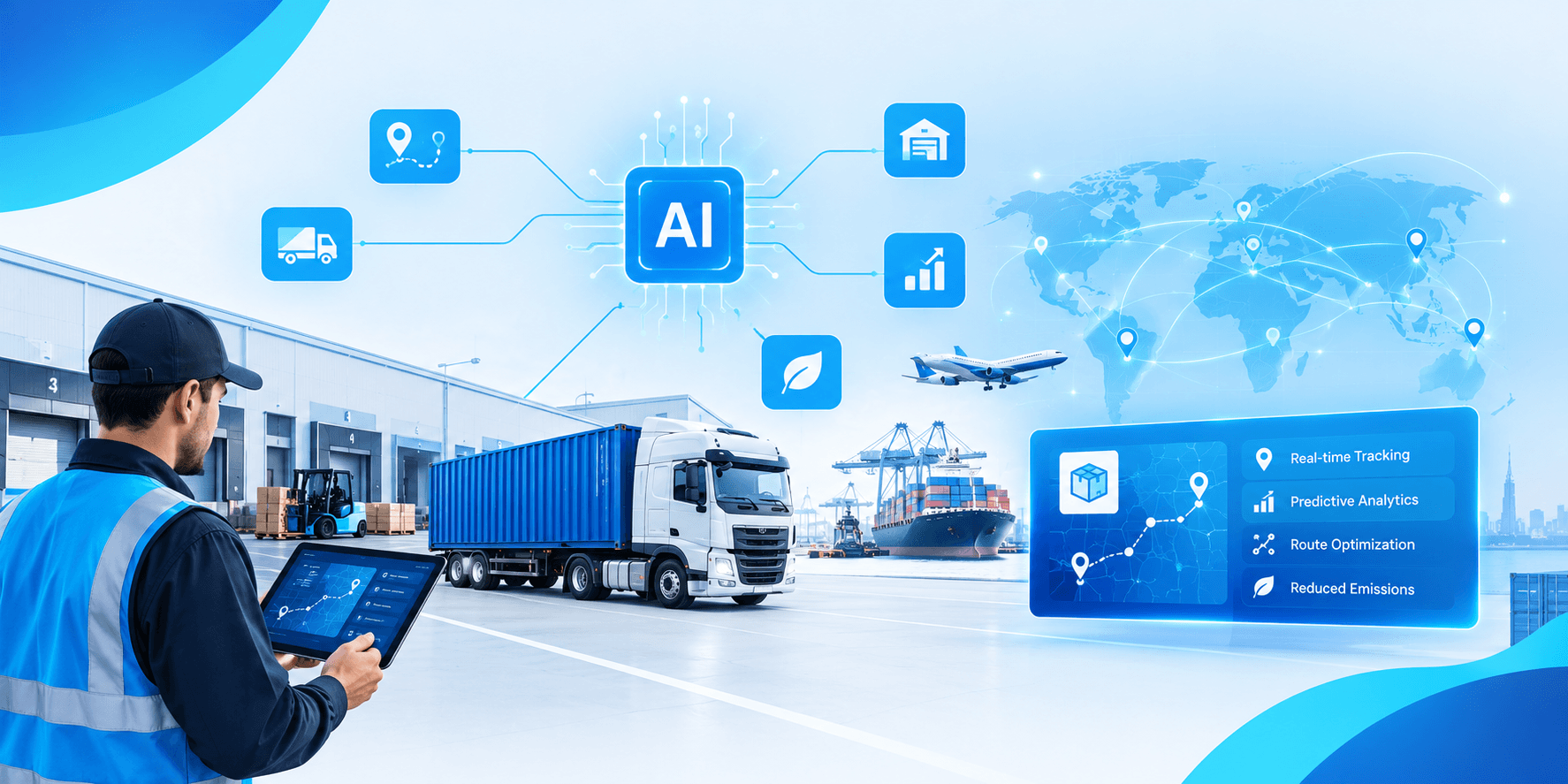

For decades, the freight sector has been incurring billions of dollars in lost profits due to an inefficient routing system, which is commonly called the 30% empty average US truck. artificial intelligence in logistics didn't solve that with the speed of trucks. It solved that by making routing decisions smarter, based on algorithms that recognize patterns that a freight network dispatcher could not see by hand. Today, AI in logistics is no longer being tried but implemented, with each use case from route optimization to warehousing and demand forecasting yielding tangible benefits, not anticipated.
It discusses the actual impact of AI in supply chain and logistics operations, from routing to warehousing, forecasting to risk detection, and explores the remaining roadblocks to real-world adoption.
Key Takeaways
- The algorithmic routing feature on Uber Freight reduced empty truck miles by approximately 30% to 10–15%.
- Once the ORION system is implemented, it is expected to reduce 100 million miles of driving annually for UPS, which will equate to a reduction of 100,000 metric tons of greenhouse gas emissions.
- According to peer-reviewed research published in MDPI's Logistics journal, machine learning in logistics and inventory management can help to achieve a 15% increase in demand forecasting accuracy, 12% lead time efficiency, and 10% reduction in overstock and stockouts.
- Logistics teams cite data integration between legacy systems, rather than model accuracy, as their top adoption challenge.
What are the key applications of AI in logistics?
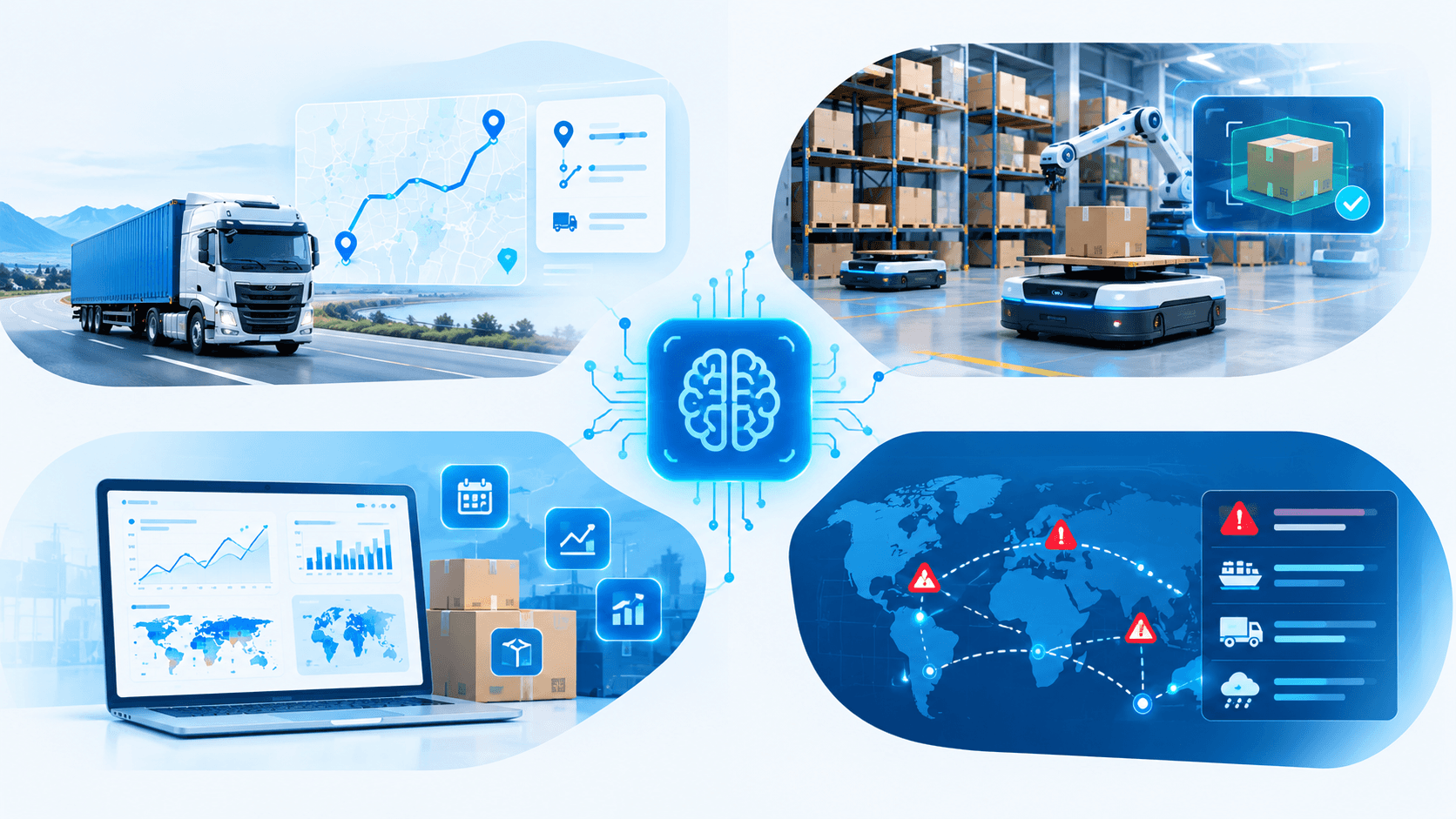
In reality, AI logistics solutions fall into four distinct categories, each addressing a different operational pain point, and all of which are already in production use. Each of these use cases must be understood individually to be able to determine the value that AI supply chain solutions can bring to a particular operation.
Route optimization is the most mature use case. Uber Freight's algorithmic pricing of carriers eliminates pricing guesswork by leveraging hundreds of parameters, and its routing capabilities have cut empty miles by 30% down to 10 – 15% of all freight movements. UPS' ORION system is a similar program albeit on a far larger scale: once fully realized, it is estimated it will save 100 million miles a year off the network and eliminate 100,000 metric tons of greenhouse gas emissions.
Warehouse Automation where AI logistics solutions go beyond the digital realm and into the physical world. Amazon has installed over 750,000 robots in its fulfillment centers to pick, sort, and move inventory on its own, far more than any human could do in the same time. Now computer vision systems ensure picking accuracy, as errors are caught before they are turned into shipping mistakes, but after a customer complains.
Demand Forecasting is the least noticeable of the four, yet it is also the highest leverage. The cost and inventory reductions described in the next section are based on machine learning models that rely on actual purchasing data, rather than simple reorder-point formulas that are based on the assumption that next month is just like last month.
Risk detection complements the list: predictive models search for predictive signals of a disruption in your supply chain, a delayed port shipment, a supplier slowdown, an unusual demand spike and alert the operations team days before a stock out or the loss of a delivery window.
The answer depends on the exact point of failure in the operation - a logistics business with a losing operation of empty miles will require route optimization rather than warehouse robots, and vice versa.
How AI in Supply Chain Management helps lower costs?
Research published in the peer-reviewed Logistics journal showed that machine learning for logistics and inventory management boosted demand forecast accuracy by 15% and lowered the ratio of overstocking and out-of-stock by 10%, measured by optimization results, not based on vendor estimates. The same study reported a 12% increase in efficiency of lead time and an 8% decrease in replenishment errors. The combination of these elements is more important than any single number, a better forecast reduces stockouts and allows a business to carry smaller inventories, with less risk of running out of stock.
The mechanics are easy to understand even though the math isn't. The assumption of a traditional reorder-point system is that next month is similar to last month, and orders are placed accordingly; until a seasonal change, promotion or disruption in the market occurs, this is fine. A machine learning forecasting model combines current demand signals, seasonality and history's accuracy into a single model to constantly adjust its forecast instead of waiting for a human to realize that the pattern has shifted.
A forecasting-accuracy improvement is a lesser call than a hard cost number? Yes sort of, and more truthfully. The underlying figure of forecast accuracy is where the cost savings and lower inventories happen it is the number that deserves more credence than a headline savings figure lacking any apparent methodology.
What is the difference between traditional AI vs. Generative AI vs. Operations Research?
Logistics teams considering AI logistics solutions are actually deciding on three types of analyses to choose from and using them interchangeably results in selecting the wrong tool for the job.
- Traditional AI / machine learning models, based on historical data, which excel at pattern recognition, such as predicting demand or detecting fraud.
- Generative AI - Large Language Models (LLMs) capable of summarizing disruptions in shipment reports, composing customer messages, or answering natural language questions to logistics information.
- Operations research - When dealing with clearly defined and constrained problems, like route planning and network design, operations research classical optimization science still outperforms AI.
According to the research by MIT Sloan, the managerial upside to machine learning models is that they extrapolate their learning beyond the data they were trained on and automatically adapt to new cases without the need for a human to rewrite the rules each time. A definite plus over the static operations-research models, it does not make OR redundant. The best deployments of AI in logistics combine the two: the operation research is used to solve the well-defined optimization problem, and the machine learning is used to solve the messy, less-formalizable parts around the problem.
What is the role of Generative AI in logistics?
Generative AI in logistics is focused right now primarily on documentation, communication and data queries. The ability to generate a plain-language alert from a disrupted-shipment report or to compose a customer notification of a delayed delivery might be accomplished using a LLM. An operations manager could also send a natural language question to a live logistics data source, rather than writing a database query.
It's a less broad use of generative AI than the routing and forecasting that traditional machine learning does, and that's because generative AI is about language and synthesis, not the narrow type of optimization math that the actual routing and forecasting jobs are all about. It's adding value to a traditional ML forecasting system to put a generative AI interface on top of it rather than relying on a language model for route planning.
Where generative AI really has value is in how it can save a human the time it takes to transform raw operational data into something a human can act upon, such as a dispatcher scanning 10 disrupted shipments for the one that needs to be escalated. It's a real productivity boost that may not be as impressive as a truly independent supply chain, but that's a good one all the same.
What is Blocking Wider Adoption of AI in Logistics?
While AI for logistics is still far beyond the proof-of-concept phase, adoption is not consistent. According to research cited in ShipBob's 2025 logistics market analysis, only about 35% of businesses have implemented some level of AI, which suggests that most logistics processes are still current - and it has nothing to do with the technology! There are always three barriers that appear:
- Siloed system integration to data. Warehouse management, transportation management, and ERP systems don't always communicate cleanly, so an AI model is left with an incomplete view of the network.
- Data quality issues. The accuracy of a forecasting model depends on the quality of the data being fed into it and logistics data tends to be dirty and requires many manual corrections, inconsistent formats, etc.
- Up-front cost and unknown ROI timeline. Investment in AI logistics solutions must precede returns, making it difficult to secure budgetary approval in an industry with narrow profit margins.
None of these are model-capability. It's an infrastructure and data-governance issue that emerges before the AI layer can even deliver a proof-of-concept, which is why it's not the model that takes the most time in the logistics operations that work well with AI; it's the data architecture.
There is another barrier, albeit not as widely talked about, that is organizational resistance from teams that have seen other “optimization” tools under deliver: A dispatcher who has experienced a routing tool that failed to take real-world considerations into account will not readily trust the next one, regardless of the fact that the model might be superior. Typically, one has to begin with a small, obviously successful pilot before earning that trust back, but that's a longer road to follow and a more enduring journey.
How Chirpn Brings Change with AI in Logistics
Like many companies, the challenge of fragmented operational data is often the first hurdle in the path to AI logistics solutions. Chirpn personally experienced this in the case of a rice manufacturing and export company named rice exporter in India, whose stock, logistics, and documentation were spread out in various tools and spreadsheets. Chirpn developed an integrated digital platform powered by its AI-led delivery framework, AutoPATH, which includes real-time inventory management, a logistics module at the gate for inbound and outbound deliveries, centralized procurement management and AI recommendations for blending. This gave them a complete visibility across their supply chain from raw material receiving to the final dispatch.
Before route optimization or demand forecasting can make a meaningful impact in any AI in a logistics program, that's the foundation every program must have. Today, if your supply chain data is scattered across disjointed systems, reach out to Chirpn regarding our AI & ML development team's supply chain data architecture approach – starting from the entire case study about how AI worked for rice exporter.
Frequently Asked Questions
What are the key applications of AI in logistics?
The four areas most likely to see production deployment are route optimization, warehouse robotics (Amazon has more than 750,000 of these; UPS' ORION system is expected to save 100 million miles a year when fully implemented), demand forecasting, and predictive risk detection of supply chain disruptions.
What is the true reduction of logistics costs with AI?
The research, published in MDPI's Logistics journal, showed that machine learning in logistics led to an increase in the accuracy of demand forecasting by 15%, an increase in the efficiency of the lead time by 12%, and a reduction in the number of overstocks, stockouts, and other results that demonstrate that machine learning brought not only to the field of logistics, but to an improvement in the accuracy of forecasting.
What's the difference between AI and traditional operations research in logistics?
Operations research is based on classical optimization math, strongest in well-defined problems such as routing. AI and machine learning continue to evolve and are able to make generalizations to new situations that have not been trained with. The best deployments use both of the above.
What are the challenges for companies in implementing AI in supply chain management?
According to ShipBob's 2025 research, the top three cited obstacles to data integration are data from siloed warehouse, transportation, and ERP systems, along with data quality problems and the initial financial investment needed to generate ROI.
How does generative AI fit into logistics?
Although generative AI is employed primarily for summarizing disrupted-shipment data, for creating customer delay notifications, and for answering natural-language queries to operational data, the decision making on warehouse operations and route planning remains within the scope of traditional machine learning and operations research.