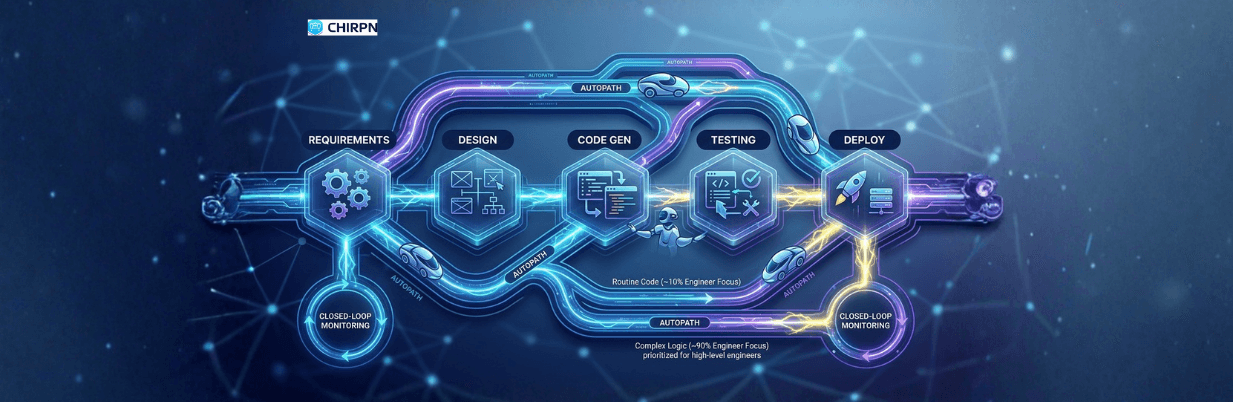





Most AI-assisted development tools make individual developers faster inside the phases they are already running. AutoPATH framework Chirpn has created does something structurally different: it runs all five SDLC phases in parallel, using AI agents coordinated across requirements, design, development, QA, and deployment simultaneously.
The result is not a dramatic improvement in one phase, it is continuous compression across all five, because each phase hands its output to the next in directly consumable form, with no re-formatting queue or hand-off context loss. That continuity is how Chirpn achieves AI development time reduction to ship production AI products in 45–60 days. This guide explains the mechanism of AI software development phase by phase.
Where Traditional SDLC Projects Lose Time
Before examining what AutoPATH SDLC does at each phase, it is worth understanding where the time actually goes in a traditional sequential SDLC. The answer is not slow coding it is context loss at every hand-off, and idle waiting between phases.
| SDLC Phase | Where traditional projects lose time | What AutoPATH does instead |
| Requirements | 2–4 weeks of workshops, re-drafts, and alignment cycles | AI agents decompose a brief into executable specifications in hours; stakeholders review output rather than generate it |
| Design | 1–3 weeks to produce design artefacts; further time if engineering finds them unimplementable | AI generates design variants from specifications; engineering-compatible artefacts produced concurrently |
| Development | 80–90% of development time is commodity code boilerplate, CRUD operations, API wiring, configuration | AI agents generate commodity code; engineering effort concentrates on differentiated business logic |
| QA | Industry average test coverage of 40–60%; test creation is manual and lags development | AI generates tests in parallel with development; 80–90% coverage as a structural output |
| Deployment | Manual pipeline configuration; deployment defect rates of 35–50% in first post-launch weeks | Automated pipelines; deployment artefacts produced during build; defect rates materially lower |
The compounding effect is the key insight. In a sequential SDLC, each phase must complete before the next begins. Every delay in one phase cascades through all the phases that follow. AutoPATH eliminates this cascade by running phases in parallel, with AI agents maintaining context across the transition.
Phase 1: Requirements
In conventional delivery, requirements gathering is the most variable phase it takes as long as the stakeholder communication takes, which can range from one week to several months. AutoPATH replaces the documentation phase with an AI-driven decomposition: a structured brief is fed in, and AI agents produce an executable specification of user stories, acceptance criteria, and technical constraints in hours rather than weeks.
Stakeholders review and confirm output rather than generating it from scratch. The shift from generation to review compresses the requirements phase and reduces the scope misalignment that typically surfaces during QA.
Phase 2: Design
Design is typically a sequential gate: design must be complete before engineering begins. AutoPATH runs design concurrently with the tail end of requirements, generating design variants from the specification and producing engineering-compatible artefacts not design files that engineering must then interpret and re-implement.
AutoCAR, Chirpn's rapid-prototyping companion tool, generates interactive prototypes for end-user review before production code begins. This moves user validation earlier where misalignment costs hours rather than weeks.
Phase 3: Development
McKinsey's February 2026 developer research (4,500 developers across 150 enterprises) found daily AI users completed approximately 46% more pull requests. AutoPATH applies AI accelerated product delivery principles to code generation more systematically: commodity code boilerplate, CRUD operations, API wiring, configuration, and standard patterns are generated by AI agents. Engineering effort concentrates on the differentiated business logic that determines whether the product solves the actual problem.
Phase 4: QA
Conventional QA lags development test creation is manual, typically consumes 20–30% of overall project time, and produces industry-average coverage of 40–60%. AutoPATH generates tests in parallel with development rather than after it, producing 80–90% coverage as a structural output of the build process rather than a separate, time-consuming activity.
The coverage improvement is not incidental tests generated from the same specification that drove development are structurally more likely to test the right behavior than tests written retrospectively against finished code.
Phase 5: Deployment
Deployment pipelines in AutoPATH are generated during the build rather than configured after it. By the time development and QA are complete, the deployment artefacts are ready. Post-launch defect rates are materially lower because the deployment infrastructure was planned alongside the product, not assembled under go-live pressure.
Why the Phases Compound
The gain from each phase is real but the compounding effect of running all five in parallel is the structural advantage. In a sequential SDLC, waiting time between phases reviews, hand-offs, context re-acquisition when a new team member picks up where another left off accounts for as much elapsed time as the work itself.
AutoPATH eliminates inter-phase waiting because the AI agents maintain context across the transition. Requirements context is available when design begins. Design context is available when development begins. The same context thread runs through QA and deployment. No re-ramping. No context loss. No idle queues.
What AutoPATH Does Not Claim
AutoPATH does not eliminate the need for human engineering judgment. Architecture decisions, the business logic that differentiates the product, edge cases that require domain expertise, and the governance decisions that determine what the system should and should not do all of these require human engineers. AutoPATH compresses the commodity stages so that engineering effort is concentrated where human judgment adds the most value.
AutoPATH also does not claim to work without good inputs. A well-structured brief produces a well-structured specification. A vague brief produces a vague specification. The quality of the inputs to the AI agents determines the quality of their outputs which is why discovery and brief quality are the first things Chirpn focuses on in every engagement.
Where Chirpn Fits
Chirpn's Rapid Launch program is built on AutoPATH. 100+ products shipped. Engineering alumni from IBM, Airbus, Publicis Sapient, Apple, and Cisco. Google Cloud Partner (Vertex AI, AgentSpace, Agent Assist, Gemini).
Verified outcomes: Parentis Health (33% user engagement increase, 68% organic traffic increase, 84% CAP efficiency improvement); Talent100 (custom LMS from scratch; hundreds of active students and instructors).
Ready to compress your next build? Book a discovery session.
Frequently Asked Questions
How does AutoPATH reduce delivery time?
By running all five SDLC phases in parallel via AI agents, rather than sequentially. Requirements, design, code generation, QA, and deployment proceed concurrently, with each phase handing its output to the next in directly consumable form. The elimination of inter-phase waiting and context loss is what compresses a 3–6 month timeline to 45–60 days, not faster execution within each individual phase.
What percentage of development does AutoPATH automate?
AutoPATH automates the commodity stages of each phase: boilerplate code, standard test generation, deployment pipeline configuration, specification decomposition. Engineering judgment on architecture, business logic, and domain-specific decisions remains human. The proportion that is automated depends on the engagement: projects with more standard components see more automation; highly differentiated business logic requires proportionally more engineering effort.
Is AutoPATH only for AI products?
No. AutoPATH is an SDLC framework applicable to any software product. The AI orchestration layer applies regardless of whether the product being built contains AI features. For AI-specific products ML models, LLM integrations, agentic workflows AutoPATH also coordinates the model training, validation, and integration stages.