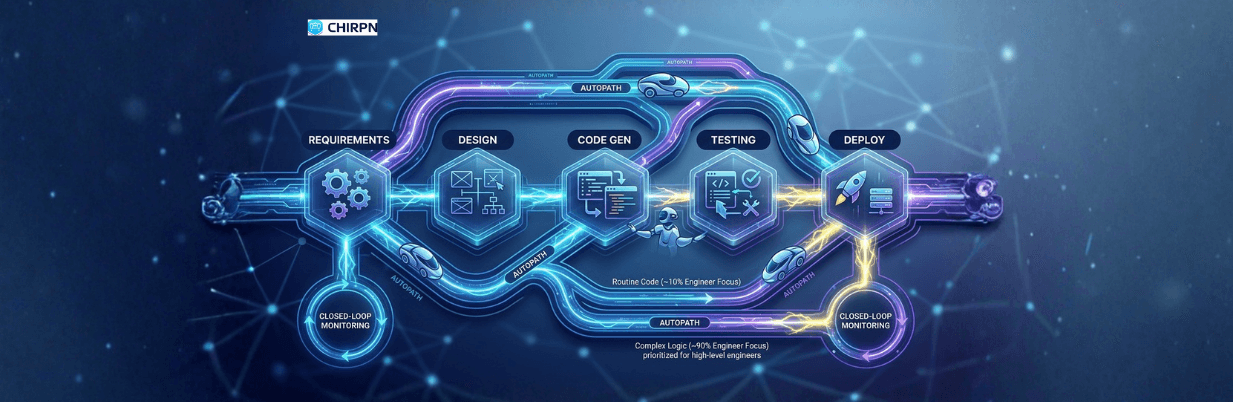





Companies are increasingly leveraging AI algorithms to refine workflows, maintain stability during pivots, and deliver impactful solutions. The technology brings clarity and speed from early-stage scope analysis through real-time market feedback transforming traditional processes and enabling teams to identify scaling needs, respond swiftly to changes, and prioritise features aligned with market demand without straining resources or technology stacks.
At Chirpn, this approach is operationalised through AutoPATH, our AI-orchestrated SDLC delivery framework. AutoPATH embeds AI decision-making at every phase of the development cycle, from requirements analysis through deployment, enabling structured, predictable delivery in 45–60 days across 100+ enterprise engagements.
Intelligent Scope Refinement
AI algorithms analyse client requirements, user data, and market trends to optimise scope, enabling teams to focus on essential features while avoiding unnecessary iterations and delays. Within the AutoPATH framework, this analysis runs before a single line of code is written ensuring the build phase begins with a stable, agreed specification rather than an evolving brief.
Agility Meets Stability
AI-enabled data processing allows integration of new requirements without interruptions, helping teams respond to client needs while maintaining structure and cohesion. Where traditional agile processes struggle with mid-sprint scope changes, AI-orchestrated workflows surface the dependency impact of each change request before it is accepted, preserving sprint integrity.
Real-Time Market Insights
AI-driven models monitor industry trends, competitors, and user behaviour to guide data-centric decisions, helping produce high-quality applications that align with real-time user demand. This continuous feedback loop means product decisions are grounded in current market signals rather than assumptions made at project inception.
Streamlined Cross-Team Workflows
AI-driven tools improve visibility across development, marketing, design, and support teams surfacing workflow friction early so it can be resolved before it compounds into delivery delays. Bottlenecks that once required a retrospective to identify are now flagged proactively, keeping cross-functional collaboration on track.
ROI-Driven Priority Setting
AI analyses cost-effectiveness at the feature level, helping product teams focus development effort on high-impact capabilities rather than spreading resources across a long, undifferentiated backlog. This shifts prioritisation from opinion to evidence, aligning engineering investment with commercial outcome.
Risk Management
Predictive analytics identify potential delays from market shifts, resource constraints, and scope creep, enabling proactive problem-solving. Within AutoPATH, risk signals are surfaced as part of the sprint-readiness checkpoint giving delivery leads a structured opportunity to course-correct before a risk becomes a miss.
User-Centric Development
AI analyses customer feedback from surveys and forums, ensuring each iteration remains relevant and responsive to user needs. Rather than relying on periodic user research cycles, this approach creates a continuous signal that informs backlog prioritisation in near real-time.
Code Quality Enhancement
AutoPATH embeds automated code-quality gates throughout the development cycle. AI tools flag inconsistencies, outdated syntax, and potential bugs before they reach review, reducing the cost of defects that would otherwise surface late in the cycle. Teams may also use supplemental tools such as Tabnine and GitHub Copilot to accelerate code generation, but these operate within the governed pipeline rather than as standalone shortcuts.
Automation of Routine Tasks
AI testing tools reduce manual intervention by checking new code for compatibility and vulnerabilities. Automated test generation covers regression paths that manual QA typically misses under time pressure, ensuring release candidates are validated against a comprehensive, reproducible test suite.
Scalability Improvements
AI predicts server loads and potential scaling needs before they become urgent, optimising infrastructure proactively. Capacity decisions made during development rather than as emergency responses post-launch carry significantly lower cost and operational risk.
Complementary Applications
AI extends the same principles beyond product development into adjacent functions:
- Supply chains: improving supplier selection and logistics through demand-signal analysis
- Marketing: enabling personalisation and customer behaviour prediction at scale
- Operations: automating reporting cycles and exception management to free analyst capacity
Future Trends Worth Watching
Explainable AI (XAI)
As AI takes on higher-stakes decisions in finance, healthcare, and regulated software, the ability to surface a human-readable rationale for each AI recommendation is becoming a procurement requirement. XAI frameworks make the decision path auditable critical for enterprise adoption in regulated industries.
Edge AI
Running inference on-device rather than in centralised cloud infrastructure reduces latency, saves bandwidth, and enables real-time processing in environments where connectivity cannot be assumed IoT deployments, remote operations, and latency-sensitive consumer applications.
Agentic AI in SDLC
The next evolution is AI that does not merely assist developers but acts as an autonomous agent within the development pipeline drafting requirements, generating test cases, reviewing pull requests, and flagging security vulnerabilities without human prompting at each step. Chirpn's AutoPATH architecture is designed to accommodate agentic components as they mature.
Implementation Strategy
Chirpn's approach to AI integration in product development involves three foundational steps:
- Rigorous market research to identify where AI creates genuine leverage versus where it adds complexity without proportionate return
- Team development with specialised expertise in AI-assisted engineering, ensuring the tools are used effectively rather than adopted superficially
- Strategic assessment of integration points where AI amplifies product strengths and optimises development efficiency prioritised by impact, not novelty
The result is delivery that is faster, more predictable, and better aligned with what users actually need structured through AutoPATH across 45–60 day cycles and validated against enterprise-grade quality standards.
Conclusion
AI algorithms are fundamentally transforming product creation and delivery by adding intelligence to every development phase from scope refinement through market launch. For organisations ready to move beyond pilot projects, the question is not whether to integrate AI into development but how to do so in a way that scales.
Chirpn's AutoPATH framework provides that structure: AI-orchestrated SDLC delivery with 100+ enterprise deployments and a consistent 45–60 day timeline from validated requirements to production-ready software.