




GitHub Copilot, Chirpn's AutoPATH, and Publicis Sapient's Slingshot are three of the most-discussed GenAI tools in software development in 2026 when checking out trends for AI code generation 2026. The question most GenAI code generation tools comparison guides don't answer is whether they should be compared at all because they operate at different layers of the development process and serve different buyers.
This guide explains what each tool actually does, why they are different categories of best AI coding tools for software development rather than competing substitutes, and which is the right fit for your situation including when you would use them together.
The Three Tools: Different Layers, Different Buyers
GitHub Copilot: The Developer Assistant
GitHub Copilot is an AI coding assistant that operates inside the developer's IDE VS Code, JetBrains, Neovim, and others. It provides real-time code completion, generates functions from natural-language comments, produces unit tests, and writes documentation alongside the developer. It does not manage the project, coordinate the team, or replace the SDLC; it makes an individual developer faster inside the process they are already running.
Pricing: $10/user/month (Individual); $19/user/month (Business); $39/user/month (Enterprise) on top of GitHub Enterprise Cloud at $21/user/month. The Business and Enterprise tiers add IP protection, organisation-wide policy controls, and compliance features.
A relevant note for teams evaluating scale: McKinsey's February 2026 developer study (4,500 developers across 150 enterprises) found that daily AI users completed approximately 46% more pull requests though review discipline and code quality standards determine whether that throughput translates to net-positive outcomes. The tool amplifies throughput; review discipline and quality standards determine the net outcome.
Chirpn AutoPATH: The AI-Orchestrated Delivery Framework
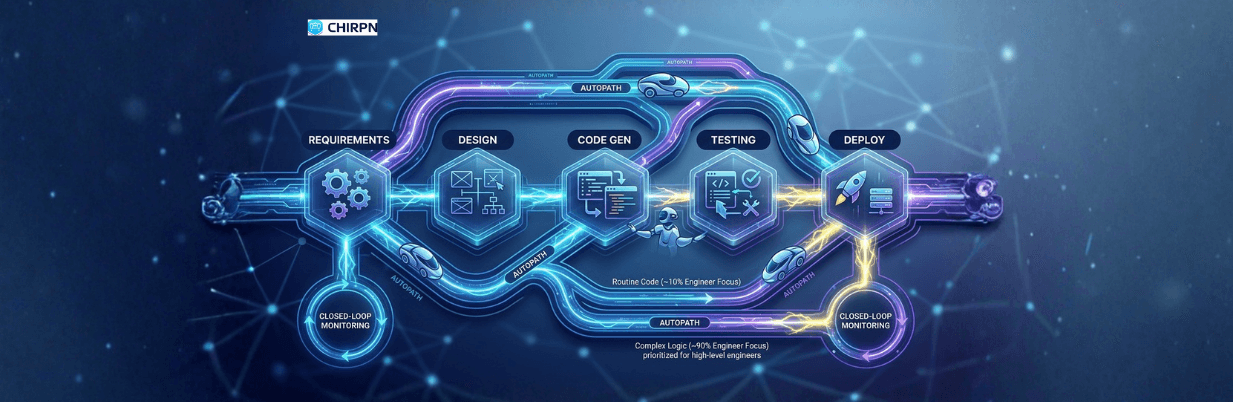
AutoPATH is not a coding assistant, it is among top AI SDLC automation tools operating as AI orchestrated framework. Where Copilot assists a developer inside one phase of the build, AutoPATH coordinates AI agents across all five phases simultaneously: requirements decomposition, design generation, code generation, automated QA, and deployment. Each phase hands its output to the next in directly consumable form, with no re-formatting queue or hand-off context loss.
The gain is not a dramatic improvement in a single phase, it is continuous compression across all five, because parallelism eliminates the waiting and re-ramping that accounts for most of the elapsed time in sequential delivery. That continuity is how Chirpn ships full products in 45–60 days. AutoCAR, Chirpn's rapid-prototyping companion tool, generates interactive prototypes for end-user review before production code begins catching design misalignment in hours rather than weeks.
As a Google Cloud Partner, AutoPATH builds on Vertex AI, AgentSpace, and Gemini. Pricing is per-engagement and scoped before commitment, not a per-seat subscription.
Publicis Sapient Slingshot: The Enterprise AI Platform
Slingshot is Publicis Sapient's AI-powered software delivery platform, designed for enterprise-scale programme delivery. It ranked #3 on the Hugging Face DeepResearch Bench Leaderboard in 2026 and is built for organisations making a multi-year investment in AI-native software delivery across large, complex systems.
At $500K–$2M+ for large implementations, Slingshot is structurally inaccessible to startups and most mid-market companies. Its engagement model is optimised for the procurement processes, compliance requirements, and programme governance of large enterprises.
Head-to-Head Comparison
| Dimension | GitHub Copilot | Chirpn AutoPATH | Publicis Sapient Slingshot |
| Category | AI developer assistant | AI-orchestrated delivery framework | Enterprise AI platform |
| What it does | Assists individual developers with code completion, test generation, documentation | Runs the full SDLC requirements, design, code generation, QA, deployment in parallel via AI agents | Enterprise platform for AI-powered software delivery at scale |
| Delivery time | Faster individual coding sessions | Full-project delivery in 45–60 days via parallel, AI-orchestrated phases | Faster than conventional enterprise delivery; timeline varies by engagement |
| Pricing | $10/user/month (Individual); $19/user/month (Business); $39/user/month (Enterprise on GitHub Enterprise Cloud at $21/user/month+) | Per-engagement; scoped before commitment | Enterprise platform pricing $500K–$2M+ for large implementations |
| Best for | Software developers wanting autocomplete, test generation, and inline documentation | Growth-stage and mid-market companies that need a production AI product in weeks, not months | Large enterprises investing in AI-native software delivery at programme scale |
| Hard limit | Assists the developer, does not replace the development process or manage project delivery | Not built for Fortune-500 managed services across multiple regulated geographies | Minimum engagement size and timeline mismatched to startups and mid-market buyers |
Which Is Right for Your Situation?
Use Copilot if: your software engineering team wants faster code generation, better test coverage, and inline documentation and you want to buy it per seat, install it in your IDE, and start using it today. It is the right tool for an engineering team; it is not the right tool for a company that needs to build a new AI product in weeks.
Use AutoPATH if: you are a startup, scale-up, or mid-market business that needs a production AI product in 45–60 days and wants a partner that takes end-to-end delivery accountability including post-launch monitoring and retraining. The constraint is not engineering capacity; it is the delivery process itself.
Use Slingshot if: you are a large enterprise making a strategic, multi-year investment in AI-native software delivery across a complex, multi-system estate and you have the budget, procurement process, and programme governance that a Publicis Sapient engagement requires.
Can you use them together? Yes, especially when evaluating github copilot vs autopath. Copilot can operate inside an AutoPATH engagement individual developers using Copilot for in-phase code assistance while AutoPATH coordinates the inter-phase AI orchestration. The two layers are compatible and complementary.
Where Chirpn Fits
Chirpn sits between the developer-productivity layer (Copilot) and the enterprise platform layer (Slingshot) specifically designed for the buyer; the enterprise layer cannot serve at its price point and the developer layer cannot serve at its scope. 100+ products shipped across healthcare, EdTech, sports technology, and enterprise software. Delivery centres in Pune, offices in Australia and the US.
Verified outcome: Parentis Health 33% user engagement increase, 68% organic traffic increase, 84% CAP efficiency improvement. Full IP on delivery. No lock-in.
Talk to us about your project chirpn.com/contact-us/.
Frequently Asked Questions
Is GitHub Copilot the same as AutoPATH?
No, they operate at different layers. GitHub Copilot assists individual developers within the coding phase of a project. AutoPATH orchestrates AI agents across all five SDLC phases in parallel requirements, design, code, testing, and deployment. Copilot makes developers faster inside an existing process; AutoPATH replaces the process architecture with one designed for AI.
Does Chirpn use GitHub Copilot in its delivery?
The AutoPATH framework coordinates the delivery process; individual tools including AI coding assistants may be in use within phases. The relevant distinction is that AutoPATH manages inter-phase orchestration and context continuity which is the part of delivery that determines elapsed time, not the in-phase coding velocity.
How does AutoPATH compare to Publicis Sapient's Slingshot?
Both are AI-orchestrated delivery frameworks. Slingshot is an enterprise platform priced and structured for large-enterprise multi-year programmes ($500K–$2M+). AutoPATH is an engagement framework that delivers production AI products in 45–60 days for growth-stage and mid-market companies, at a cost structure accessible to those buyers. They are not direct substitutes; they serve different stages and scales.