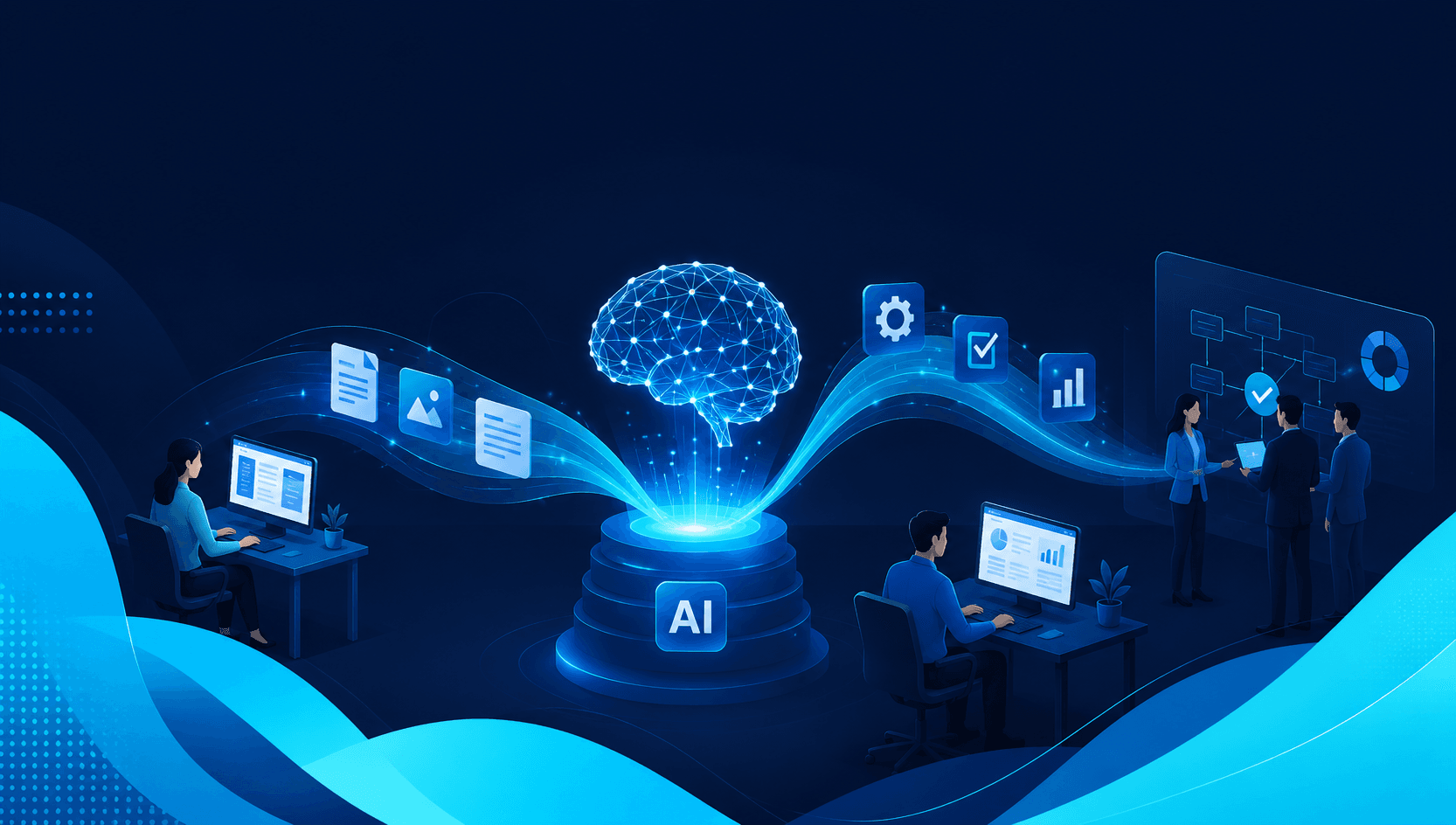




Generative AI and low-code development platforms are reshaping how software is built. Together, they compress development timelines, lower the barrier for non-technical contributors, and free engineering capacity for the work that genuinely requires it. For businesses under pressure to deliver more with the same team, the combination is significant.
What Is Low-Code Development?
Low-code platforms provide visual development environments with pre-built components, drag-and-drop interfaces, and minimal hand-coding requirements. They allow both professional developers and business users often called citizen developers to build functional applications without writing every component from scratch.
When generative AI is embedded in these platforms, the capability expands: developers describe what they need in natural language and receive working code, workflow logic, or UI components to review and refine.
Key Advantages of Generative AI in Low-Code Platforms
Rapid Code Generation
AI generates and refines code snippets on demand, allowing developers to iterate quickly through options rather than writing boilerplate from scratch. The developer's role shifts toward review, selection, and refinement of higher-value work than initial generation.
Intelligent Augmentation for Citizen Developers
AI identifies issues in user-built workflows and recommends fixes, extending the viable scope of what non-technical contributors can build and maintain independently without creating technical debt.
Code Optimisation
Built-in AI algorithms analyse generated code for inefficiencies and optimise it for faster compilation and execution without requiring the developer to diagnose performance issues manually.
Predictive Testing
Automated vulnerability and performance checks run before deployment, catching issues that would otherwise surface in production. The earlier in the pipeline a defect is caught, the lower its cost.
Scalability and Developer Productivity
Automation of routine development tasks boilerplate generation, documentation, test scaffolding frees developers for architecture, complex logic, and integration work. Teams scale output without proportionally scaling headcount.
Significant Drawbacks to Manage
- Maturity: Generative AI in low-code is still evolving. Models require extensive training and continuous refinement to perform reliably in specific business domains.
- Privacy and security: LLMs may process sensitive data during code or content generation organisations must evaluate data residency and confidentiality controls before deployment.
- Bias and hallucination: AI models can produce plausible but incorrect outputs. Human review is non-negotiable for any code entering production.
- Organisational change: Effective adoption requires training, governance, and a shift in how development teams work tools alone are insufficient.
- Compliance gaps: Regulated industries must audit AI-generated code and workflows for compliance before deployment.
Applications in Practice
Chatbots and Conversational Interfaces
Generative AI accelerates chatbot development by generating conversation flows, intent mappings, and response templates reducing the time from specification to testable prototype from weeks to days.
Automated Workflow Generation
Business users can describe a process in natural language and receive a structured workflow to review, modify, and deploy without waiting for developer capacity.
UX Autocorrection
AI analyses user interaction patterns and surfaces UX improvements flagging friction points and suggesting interface adjustments based on observed behaviour rather than assumption.
Platforms in This Category
The generative AI + low-code space has attracted both established platform vendors and specialist players. Early-mover platforms include:
- Google AutoML: Google's machine learning model-building platform for teams without deep ML expertise
- OutSystems: a low-code enterprise platform with embedded AI-assist capabilities for code generation and process automation
- Apple CreateML: a framework for training custom machine learning models for Apple platform applications
The broader market consensus, reflected across analyst coverage and platform adoption data, is that the highest returns from this category come when AI-generated outputs are governed by a structured delivery framework not deployed ad hoc.
How Chirpn Applies This
Chirpn embeds generative AI and low-code acceleration within the AutoPATH framework Chirpn's AI-orchestrated SDLC delivery system. Rather than treating AI tools as standalone productivity add-ons, AutoPATH governs how AI-generated code, workflows, and components are validated, integrated, and deployed within a structured 45–60 day enterprise delivery cycle.
This means faster output and governed quality, not a choice between the two.
Conclusion
Generative AI and low-code development are genuinely powerful together compressing timelines, expanding who can build, and automating the low-value work that consumes developer capacity. The organisations that realise the most from this combination are those that pair the tools with a structured delivery process, clear governance, and human review at every critical stage.