



The quickest path to spending $200,000 and 6 months on a product for an assumption that a prototype could have proved in 2 weeks. The next fastest way is to spend four weeks on a prototype, but you need a working product in the hands of users generating real data now.
It's a mistake that's made by founders because it's not that they are wrong in their concepts, it's that they are wrong in the right answer, depending on what they want to know. Here are a few points to consider and a clear decision framework that will help you understand when the prototype vs full product decision is not a question anymore.
Prototype vs MVP vs Full Build: The Definitions That Actually Matter
What is the difference between a prototype, an MVP, and a full build?
A prototype is a test to determine if a concept is viable. An MVP enables you to determine if there is a market for the product you've built. The product is a full build for scale. Each has one question it seeks to address, and if the wrong question is asked at the wrong time in the rapid prototyping software development process, it may be asked at the cost of the right answer.
In reality, founders view prototype-vs-MVP-vs-full products as a sequence that needs to be followed. All three stages may not be necessary for all products. If they're required steps, then you are wasting time convincing the market.
Important difference to consider:
- A prototype is a mock-up that can't or only partially perform the desired functions. It is for testing the concept, user flow and design users interact with it, but cannot do a real task.
- An MVP is a functional product with only the essential features that are needed to test the hypothesis with real customers performing real tasks.
- A full, scaled product is planned to be reliable, scalable and have a full user base.
So, the debate of the prototype vs full build is not the right one to be making in 2026, as the actual question for most founders is between the prototype and the fast-built MVP. The cost of prototyping is now very close to production costs, thanks to today's AI-driven development. Taking the time to prototype a shipped product, with the added help of AI, is now a standard six week process. This alters all the calculations for founders who are considering this.
The Four-Question Framework: End the Prototype vs Full Build Debate
How do you decide between a rapid prototype, an MVP,or a full product?
Answer the questions below in order. The first one you cannot answer determines which stage you need.
Question 1 Knowing what to build?
If not, you're still figuring out if users will desire this idea then you need a quick prototype. The answer comes at a low price from rapid prototyping software development. If you build anything more costly, you have just answered a question you didn't ask right.
Question 2 Know the users and whether they will really use it?
If no, then the concept is validated, but the adoption is not, an MVP is required. The only answer to this is real behavior data from a working product. Building an MVP vs staying in prototype is dependent on the type of testing you are conducting: concept or retention.
Question 3 Will a full product be worth your usage and capital?
If no pre-revenue, pre-Series A, unproven market remains in an MVP iteration. Every team that rushes to a full product too quickly, finds they've confused excitement from investors as validation.
Question 4 Which is your runway when it comes to time?
This is the clinching factor. You can't expect a team with 6 months of runway to absorb a product that is built over 5 months and has no user learning. Keep all decisions until the actual runway to a time limit.
Five clear situations where a Rapid Prototype Wins
Speed wins a prototype is the right choice in five specific situations:
- Investor presentations in the run-up to a round funding. When investors see something they can interact with, they respond to it. A clickable prototype from modern prototyping practice - no engineering investment, product thinking and UX clarity. There is a direct correlation between the number of founders going into Series A with a prototype, and the performance of those founders.There is a correlation between founders entering Series A with prototypes and the performance of those founders.
- Internal stakeholder sign-off. Multiple decision makers are required to give their approval to the scope of an enterprise or B2B product before development starts. A prototype brings to light some disagreements during a review session, not mid-sprint, when scope changes cost ten times as much.
- Research with the user prior to establishing requirements. With rapid prototyping software development, one can get a genuine response before any production code is written by an engineer. The feedback changes the requirements so as to avoid re-working requirements which may be months down stream.
- When the real problem is design, not demand. There are some products that are known to have a demand but it's not clear how their UI will feel. A prototype is an answer to a design question at a lower cost than a complete build
- When the complexity of integration is unknown. A prototype which surfaces data flow and integration touch points before they become a discovery event during mid build introduces complexity.
When an MVP or Complete Product is the Right Choice
There are three scenarios that are common grounds for a founder to go for a rapid prototype:
- If the concept has already been tested. Prototype vs MVP is simple with customer interviews that validate demand or a paying customer on the waitlist. A prototype does not contribute any additional information. Build the MVP. If you treat a good idea as if it requires a prototype, then you're being lazy.
- If the hypothesis is based on actual usage data. Knowing when to prototype vs MVP is determined by this: prototype feedback is what users think they'll do, MVP feedback is what users actually do. If your hypothesis needs behavioral information like retention, activation, churn, then you need to have a working product.
- When the competitor is in motion. A prototype generates no defensible position in a contestable market. An MVP does. When a competitor is 90days ahead and closing your market, the decision to rapid prototype or build the full product is obvious: ship the MVP.
2026 Comparison That Reframes the Prototype vs Full Product Decision
Traditional rapid prototyping software development had a big gap between prototype and full product: Figma files to 6 to 12 months of engineering. That difference is completely gone in 2026 at the MVP level.
Rapid Prototype | AI-Assisted MVP | Complete Product | |
|---|---|---|---|
| What it answers | Is this worth building? | Will people use this? | Can this scale? |
| Functionality | None or simulated | Fully functional | Fully functional |
| Time to deliver | Days–2 weeks | 6–8 weeks | 4–12 months |
| Best for | Concept, design, investors | Adoption validation | Scale |
This table is a rehash of prototype vs. MVP vs full product for 2026. The traditional binary cheap-but-non-functional versus expensive-but-working now has a third option: fast and working delivered by software development companies orchestrated by AI. For the majority of founders, the choice is not between a mockup versus a finished product, it is between a basic prototype and an AI-enabled prototype.
NOTE FOR WEB TEAM: Everything below this point is the Chirpn brand section. There are no brand mentions above this line, all body content is written as neutral and educational framework guidance.
How Chirpn Approaches the Prototype vs Full Product Decision
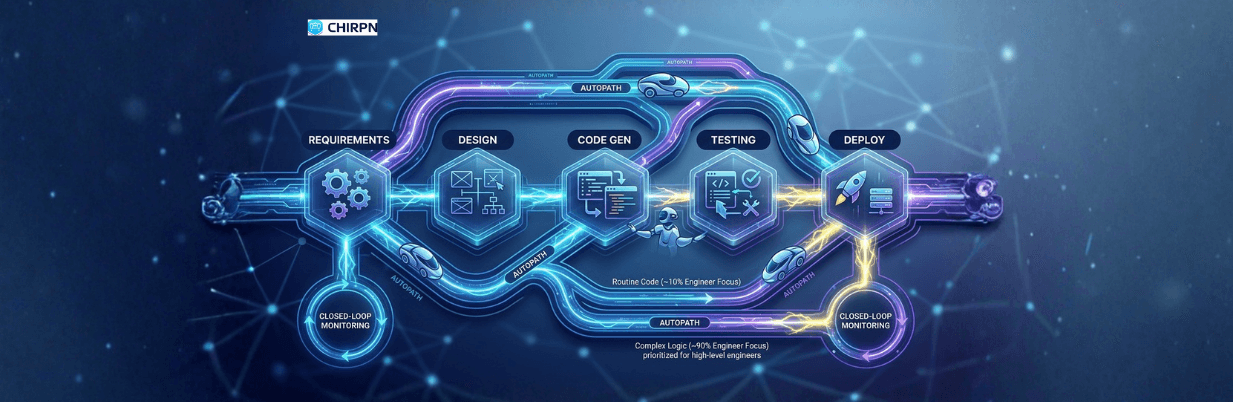
Chirpn's Rapid Launch solution was designed to bridge between prototype and working product. The AutoPATH tool automatically produces clickable prototypes and system architecture documentation in tandem from a product brief, usually within the first week of an engagement. This is not a hard copy mock-up. It represents the facts that the development phase is actually based on and the interaction of the person with the application, such as the real data model, user flows, and integration points. Clients approve direction a week into it instead of 4 weeks of silent development.
From there, the AutoPATH framework automates the commodity code layer – authentication, data models, standard API connectors – leaving only the 30-40% that is novel. The outcome: a product deployed and monitored in 45-60 days. Not a trade-off, a prototype and a product all within the same delivery window for standalone prototypes.
For a rural-based telehealth provider like Pathway Healthcare, they required a working clinical platform, not another prototype, in a short time frame. The Rapid Launch framework resulted in an effective product that real clinicians used on real patients, and feedback built in from day one.
Before building, ask the Right Question.
To decide on rapid prototype vs full build, ask yourself this question: What is the one most important assumption my product is based on? What's the lowest cost way of testing this assumption?
Rapid prototyping software development is the solution in case of assumption related to concept and design. When it comes to adoption and retention, an MVP is the solution and one that doesn't require a full product production in six months in 2026.
Frequently Asked Questions
What is the difference between an MVP, a prototype, and a full build?
A prototype is a manifestation of an idea that is not functional, but rather for design validation. The MVP is a product that contains the essential features and is ready to be put into the market to test the adoption of the features. Once the demand has been validated, a complete product is built for scale. Rapid prototyping software development is defined as each step addressing a different question and demands a different investment level.
When is it better to create an MVP than a prototype?
Test concept clarity, design direction or investor appetite, not market adoption, by building a prototype. If you don't know whether the user will understand the product, prototype.If you're unsure if the user will understand the product, prototype. When it comes to knowing when to build an MVP, if the question is whether or not they will continue using it, they will. There are different hypotheses for each stage.
What is the cost of rapid prototyping software development as compared to a full blown product?
Traditionally the cost between a rapid prototype and a full product has been a considerable one, a prototype requires a much smaller amount of time and budget than a full product build. An AI assisted MVP by the AI focused software development companies with an AI orchestrated framework falls somewhere in between; this is often the least expensive option for a similar solution. In 2026, a lot of that distance has been bridged with AI taking care of the commodity code layer, and an MVP becoming more attainable in a much more budget-friendly way.
Is it possible to transform a rapid prototype into a product that can be shipped?
Not directly. The rapid prototype is created using design tools, and is not production-ready code, so it cannot be shipped as a product. The results of a prototype are requirements that validate the next MVP. Once you have an MVP developed on an AI-driven framework, however, it can evolve into a full-featured product without re-writing code. This is one of the distinguishing factors of the best software development companies of today that specialize in AI.