

There are two MVP decisions that are often confused for MVP Development with A in 2026:
What AI to build into the product - the model, the features, data loop.
Which AI to use to develop the product quicker. The development framework, the automation layer and the SDLC. If either is incorrect, it's a burn startup runway.
Having both right makes teams that ship in six weeks different from those still scoping month four. This playbook covers both decisions sequentially and how an AI development company would tackle them differently to other traditional software development companies.
What Makes MVP Development AI in 2026 Different?
What is the difference between an AI MVP and a traditional MVP?
What is the difference between an AI MVP and a traditional MVP? A traditional MVP
Checks if users would like to have a feature. An AI MVP is a test of a particular level of AI capability. Solve a specific problem with a sufficient level of accuracy and confidence to enable value creation. The data required are different, the validation question is different,
What is defined as a "done" is different which means the development process must be different too.
The primary risk of a traditional MVP is product risk: will anyone want this? In AI product development, there is an additional model risk: whether the AI system can be trusted to be accurate in its predictions, will it be actually usable in production by users and trusted? A recommendation engine at 60% accuracy is useful in demo and breaks retention in production. An AI assistant with a legal hallucination problem ruins the trust in a legal tech solution on day one. These dangers can only be identified in a mockup, they emerge only when users engage a model that is live, on real data.
Teams invest at least 20 % of their startup MVP budget in pre-development work problem validation, data audit, and architecture according to the Startups research like problem
planning are three times as likely to even ship as those who just go for it. Explore our scope decisions guide for a basic overview. Before moving forward, you should understand what is meant by MVP in software development.
The Two Decisions Every Founder Must Make First
Decision 1: What AI to put into the product?
Which model should be used for the development of AI projects of the founders' MVPs?
In almost every instance, the answer to the question in MVP development with AI in 2026 is the same: "begin with a hosted model. Hosted models: GPT-4, Claude, Gemini provide an afternoon's access to state-of-the-art reasoning via an API, out of a founder's hands. The time it takes to build it from scratch from collecting data to labeling it, training, and evaluating is months before a single user can see the product.
There are what you can easily recognize are three conditions that must all be true for the case of a custom or fine-tuned model:
- You have a very large volume of proprietary data that has some impact on the outputs,
- You have tried and tested the demand with a hosted version first,
- The hosted version wasn't able to do the task with acceptable accuracy.
When three of these statements are incorrect, start hosting and fine-tune after product-market fit.
The de facto default for AI product development is a model API hosted on its own server for intelligence, a standard web framework for the app layer, and a vector database for questions on proprietary documents. Route between providers from the start to avoid vendor lock-in and outages.
Decision 2: How will the product be built?
This is where most founders spend the most time. While selecting an AI coding assistant vendor is a good step in the right direction, it is not the same as an AI development company that takes care of the whole SDLC using AI. AI coding assistants increase typing speed. They don't eliminate the passing of the torch from analysts, designers, engineers and QA that takes up most of the calendar time in a traditional build.
An AI development company with an orchestrated pipeline automates those handoffs, running the requirement generation, code production, and test creation stages as a parallel pipeline instead of a sequence. In traditional software development, the companies charge 12-16 weeks for an MVP being delivered on a scoped project. An AI first delivery partner with an appropriate AI MVP development framework has the same scope in six weeks, not only the typing time.
How to Implement MVP Development AI: 5-Step Process
What are the stages that a structured way of developing MVP development AI takes?
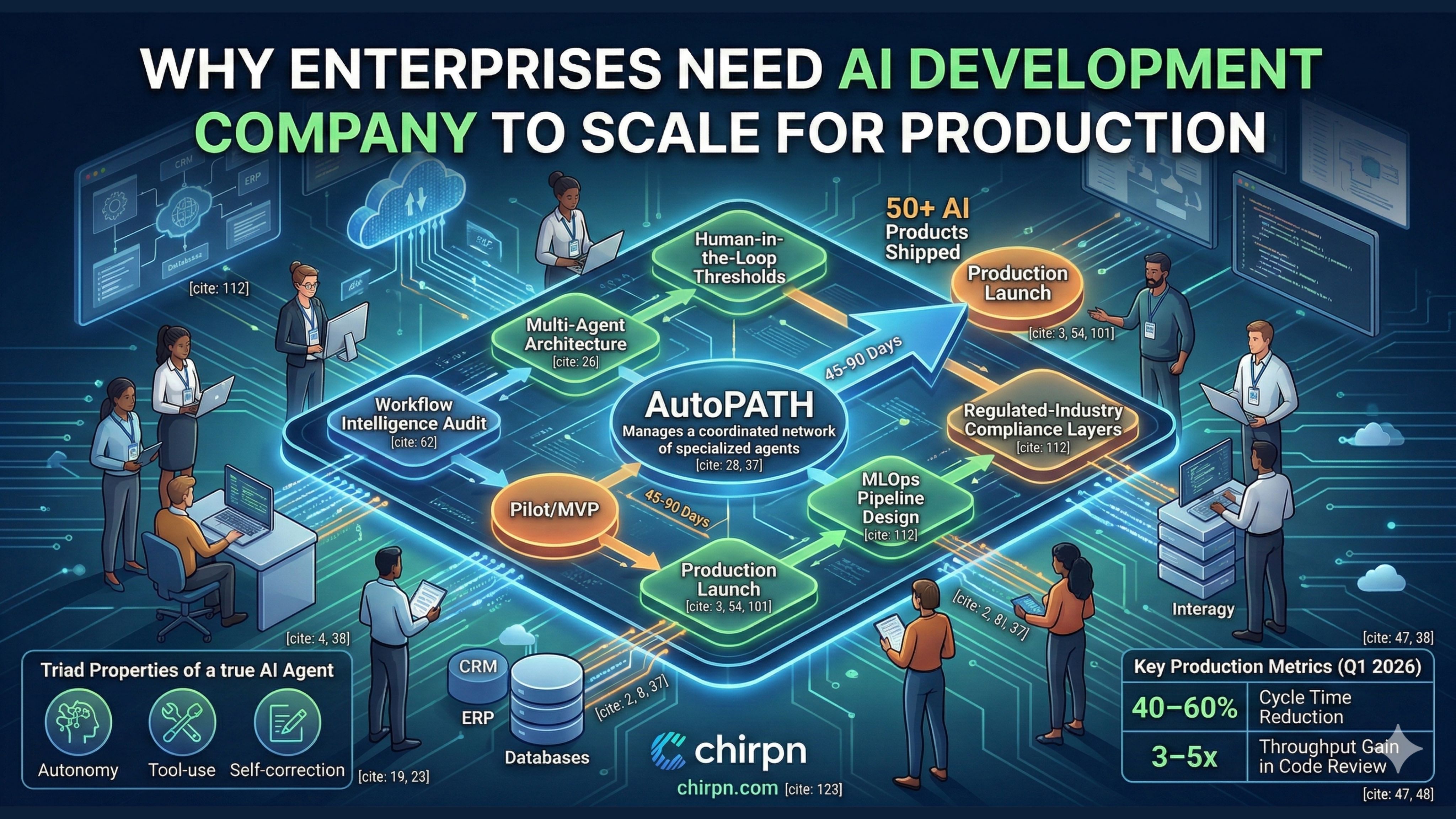
The following five steps make up the foundation of a successful MVP development with AI in 2026. They automatically advance to the next stage, and that's what makes it possible to achieve a 6-week timeline.
Stage 1 Problem Validation & Data Audit - Day 1-3
State the one hypothesis that the MVP needs to test, then examine existing data prior to coding. Data is as important to AI product development as scope. Establish a clear success criteria for the AI part in advance: what accuracy will be considered success, what will be the user action, what will be the result if the model succeeds?
Stage 2 Architecture Design and Model Selection- Day 3-7
Choose the model and stack based on validated scope, not aspirations. Design Data Pipeline and Feedback Loop before writing the first line of product code. The most crucial structural decision in any AI mvp development framework is the feedback loop, which is the mechanism that allows real user interactions to improve the model, and is often postponed till after launch at high cost.
Stage 3 AI-Assisted Build - Weeks 2-4
All the 60-70% of the code base (authentication, data models, standard API integrations, etc.) is generated automatically in a modern AI product development build. The engineers devote their efforts to the 30–40%, which is truly new: The integration of AI, the core logic, the feedback loop. As well as this is the time when the model is first put to the test against real data, not in a notebook but in the actual product.
Stage 4 Evaluation & Guardrail Implementation - Weeks 4-5
Test their AI functionality for the failure modes important to their users: text generation failures, prediction confidence calibration failures, classification failures in the edge cases. Use Guardrails: output filters, confidence thresholds and human-in-the-loop escalation before a real user sees the product. The leading cause of trust loss among start-up AI products on launch day is shipping without guardrails.
Stage 5 Deployment with Monitoring
Real-time model performance monitoring capabilities from day one: prediction accuracy, user override rates, feedback signal quality and data drift. An AI development company that does not have a monitoring setup in place is not really providing an MVP, it is providing a prototype.
AI Development Company vs Traditional Software Development Companies
The difference between an AI dev company and traditional dev companies is clearly reflected in the calendar and the invoice. Engineering hours are the basis for traditional vendors' pricing and planning. An AI-first delivery partner prices and plans based on what is automation friendly. In the MVP development phase of startups, the time would otherwise be spent on writing commodity code that gets saved and reallocated to sections of the product that generates competitive value.
Dimension | Traditional Dev Companies | AI Development Company |
|---|---|---|
| Requirement analysis | 2–4 weeks, manual | 1–3 days, AI-generated |
| Commodity code | Hand-written, billed hourly | Automated via the AI orchestration layer |
| Testing | Begins after development ends | Continuous, generated alongside code |
| MVP timeline | 12–24 weeks | 6–8 weeks |
| Senior engineer time | ~60% commodity work | ~10% commodity, 90% core logic |
What mistakes do AI product development startups make?
Why startup AI MVPs fail despite good intentions?
There are four dominant failure modes for AI MVPs in 2026:
- Validating interface, not the model. Doing user test of a prototype is not the same as testing the AI value. A startup AI product needs to be deployed with an actual model and real data since the model is the hypothesis being evaluated.
- No feedback loop architecture. The AI product that can't learn from the user's feedback suffers as their expectations go up. The feedback loop should be in place in the MVP during Stage 2 of the build process, not v2. It can't be added on later and when it is they have to rebuild it, which can be as expensive as doing it from scratch.
- Selecting development vendors who don't bring AI delivery experience. AI MVP is not an AI-augmented software product, it is an AI system with a software interface. There are clear distinctions between the principles of development methodology, architecture selection and evaluation processes. The bad combination creates a good-looking but non-functioning product.
- Postpone dealing with data as if it were a future concern. Often, the downside of a start up building an AI is not a poor model; it's not enough labelled data to assess or retrain the model. The data audit should be done at Stage 1, not post launch.
NOTE FOR WEB TEAM: Everything below this point is the Chirpn brand section. The top of this line contains no mention of a brand; it is used as a neutral and educational framework statement of body content.
How Chirpn applies this MVP Development AI Framework
That's the five-stage process Chirpn has used to get over 50 products from a brief to working software in 45-60 days across multiple sectors like healthcare, EdTech, sports tech, and enterprise SaaS that forms the basis of Chirpn's Rapid Launch solution, the AI MVP development framework.
At Chirpn, we see the MVP development as an opportunity to engage in two parallel engineering tracks, the AI system track (model, data pipeline, feedback loop, guardrails) and the application track (UI, integrations, deployment), both at the same time. The commodity layer is automated by AutoPATH, allowing Chirpn engineers to concentrate on the AI system track, the key realm where the actual product decisions reside.
Talent100, an Australian coaching institute, required an LMS with AI learning capabilities on an start-up time frame, rather than on an enterprise one. In six weeks, Chirpn's AI mvp development framework provided the platform, which was model connected, feedback loop had been established, and deployed to real students. The data architecture that was created in week one was used by the retraining pipeline to enhance the recommendation engine in week 8.
Chirpn's approach to AI product development is to bring on specialist expertise, such as an LLM architect, or an engineer specializing in Google Cloud's Vertex AI, without the time delay of being onboarded.
The Playbook in a Single Decision
In the 2026 AI MVP playbook, there are only two decisions: What AI to put in the product and How to build the product. Plan from the beginning, create the feedback loop, review your data before you code. Next, select an AI development company that has the most automated framework as that being utilized by the product you are creating.
Frequently Asked Questions
What are the differences between an AI MVP and a traditional MVP?
In a traditional MVP, you are asking customers if a feature is desired.With a traditional MVP, you're asking customers whether they want a feature. An AI MVP helps determine if a particular AI function is accurate enough and trusted enough to be valuable. On top of product risk, MVP development AI introduces another layer of risk: data audit before build, and AI MVP development framework that evaluates in parallel with the code, all with monitoring set-up from the day one.
Should a startup use a pre-trained or custom AI model?
In almost all cases, use a pre-trained hosted model. Creating a custom model adds months to the first time that a startup's product is seen by its first user. Adjust, or custom only, after testing to see if there is demand for a fine-tuned version, and if there is enough proprietary information to meaningfully enhance the outputs of a hosted model.
What is the Cost of MVP development with AI in 2026?
Cost will vary based on the value proposition whether it is an integral part or an add-on. An AI development company, leveraging an automated AI mvp development framework, can save a lot of billable hours on commodity code. Compared to the traditional vendors who take 3-4 months, a Rapid Launch MVP at Chirpn is a much cheaper option.
What is the time it takes for the AI product development for a startup?
An MVP that is well scoped and developed using a proper AI mvp development framework is delivered in 6-8 weeks. The same scope with the traditional software development companies is 16-24 weeks. The difference is not on the product side of the coin, but rather on the development process side of the coin, as it relates to structural handoff automation.