



The general consensus is that an MVP takes 3-6 months. That's not a characteristic of software. It is a characteristic of software development teams that are typically structured: one expert completes his work, passes it on to another expert, and along the way some context is lost. Many of the days of the calendar are not spent in building. Wasted time is waiting, and retaking what has already been learned.
In the traditional software development model, each stage of the software development process communicates with the next. An AI development company breaks them down. There are no handoff delays that aren't being cut by removing them, and no team is working harder than they are by not working so hard.
What actually gets automated: The AI MVP Development Framework
A large amount of the engineering work of a new product is dedicated to code that is not product specific: authentication, CRUD code, standard API connectors, test scaffolding etc. It does not differentiate anything from it. It has historically taken up a lot of senior engineering hours - it was something that had to be written and it had to be written correctly.
It is the compressed time without compromising quality that is so possible thanks to the AI MVP development framework that eliminates this layer by orchestration. The novel part of the product core logic, AI behaviour, which a competitor cannot copy still receives human engineering attention. It gets more of it, because that is where the freed capacity goes.
Why Speed Is the Point: Build an MVP in 6 Weeks, Not 6 Months
Here it's not about cutting costs on engineering. It's the matter of reducing the gap between "we think users want this" and "users want this". By developing an MVP in 6 weeks instead of 6 months, you can gain the benefit of getting to market validation 20 weeks early.
The most common reason startups fail is not running out of time. It's building something that the market didn't need, and it's been a common theme in all of research into startup failure. A compressed build is beneficial because it pushes that discovery further up, and with time to spare, to act.
How the Rapid Launch Framework works.
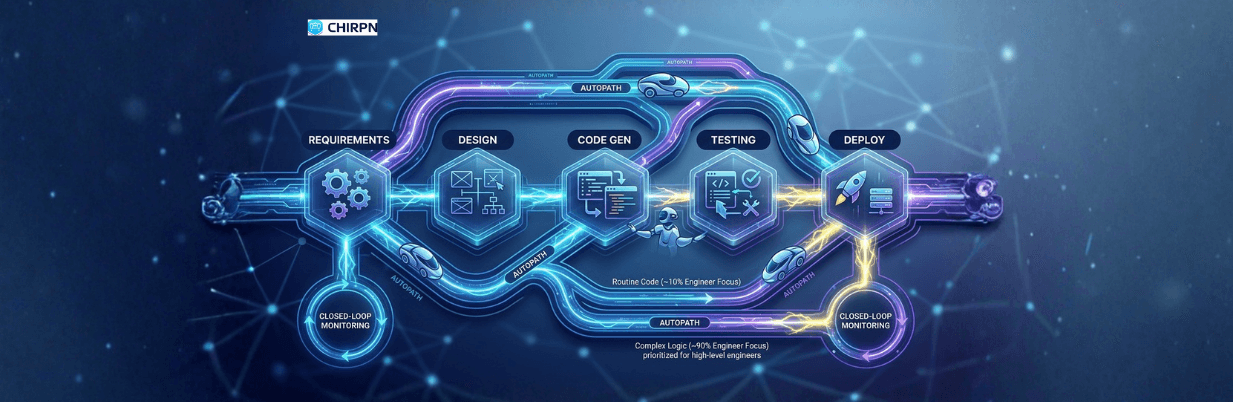
The five SDLC stages still exist. What changes is that they run as one continuous pipeline rather than as sequential gates with a handoff between each pair. The essence of how AI software development companies streamline time without compromising quality.
Requirement Analysis: Days 1 to 3
The brief is broken down into user stories and engineering tasks. Traditionally, this takes two to three weeks and the quality of the output is frequently a document and not clarity. Compressing it proves to be successful only due to the fact that ambiguity and conflicting requirements are brought to the surface, not smoothed over something that isn't as comfortable in week one as it is in month three, and is much cheaper.
Design: Days 3 to 7
Prototypes created from the stories which can be clicked. The founder does not react to the results of four weeks of finished development, but instead approves a direction at a time when it is easy to change.
Implementation: Weeks 2 to 4
The commodity layer is created and reviewed. Engineers are involved in that new part of the product.
Testing: Weeks 4 to 5
Test scenarios are generated concurrently with the code, not after it, and defects are found when there is a plan to address them, not the week before launch.
Deployment: Weeks 6 to 8
With monitoring and analytics already deployed so that the first time its used it creates data instead of anecdotes.
What gets shipped is a PROVEN product that works, not a prototype.
How AI Development Companies Differ From Traditional Software Development Companies
The real-life implication is where your money goes. The average software development company charges senior rates for commodities. The top AI software development companies charge premium prices for what you actually want to create. The price is the message: commodity code in the first model, and competitive advantage in the second.
Four Things That Blow The Development Timeline
Orchestration does not save a badly framed engagement. The four of these guys do the damage and all four are determined prior to the build.
Scoping the Product Instead of the Validation Question
When considering the MVP, an MVP should ask one question: will users embrace this workflow, will they pay for this? A founder who gives an entire product vision instead of a hypothesis, will find themselves in a house for 4 weeks and realize the scope should've been 45 days.
Skipping the Requirements Review
The first stage is there to bring the ambiguity to the surface and it only functions if the founder embraces it and doesn't just take the output at face value. When you find that you are having to rework late, it is always because nobody reads the review.
Selecting a Vendor With No Real Orchestration Layer
Not all AI software development companies are genuine. Many companies call themselves AI-native due to their engineers' use of coding assistants. That saves typing. It doesn't eliminate the calendar's structural handoffs. Don't ask about how code is written but how requirement analysis, test generation and test deployment is automated.
Discovering Integration Complexity Late
If a product needs to be integrated with an existing CRM, payment processor or legacy system that's a requirement task. It is the only guaranteed method to convert a 45-day build to a 90-day build and can be found in week 5.
How Chirpn Delivers: The Rapid Launch Framework in Action
The rapid launch framework above is delivered through AutoPATH, our AI-orchestrated SDLC. It has delivered more than 50 products from prototype to working software in 45-60 days, across healthcare, EdTech, sports technology and enterprise SaaS.
In the case of integrations, they are audited at the analysis phase and priced prior to development. If a product requires LLM capability from the beginning, it's an architectural choice that was made during the scoping phase, not as an afterthought. After the MVP, the team can scale without a delay with Capacity PODs because you want to validate the answer and then take action.
Sportly, an Australian sports science platform, partnered with Chirpn to develop a comprehensive MVP for coaches and athletes seeking data-driven insights for training and performance analysis. Using React Native, Java microservices, and Angular, Chirpn deployed a cross-functional team that delivered an end-to-end solution in under 90 days. The launched MVP garnered immediate attention from major sports organizations including Basketball NSW and Cricket Ireland, proving that the rapid development cycle delivers products ready for professional adoption and market validation.
When this model doesn't work: When your core value proposition is something that can only be demonstrated after months of data, a compressed MVP will not give you the information you want and you need a roadmap, not a sprint. A prototyping studio is cheaper if you are looking for a prototype that will only be used to test one hypothesis and not be scaled up. If the MVP is intended to be a product, Rapid Launch is well worth the investment.
Building MVP in 6 weeks With The Right Validation Question
The key to a compressed MVP timeline isn't that the work is rushed, but rather that the right framework eliminates the handoff delay which slows down traditional builds. You work with an AI development company based on orchestration, and you will have a pipeline that continues on, with AI sitting in the middle, somewhere between requirement analysis and design, and design and implementation, and design and test and design and deployment.
When looking at the validation question, instead of the feature list, scope if and how a product will be buildable within the 45 to 60-day timeframe using the rapid launch framework. Book an MVP scoping call with Chirpn's Rapid Launch team for free and see what can be done within your timeline.
FAQ
How much does a 45 to 60 Day MVP cost?
The equivalent of less than 3-4 months work with an hourly vendor, since the hours that would be spent on commodity code don't exist. The factors that shift the number are complexity of the integration, and the amount of truly custom AI logic needed. We don't charge by hours, but by milestones based on a working build, and the initial scoping call sets the range and neither party locks in any time commitment. If they are unable to provide you with a range at this point, it is information about a vendor.
Can Any MVP Ever Be Made in the Timeframe of 45-60 Days?
As long as there is one simple validation question, the majority of web and mobile products can. The poor fits are those products for which the value of their core is only obvious after a good number of years full of data accumulation, and products that have a huge surface of legacy integration, where it is not the product that is the constraint but rather the other systems.
What's the Difference Between an AI Development Company and a Normal Software Vendor?
A conventional vendor plans and prices by engineering hour. An AI native development company designs and budgets for automation. It's reflected in the calendar, since the three things that take the most time in a traditional build are requirement decomposition, commodity code and test generation and orchestration solves for those three.
What should be done after the MVP Ships?
You receive monitoring and analytics with the product, not a live URL and nothing else. The vast majority of clients go right into an iteration cycle based on real data usage and many grow the staff using Capacity PODs based on the MVP's testing.
How to know if an AI Claim by Vendor is Real or Not?
Discuss the following questions: What are the stages of compression (and how much)? What is their commercial model? A company that's truly reimagined delivery around AI can respond specifically and has shifted their pricing. When an AI software development company becomes a part of an unchanged process, the answer will be in the form of tools.