


Product Development Services in India: Why Selection Matters
Selecting the wrong product development company is not only a waste of time. It can take up to 18 months to launch and take up the runway of two whole product development cycles, with money and time that can never be recouped. Most guides on product development services in India neglect this: The talent is not a variable that decides the success. The choice of the selection process is.
India's product development companies range from three-man AI-native studios to firms with thousands of engineers across multiple cities. That range is why so many engagements fail. Choosing a software product development company is not difficult for a business. It's lacking in any consistent method of discerning which of those choices will work.
This is not a ranked list of the best product development companies in India, nor a comparison of named vendors. It's a list of specific pain points: the point of product development, software product development services and overall relationship with a digital product development company, where it all falls apart—the exact question that arises before every problem, but only if asked before a contract is signed.
Hiring Product Development Services: What It Really Means
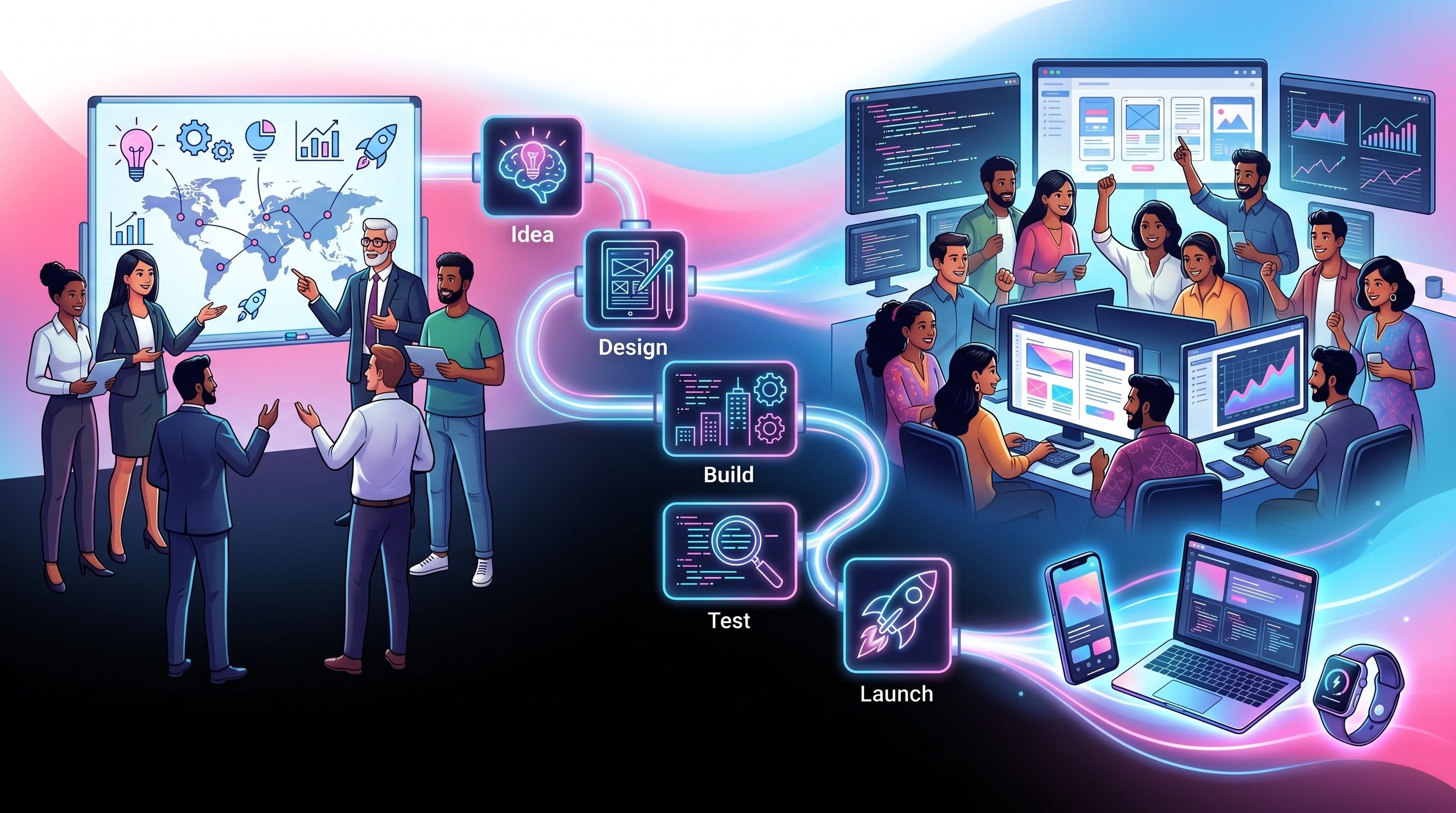
Product development is the systematic process of developing a concept into a product that can be offered to the market; from ideation through validation, design, engineering, testing, launch and iteration. This process is used specifically in the software product development services for web platforms, mobile apps, SaaS tools, and AI-powered systems. An integrated product design and development company is responsible for the design side (UX, UI, and user research) and the engineering side are not separate work streams done by different vendors.
The critical difference that buyers must consider:
Product Development consultant is someone who helps you with strategy, validation and roadmap, but doesn't develop anything. A full software product development company performs design, engineering, testing and deployment. Many businesses require both at one time and another to be sure of an idea before spending engineering dollars to create it. One of the most frequent and expensive early errors of this type is to confuse the two or to employ one where the project requires the other.
Why a delayed engagement compounds instead of ending
A delayed build is not just a delayed build. It is a delay during which your competitors shipped, the market moved, and the product you eventually launch answers a question that has changed.
Technical debt works the same way. Shortcuts taken to hit an initial deadline do not stay in the first release; every subsequent release pays interest on them. A team spending capacity maintaining what exists cannot build what is next, which is usually what outsourcing was supposed to solve.
That is why vendor selection deserves more rigour than the build itself. The build is recoverable. The selection is not.
The 5 Points that make or break any Product Development engagement
When evaluating product development companies near me or in India, these are the exact moments where engagements fail. These are not imaginary threats. These are the exact, recurring types of moments when product development services relationships either work or subtly go off the boil and they're accompanied by a question that comes up when it's time to assess the relationship, not six months into the build.
1: The Proposal Never Named Who Would Actually Build It
Senior architects and seasoned product leads were part of the pitch. Three weeks later at the kickoff call, the team that shows up is mostly composed of junior members, with the senior names only showing up in status updates, not engineering work.
What is actually happening: This bait and switch is one of the most often reported project "failure modes" when outsourcing products and is hard to find in a proposal document; it only shows up once the job has begun.
Ask: "Who will be writing code on this day to day, not managing it? Can I meet them before we sign?"
2: Validation Was Skipped Before the Build Started
The vendor didn't bother with a discovery phase, a market validation step, or a formal evaluation of if the as-scope product is the solution to the problem claimed to be solved.
What is actually happening: The most common ground path for a technically flawless product that nobody needs is to skip out on ideation and validation and that's where most sales cycles run out of speed when sales people are trying to get things done quickly as opposed to having a successful product.
Ask: "Walk me through your validation process specifically. If discovery shows my brief is wrong, what happens to the timeline and the price?"
3: Integration Complexity Was Never Priced In
The first quote was for the development of the core features. No one thought about linking to the client's current CRM, ERP or legacy enterprise system with its own protocols and authentication procedures would require weeks of engineering work that would end up as a change order later.
What is actually happening: Third-party and legacy system integration is one of the cost and time drivers that is most underestimated, precisely because simple REST API connections are not costly, whereas proprietary enterprise systems are and many proposals don't differentiate.
Ask: "Have you audited every system this product must talk to? What is your approach for the ones without modern APIs, and is that work inside this quote?"
4: AI Was Treated as a Checkbox, Not an Architecture Decision
The announcement doesn't define what the AI features are, which could range from an embedded recommendation model to a generative AI layer or an agentic workflow, each of which has significantly different engineering needs and cost.
What is actually happening: For a company on a funding runway, discovering the specific type of AI required in month three is a cash event, not a scheduling one.
Ask: "Is the AI in this product predictive, generative or agentic? How does that answer change the architecture and the timeline?"
5. Nobody Discussed What Happens After Launch
The contract is terminated at the time of deployment. Bug fixes, performance monitoring, security patching, and feature iteration are not yet a planned component of the engagement, but a future negotiation instead and the team that developed the product may move on to another project by the time support is needed.
What is actually happening: A launched product that is then left to maintenance builds up the same technical debt and operational drag that outsourcing was supposed to eliminate, and accounts for the 70% of IT budgets spent on maintenance instead of new development.
Ask: "What does support look like for the first ninety days after launch, and is it the same team that built it?"
What actually moves the price
Price is the first question asked and the one most proposals answer least honestly. A vendor who can talk through these before quoting has scoped your product. One who leads with a number has priced a category.
Cost Factor | How It Moves the Number |
| Product complexity | The single-workflow MVP is much cheaper (thousands of dollars) than the multi-role platform where the permissions, workflow, and edge cases are complicated. |
| AI requirements | Agentic workflows with autonomous decision-making are the most expensive; predictive features are the most inexpensive; generative AI layers fall in the middle ground. |
| Third-party integrations | Simple REST API connections are cheap, while legacy enterprise systems with proprietary protocols multiply engineering effort. |
| Team seniority mix | A high-priced team with senior engineers may cost more per hour, but they typically deliver a faster build and reduce the risk of costly rebuilds. |
| Timeline compression | Compressed timelines raise costs with conventional vendors; any AI speed benefits should be treated separately. |
| Post-launch support scope | Many proposals omit ongoing maintenance, monitoring, and iteration costs from the main line item, though they are significant cost drivers. |
The Art of Evaluating the Relationship, Not the Pitch
Each of the above pain points can be traced back to the same pattern; the failure surfaces after the contract is signed, not during the process, as the sales process is designed to get to yes. A product design and development company that has truly addressed these 5 questions will be able to provide answers for all the 5 questions above from previous engagements. A vendor that has not answered in generalities, redirect to a portfolio deck or just not have thought about the question before.
This is the most effective filter for narrowing down product development companies near me or product development companies in India: consider the specificity of the answers to these five questions more than the size of their staff, the number of clientele or how polished their presentation deck looks. A smaller, more streamlined digital product development company that is clearly able to solve these five operational pain points will outperform a larger name that hasn't because process failure is a failure mode that a portfolio page doesn't show.
Conclusion
Deep engineering expertise, cost savings, and the growing sophistication of AI are prime examples of the real benefits of product development services in India. It is not a geographical fact that any of that is guaranteed. Whether you're evaluating product development companies near me or searching for product development companies in India, the successful ones ask the right questions before signing such as who will be working on the project, how the product will be validated, how it will be integrated, what is the scope of the artificial intelligence involved, and what is there after sales support.
These are not isolated instances of pain, but rather the five most common ones. They are the usual, recurrent problems that kill product development projects, and each can be identified before you sign if you ask the right question at the right time. When it comes to software product development companies, that is the real difference between one that delivers and one that will cost you 18 months to realize it wouldn't.
Frequently Asked Questions
Whether you are evaluating product development companies near me or searching for the best product development companies in India, these questions will help you assess fit.
What are product development services?
Product development services encompass the systematic journey of a validated concept into a commercialized digital product by ideation, validation, design, engineering, testing, launch and constant iteration. The software product development services are specifically for Web platforms, mobile applications, SaaS tools, and AI-powered systems. The best providers integrate design and engineering in a single process instead of treating them as distinct and disconnected, with separate teams.
What Makes Product Development Projects in India Delayed?
The common delays generally revolve around five issues that frequently reoccur: lack of clarity around staffing from pitch to actual product build, skipping validation prior to product development, unpriced integration complexity with third-party or legacy systems, AI requirements that were never clearly defined, and lack of planning for what happens after launch. None of these are talent shortages - India has one of the largest engineering talent pools in the world. These are process and selection errors which manifest themselves regardless of the skill level of the team itself.
What is the Difference Between Product Development Consultant vs Product Development Company?
Product Development Consultant provides project guidance and planning on product strategy, market validation and roadmap without product development. In a software product development company, the entire process of building involves design, engineering, testing, and deployment. It's easy for a business to hire a consultant to validate an idea but then hire a development company to make it into a product, which can be a costly mistake.
What Are the Factors That Make the Product Development Services In India Cost?
Product complexity, the type of AI needed e.g. predictive, generative, or agentic each comes with varying engineering requirements, the complexity of third-party integrations (and how many), the mix of seniority of team members to create the product, the compressed nature of the desired timeline, and the extent of post-launch support are all key drivers of cost. A credible product development company will go through each of these factors as it applies to your brief before quoting you a number, rather than a general estimate depending on the type of project you are looking for.
How To Select the Best Product Development Company in India / Nearby Location?
Assess on specificity, not polish name who will actually build the product, discuss their process of validation prior to starting development, how complexity of integration will get added up, how AI requirements will be precisely scoped, and what support will look like in the first 90 days after launch. A short list of best product development companies should be created based on the physicality of the answers to these questions, not the apparent level of confidence the pitch was made.