



If you're a machine learning practitioner, only 88% of every pilot ever makes it to production. Not 88% of bad pilots 88% of all pilots, including the ones that passed the proof-of-concept stage, and the ones that impressed the stakeholders, of course, and the ones where the budget was approved. The technology works. It's the builder of that that's the variable that makes your ML investment a production system or a slide deck that nobody looks at anymore.
One of the most competitive machine learning development services markets on earth is India: 730+ registered ML companies in the market, more than 1.5 lakh STEM graduates annually, and cost structure unparalleled by North American and European companies. The depth is real. However, the distance between ‘we do machine learning’ and ‘we deploy machine learning at production scale' is vast and most buyers do not find out about it until 9 months into an engagement where they have not seen a business outcome.
This guide is not based on Clutch score or headcount of the machine learning companies in India. It assigns them to the stage on the ML journey you are on. If you are a first time pilot, the right ML development company doesn't look the same as if you're trying to scale a current ML system. Discover your stage, the questions you need to ask, and which companies are really designed for you at this stage.
Selecting Top Machine Learning Companies in India
The 4-Stage ML Journey Framework
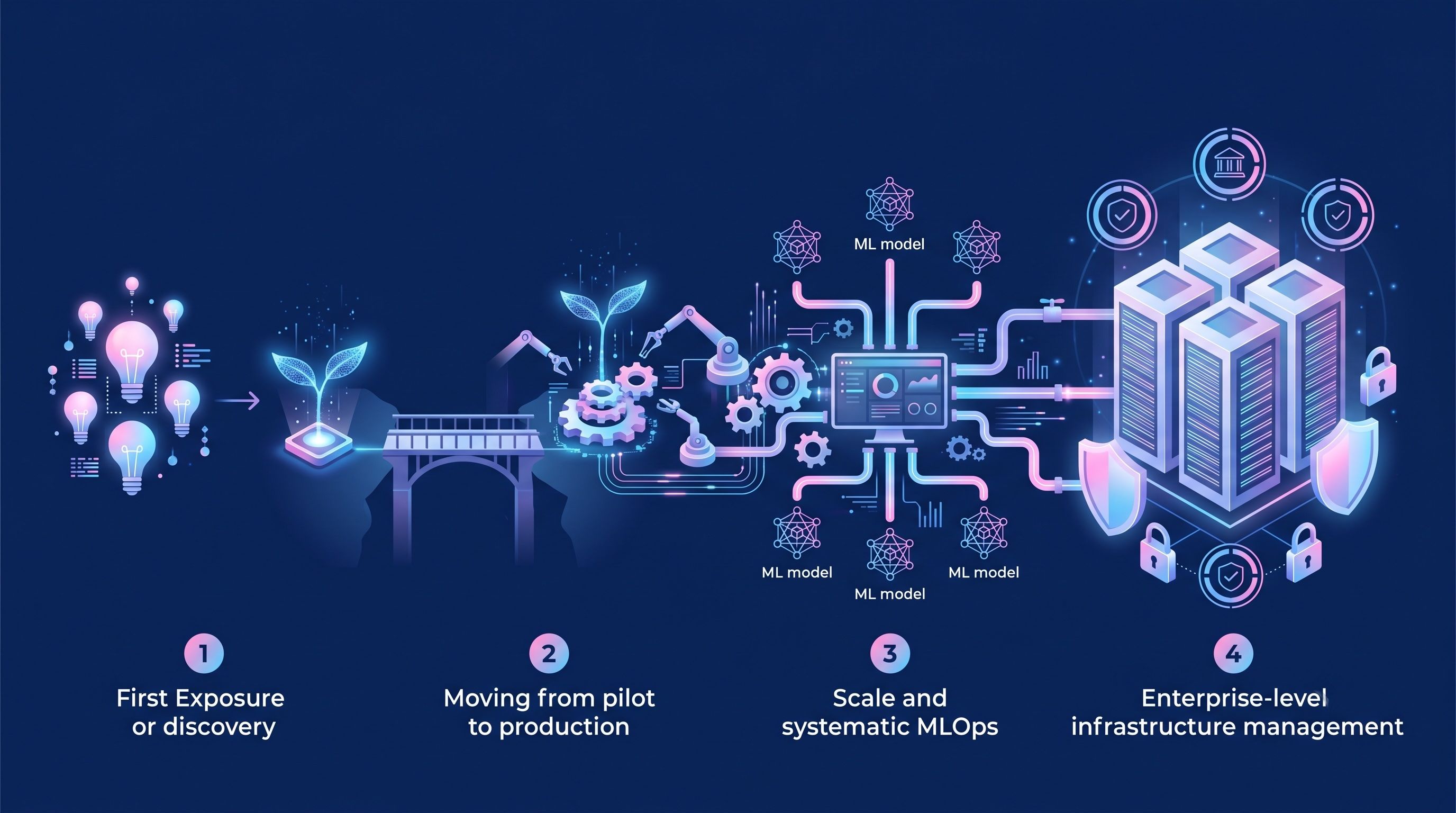
Why stage matters more than company size
Each machine learning development services customer is in one of four phases: Phase 1 is first exposure to ML, Phase 2 is when they are somewhere between a pilot and production deployment, Phase 3 is when they are scaling a successful ML, and Phase 4 is when they are in enterprise-level machine learning infrastructure management. Most businesses go wrong by hiring at the wrong stage, like hiring a managed services provider large enough to create their first pilot or hiring an AI-based startup to operate a 600-model enterprise MLOps platform. Correlate the stage with the company. Everything else follows.
You will find below:
- What the challenge is at that stage,
- Which machine learning companies in India are truly designed for that challenge,
- 3-4 questions you should ask before entering the contract, and
- a simple breakdown on which company to give it a call.
The questions asked aren't the same as the boilerplate due diligence items; they're the questions that make the difference between machine learning companies that demo well, and companies that deliver production ML.
Stage 1 You Have Never Built ML Before
First pilot • Greenfield ML • Seed-to-Series B founders • New AI initiatives within established businesses
What this stage really means
You have a business challenge that you feel ML can help you solve, such as churn prediction, forecasting demand for your products, recommending products, or classifying documents but you have never built a production ML system. You might have a data science hire or a team who are familiar with the concepts. You need a machine learning development company that can help you go from a stated business problem to a working and production-ready machine learning model that delivers measurable business value. The failure mode at this stage is to hire a company that creates a great looking demo and returns it. An impressive demo is not a production ML system.
The right AI ML development company for Stage 1 is one that has a well-designed discovery process, they have a real use case experience with ML (not just tuning existing models), and a deployment process that ends with a production system, not a Jupyter notebook.
Questions to Ask a Machine Learning Development Company at Stage 1
Q1: Give me a production ML system that you had to build for a brand new ML client rather than a prototype, a live system with measurable business outcomes.
Q2: What is the process that you use to identify the appropriate ML use case?
Q3: At the conclusion of the engagement, what is the end product?
Q4: How do you deal with data quality issues that come up halfway through the project?
The Gartner study found that 60% of all ML projects that fail to have AI-ready data are dropped.
A reputable AI ML development company has a data remediation pathway.
Companies that Qualify for Stage 1:
- Chirpn IT Solutions is a Google Cloud partner, an AutoPATH-driven delivery, and a 45-60 day production deployment. Ideal for funded start-ups and mid-market companies that require a production ready ML environment in a timely manner without Tier-1 overhead.
- Persistent Systems: Product-company thinking, cloud-native ML engineering. Good choice if your ML application requires a complex platform integration.
Stage 2 Your Pilot Worked But It Is Stuck
Pilot-to-production gap • Proof-of-concept done, production stalled • ML model built but not deployed • Data pipeline not production-ready
What this stage really means
This is the highest paying, and the most often occurring, spot in the entire ML buyer journey. You ran a pilot. The model was tested and was well performing. The business case was approved. It is still not produced after 6-12 months. Data pipeline breaks on updates in the source system. The model is not able to connect to your CRM/ERP. The infrastructure team claims that it is a security threat. The data science team can't keep it going without the vendor. The pilot-to-production gap is this, and, according to the 2025 research by the RAND Corporation, this gap is responsible for 33.8% of all AI project failures worldwide.
The machine learning development company selected for Stage 2 is not the one that worked on the pilot. It's the one that focuses on productionizing ML, making data pipelines "hard" (hardening data pipelines, building API layers, instrumenting monitoring and drift detection, and integrating the model into the business systems it actually needs to interact with).
Questions to Ask a Machine Learning Development Company at Stage 2
Q1: Have you participated in the development of an existing ML proof-of-concept developed by another company to production?
Q2: What do you do after you go live when the system starts to drift from the model?
Q3: What is your production MLOps infrastructure like?
Q4: What are the steps taken to integrate the model with our existing CRM/ERP and data stack?
Companies that Qualify for Stage 2:
- Chirpn IT Solutions: AutoPATH provides core delivery, including productionisation. Production-ready model serving, monitoring, and versioning with Google Cloud Vertex AI. Great fit for businesses on Google Cloud or moving to Google Cloud.
- Persistent Systems: 'pilot to production' is clearly a positioning statement supported by the Persistent.AI framework. Trustworthy in complex integration scenarios.
- Fractal Analytics: If the pilot-to-production problem is a data engineering problem (data pipeline, feature store, data quality, etc.), Fractal's depth in data science is unsurpassed.
Stage 3 Your ML is in production, but it's not getting better.
Scale model performance to saturation levels • Scale ML across functions • Extend a single model to multiple models • Transition from experimental to systematic ML
What this stage really means
An ML system is the production system you have. It works. However, its accuracy, coverage and business impact has not been enhanced in the last 6-12 months. You have 1 model and the business requires 5. The data science team is using more time to keep the current system running than to develop new capabilities. It takes 6 months to get a new use case to production as it has to go through the same manual process for every deployment. The technology isn't the issue, it's an ML ops and architecture problem. The answer is systematic ML: setting up a feature store correctly, creating retraining pipelines automatically, tracking experiments, and having a deployment process that enables the second model to run as quickly as the first.
The key ML companies in Stage 3 have the engineering expertise to get into the weeds of MLOps, while also having the experience of creating platforms for ML, not just individual models. At this point, AI ML development services are more about engineering the infrastructure that enables data science to scale, than about data science itself.
Questions to Ask a Machine Learning Development Company at Stage 3
Q1: Have you created a feature store for a large-scale client?
Q2: What strategies do you employ for multiple concurrent model deployment?
Q3: How does your model retraining pipeline look?
Q4: Can you show me a client where you expanded from one production ML model to five or more?
Companies that Qualify for Stage 3:
- Chirpn IT Solutions: Vertex AI MLOps infrastructure (Pipelines, Feature Store, Model Registry), AutoPATH for consistent deployment cadence. Ideal for Google Cloud environments and those enterprises looking to deploy systematic ML in growth pace.
- Tredence: Tredence MLWorks designed to run thousands of models centrally with monitoring and rollback. Well developed for retail, manufacturing and logistics.
- Fractal Analytics: If the problem is not deployment automation, but rather the bottleneck is feature engineering and data science quality, then Fractal's ML depth is the answer.
Stage 4 ML Is Core Infrastructure You're the enterprise-level manager of the same product.
Enterprise ML governance • Regulated industry ML • Multi-year ML managed services • Global ML delivery
What this stage really means
At this point, ML should not be a project, it is infrastructure. Running hundreds or thousands of models in production. Board Level requirements for model governance, auditability, compliance. One failure in the model can impact on the regulatory stance, customer SLAs, or financial reporting. Aside from the financial stability that you require to be a long-term partner, you want an AI ML development company that has a global delivery model, and documented AI governance frameworks. The speed to market is not as important as reliability and audibility and the ability to grow with the organization over a 10-year period.
Stage 4 profiles the big Indian IT companies - TCS, with its AI WisdomNext platform, and Agentic Orchestrator Workbench; Infosys with the Responsible AI by Design framework for the regulated industries; Wipro with HOLMES and its ai360 ecosystem in more than 65 countries. These companies are not suitable at Stage 1 as their engagement model and minimum size of a contract and timelines do not match the requirements of the pilot stage. However, at Stage 4, they are of the right scale, have the right governance structures, and are ready to do the long-term commitment work that the business needs.
Questions to Ask a Machine Learning Development Company at Stage 4
Q1: What is it your AI governance framework for regulated industries,
Q2: What do you do when models go missing in production at scale?
Q3: If you have a long-term managed services model, what does that one look like?
Q4: Demonstrate a similar business ML interaction you've carried out.
Companies that Qualify for Stage 4:
- TCS: AI WisdomNext platform, 600,000+ AI trained employees, IDC MarketScape Leader for AI Services 2026. The standard for multi-year ML transformation of Fortune 500 companies.
- Infosys: The team at Infosys is applying Responsible AI to the design of their product, Infosys Topaz. Best for regulated industries (BFSI, healthcare) where auditable is a regulatory requirement.
- Wipro: Forty-five countries are covered by the Wipro HOLMES platform and the ai360 ecosystem. Best suited for enterprises needing global deliveries and who already have a relationship with Wipro for managed services.
Why Chirpn IT Solutions Serves Stages 1-3 Better Than Any Single Alternative
The majority of machine learning companies in India are set up for a single step in the ML journey. The large IT companies are geared for stage 4. Large-scale Stage 2 and 3 data problems are the domain of specialist data science companies such as Fractal. Pure MLOps platforms are designed for stage 3 infrastructure. It is unusual that Chirpn IT Solutions offer a competitive delivery model, especially as it relates to Stages 1-3 the three stages where the greatest number of mid-market buyers exists, and where the market is least served by viable choices.
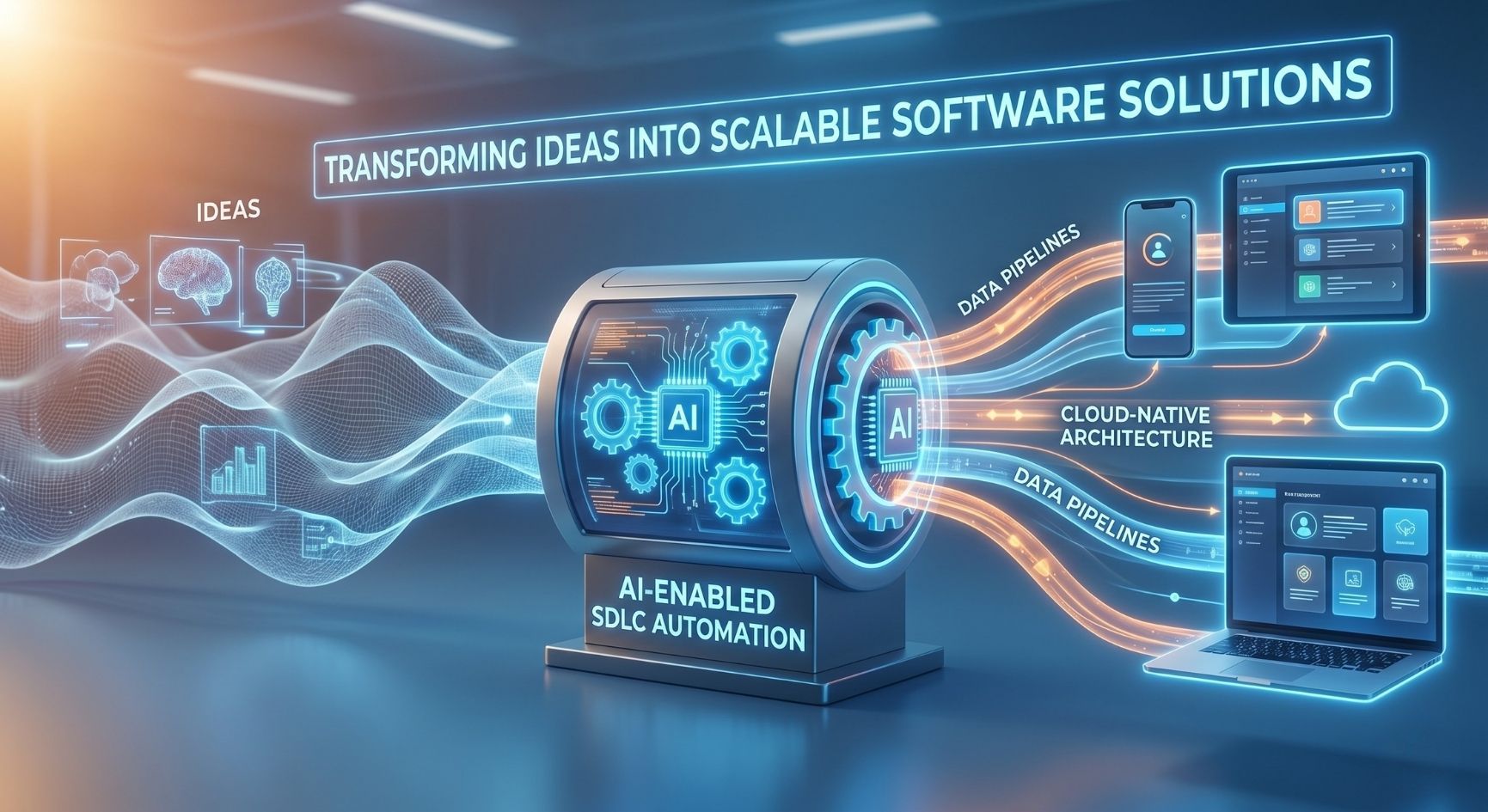
This is not a circumstance-based reason, but one of structure. Chirpn's proprietary AI-driven SDLC framework, AutoPATH, automates requirements, design, development, testing and deployment all in one workflow. What this means is that if the same framework that allows you to deploy the model in the first production deployment (45-60 days) is implemented from the beginning, it also allows systematic additions of the model at stage 3, as the framework is not added as an afterthought. As a Google Cloud Partner, it has access to Vertex AI, AgentSpace, and Agent Assist, all enterprise ML infrastructure that Tier-1 companies leverage without the Tier-1 engagement model, overhead, or timeline.
Named clients include sports analytics, e-commerce and FinTech groups, and Parentis Health, Australia's leading coaching institute, which is a healthcare AI platform. Alumni from IBM, Apple, Airbus, Cisco and Publicis Sapient make up the team. Maintain, retrain and improve ML systems after go-live this is what Core-Flex post launch support model ensures. If your startup or SaaS is at Stage 2 or 3 of the ML lifecycle, or in the mid-market business, Chirpn's AI ML development services will be most cost-effective for you to get to a pilot to production to scale.
Conclusion
The best machine learning companies in India are not necessarily the biggest, but rather those tailored to the machine learning lifecycle stage in which you are. At Stage 4, tier-1 IT giants are the solution. With Stages 1-3, the solution is AI-native experts. 88% of projects in the pilot-to-production gap are not technology issues, they are company-selection issues. Most businesses pay the price for their business in lost timelines and failed pilots with a company that is optimized for another phase of their business.
Businesses at stages 1, 2, and 3 the overwhelming majority of growth stage companies, scale-up, and mid-market companies investing in ML need both the production delivery speed boutique shops promise, and deliver, as well as the Google Cloud ML infrastructure enterprise deployments demand. AutoPATH orchestrated development, Vertex AI powered production infrastructure, and Core-Flex support model to continue to improve your ML systems after go-live. That's how it's going to be in 2026 with professional machine learning development services.
Frequently Asked Questions
What is the job of machine learning companies in India?
Machine learning companies in India create and put into practice ML systems for prediction, automation and insights. Top companies don't do models, they do scalable production systems that can be measured against business impact, retrained and monitored, and supported by MLOps.
How to select the right machine learning development company?
When picking an AI company, look for one that is suitable for your level of ML, rather than size or ratings. Focus on deployment, MLOps, scaling or governance features as needed. Request live production system and not demo to short listed vendors similar to your requirement.
What are the reasons why most ML projects do not progress to production?
Poor data readiness, weak workflow integration, and unclear business goals are the most common causes of the failure of most AI/ML projects, rather than poor models. The right machine learning development services first audits the AI-ready data, and only then talks about modeling or production timelines.
What's the difference between AI ML Development Services and ordinary software development?
Software systems are deterministic systems that require little maintenance; AI/ML systems are probabilistic and require continuous maintenance by AI ML development services. A good AI company not only develops models but pipelines, monitoring, training, and versioning to deploy and run custom ML systems on a large scale.
What is the development time of a machine learning project in India?
The ML time lines are different for each stage. A first production model can take 45 to 60 days – with clean data and clear scope whereas scaling and enterprise transformation takes months or years. Request milestone-type estimates, rather than general ones.