



There was a time when a classroom of 30 students used to receive one pace and one worksheet, and one chance to learn a concept before moving on. That's changing.
According to AI in Education report by IDC, in partnership with Microsoft, 86% of education organizations already use generative AI in some capacity in 2025, a figure that's less about novelty and more about realizing that AI in education can offer the personalization that teachers have long aspired to but never had the time to create themselves.
Let's cover the current landscape of the application of artificial intelligence in education, the numbers behind it, where the actual pitfalls lie, and the cost of a properly built AI-powered education platform.
Key Takeaways
- By 2025, 86% of education organizations are utilizing generative AI in some capacity (IDC/Microsoft, 2025), and the majority of institutions already use AI for content delivery or administrative support, with adoption rapidly gaining momentum since 2023.
- Students in adaptive learning schools demonstrated significantly higher growth in two school years than students in other schools, according to a study by the RAND Corporation (RAND Corporation, Continued Progress: Promising Evidence on Personalized Learning, 2015).
- AI grading tools can free up hours of teachers' time by cutting down on grading, allowing for more time to be spent on instruction and student support.
- The downside is that there are counterbalances like data privacy, algorithmic bias, and unequal access are unsettled in most institutions.
What are the current uses of AI in education?
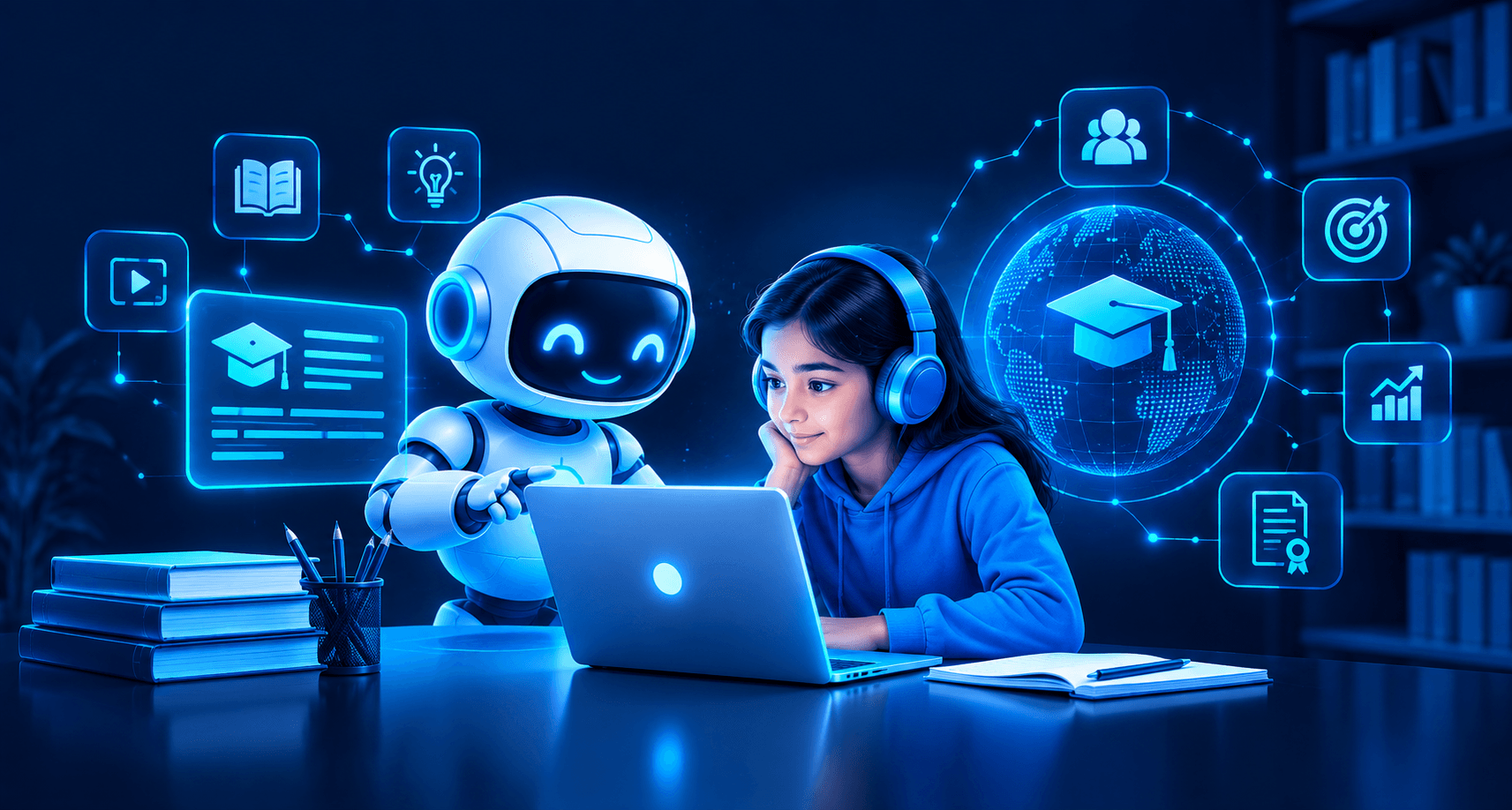
AI and education in today's landscape primarily intersect in four areas: personalized learning, automated administrative tasks, AI tutoring, and predictive analytics in student performance. These address specific capacity issues: teachers' time is limited to provide individualized instruction for each student, and administrators' time is limited to process the myriad of documents that a modern school district produces.
Personalized learning platforms offer students different levels of difficulty for content based on each student's performance during the activity. It is the sort of approach that is well adopted by Duolingo and Coursera, as they vary the level of difficulty and the order of exercises based on the individual learner, not a set course.
In addition to the more visible portion of the transition from paper to electronic enrollment processing, scheduling, and routine communications that take up staff time, administrative automation streamlines the less glamorous tasks. According to HolonIQ's Global EdTech Market Landscape, 65% of education institutions were using AI for content delivery and administrative support, compared to a much smaller percentage a few years ago.
Chatbot tutoring provides assistance outside of school hours. But when a student gets hung up on a homework problem at 9 P.M. and doesn't need to wait until the next class period to get an explanation, institutions that have adopted conversational AI tools have reported measurable gains in engagement, with the amounts differing widely by implementation and subject.
Learn more about Chirpn's artificial intelligence and machine learning development services
What about the actual outcomes of Personalized Learning?
The research, peer-reviewed, correlates measurable academic improvements with personalized, AI-driven learning paths. Students in the 62 schools studied by the RAND Corporation made significantly more progress after two school years than students at similar schools without personalized learning, and students who started out behind were making progress toward the national average. Implementation and institutional context is a major determinant of gains.
That gain is simple: a student who is stuck doesn't sit stuck. With adaptive systems, teachers can recognize student's difficulty in mastering a concept and adapt by adjusting pacing or returning to previous skills or concepts before proceeding rather than going through the program at standard pacing.
There's also a dropout risk factor. According to EDUCAUSE Review, Georgia State University's AI-powered early-alert chatbot which identifies indicators of disengagement prior to a student's official graduation, lowered summer melt (accepted students who do not enroll) by 22%. Any time a school or institution sees a meaningful drop in dropout rates, it's a worthy achievement, especially for community colleges and online programs where the trend is most difficult to make a difference.
All this does not imply that a great teacher is less effective than AI. It implies that AI is able to identify issues. A really good teacher with 150 students in five class periods just doesn't have enough bandwidth.
How can AI help teachers and administrators?
Perhaps the most direct, and least contentious, victory for AI in education is time. Time saved by using AI-assisted grading tools ranges from more than half of the grading time prior to their use, and wider administrative automation has been linked to efficiency gains around 30% in institutions that have implemented it early.
That time is not lost, it is usually transferred to direct teaching, office hours and the one-on-one assistance that attracted most teachers to the profession. A study by the World Economic Forum estimated that about 40% of the tasks performed by teachers can be automated over the next 10 years, including grading, scheduling, and routine feedback, but not teaching.
This is what Chirpn experienced first-hand when developing a learning management system from scratch for an education client from Australia. The platform had to facilitate the automatic enrollment and monitoring of enrollments without increasing the number of people in the administrative office, which affected almost all of the decisions made in the architecture of the project.
Check out the complete case study of an EdTech Platform from Australia.
What are the True Risks surrounding AI in Education?
The honest risk of the deployment of AI education is not that the technology fails to work, it's that the technology works well enough that it seems to work with some students, but not others. The review of EdTech identified that 96% of the applications shared student related data with third parties, which in many instances is likely in violation of student privacy laws such as FERPA and COPPA in the United States (Me2B Alliance, Student EdTech Research, 2021). Since then, the trend has followed an upward trajectory with the rise of AI-powered tools in the market.
When it comes to implementing AI in institutions, three risk categories keep appearing:
Data privacy exposure. Student information passing through third party AI vendors without transparency and without retention limits, or even with behavioral restrictions in place.
Algorithmic bias. Algorithms designed to achieve a particular set of results on past data can repeat and reinforce exactly the same achievement gap, especially for students in low-resourced schools.
Unequal access. Personalized AI tools also rely on having students with access to reliable internet and a device to access it, a requirement that is not the case for all districts and can do more harm than good when it comes to narrowing the digital divide between well-resourced and under-resourced school districts.
All these risks are arguments against using artificial intelligence for education. They're arguments for integrating compliance and equity into the design from the start and not at the end.
Chirpn's platform and product development approach
How Much Does an AI-Powered Education Platform Cost?
The price of an AI-driven EdTech platform can vary widely based on its scope and architecture. At one end of the spectrum is a narrow single-feature tool and at the other end is a broad, personalised learning, analytics and LMS-enabled platform. The destination of a particular project will largely rely on two considerations: the number of student data sources the project needs to connect with and the amount of compliance work that must be loaded into the architecture or done later in the development process (either FERPA or COPPA, or regionally equivalent compliance). The latter is nearly always more costly than the design-in approach.
At the bottom end of this range is a narrow proof-of-concept - say, a single AI tutoring chatbot. A full institution platform on top of it, for enrollment, personalized content delivery, grading automation and analytics for an entire school or university system, with a build time of months, not weeks.
Future of AI in Education?
AI for education has been predicted to expand significantly over the next ten years. Based on an industry market analysis with a compound annual growth rate of approximately 35%, the market is estimated to hit approximately $7 billion in the mid-2020s and more than $100 billion in the mid-2030s (market analysis, 2025). Projections beyond that time are directional not definitive, but the growth described in that trend can be seen in classrooms now.
The next phase is not likely to be characterized by showier models. It will be marked by which institutions succeed in addressing compliance and equity issues so as to implement AI at scale rather than in pilot programs, which are not applicable to all learners.
Conclusion
Artificial intelligence education is no longer a prediction, but a reality. As of 2025, 86% of education organizations already had experience with generative AI, with statistics supporting the reasons for their use of personalized learning and dropout prevention. The institutions that are getting real value are the ones who integrated aspects of data privacy, equity, and compliance from the ground-up and didn't just add it as an afterthought.
When developing an LMS from scratch for Talent100, Chirpn's platform and product development team has created just such a foundation, and created it without sacrificing any level of data handling capabilities. If you're evaluating an AI-powered education platform and wish to discuss architecture decisions up front, reach out to Chirpn for insights on what a well-designed AI education platform entails.
Frequently Asked Questions
What are some examples of how AI is being applied in education?
Current uses of AI in education include tailored learning pathways, automated marking, administrative automation, and AI-powered chatbots providing tutoring at any time. According to IDC/Microsoft (2025), 86% of education organizations are using Generative AI, which represents the largest rate of adoption across all industries.
Is AI in education really effective at enhancing learning outcomes?
Evidence is indeed promising, but limited. Both of these results were found in studies conducted by RAND Corporation and Georgia State University's early-warning AI system that reduced summer melt by 22%, not a promise for every implementation.
What are the risks of implementing AI in schools?
Student privacy concerns, the potential for perpetuating inequities of achievement through algorithmic bias, and the lack of access for students without adequate devices and internet connection are the primary concerns. The EdTech applications surveyed revealed 96% were sharing student data with third parties, creating an actual compliance risk under FERPA and COPPA (Me2B Alliance, 2021).
What is the price of developing an AI-driven EdTech solution?
The cost is mainly dependent upon scope, complexity of integration and compliance requirements. A single-feature AI tool is at the bottom and a comprehensive platform with personalized learning, automated marking and analytics is much higher. The real cost driver is the number of student data sources that the system needs to integrate with and whether compliance frameworks like FERPA and COPPA are built into the system from the ground up or bolted on.