



An AI MVP fails the same way most MVPs fail, because not enough people checked whether the problem needed to be solved before the team began to build it. Product School research into the outcomes of MVPs revealed that about one-third of MVPs never achieve their goals, while CB Insights has consistently identified "no market need" as a top reason for the failure of startups to succeed. Adding AI into the mix doesn't remove that risk. It simply provides a new method for the founders to evade it with a mesmerizing demo.
This guide takes you through the process of building an AI MVP for a startup, from things to think about before coding one line, to a 6-step process for building, to understanding the cost by complexity tier, and what mistakes drain your runway the quickest.
What is an AI MVP and What Makes It Different From a Regular MVP?
An AI MVP is an MVP focused on testing an AI capability, rather than a UI feature or workflow. A normal MVP confirms if users require a remedy to an issue. An AI MVP is a test of two things: does the user need the solution and can an AI model reliably provide it at a level that is useful?
The second layer alters the build. Even if the UI is not as polished as it could be with a more traditional MVP it can still make its point. Hallucinating, providing inconsistent answers, or taking 10 seconds to respond will quickly erode user trust, before a user has even had a chance to see if the AI product is a good fit. That's why hosted models and existing APIs are more heavily utilized in the early days of AI MVP development. The aim is to test the product idea and not to show that you can train a model from scratch.
There Are Two Decisions To Make Before You Build
There are two questions that are often confused in the mind of the founder before starting any product development with AI:
The practical application of AI to the product. It is the model, the particular feature of the model, and the data loop that continuously enhances the model. You get it wrong and you're sending a product that works, but hasn't sold a single copy.
What tools and processes you use to make the product quicker. This is your tech stack, your AI-assisted coding and your development framework. In fact, a good idea will take twice as long and twice the budget if this step is not done right.
Founders who mix up these two decisions will invariably invest too much in model work before they've been told that there's a "no" for the product that the custom model work is for.
The 6 Step Process to Building an AI MVP
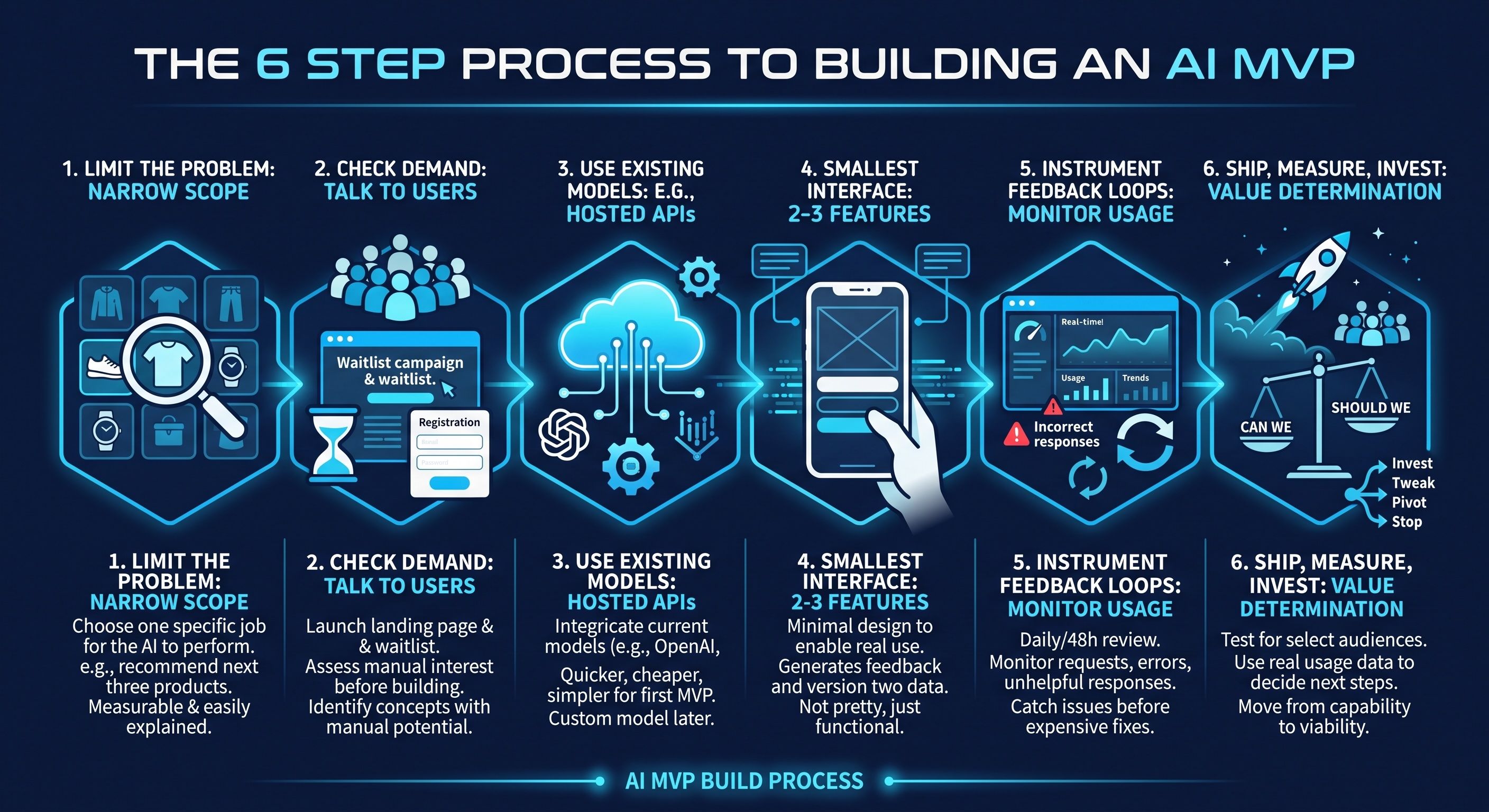
1. Limit the problem to one AI powered outcome
Choose one specific job for the AI to perform – don't use "personalization" but use "recommend the next three products based on a user's last purchase. A narrow scope is more easily measurable, more easily explained to users, and more easily priced as well.
2. Check out demand before working on a model.
Discuss with potential users, or launch a landing page and a waitlist campaign to your target audience. An AI layer will not make any difference if no one registers to solve the problem manually. By doing this, you will be able to see a high percentage of concepts that might have been lost after months of working on the MVP.
3. Use hosted models and existing APIs rather than custom builds
Generally, it makes much quicker, simpler, and less expensive sense to integrate an existing model (OpenAI, Anthropic, Google's Gemini with Vertex AI, or an open-weight model) than to train a proprietary one for a first AI MVP. Custom model development comes after, once you see that a generic model isn't working for you.
4. Make the smallest possible interface that can fit it.
There are two-3 features maximizing. The interface is designed to enable real people to use the AI capability, provide feedback and generate the data used to develop version two – it is not meant to be pretty.
5. Instrument feedback loops from day one
Monitor users' requests, where the AI provides an incorrect or unhelpful response, and where users stop the flow. Such short cycles of daily or every 48 to 72 hours review will bring to light issues before they become expensive fixes.
6. Ship, measure, and make investment decisions on what's worth further investing.
Test for a select few audiences before mass audiences. Based on real usage data rather than internal opinion, determine if there's more value to investing further in the AI capability, tweaking or pivoting the feature or killing it off. This is when AI product development becomes from "can we build this?" to "should we continue to build this?".
AI MVP Development Cost
Of all the questions that are asked in this space, and none of the guides mention it, there's one that is often asked and never answered: MVP development cost. The honest answer is that there is no such thing as a standard price tag and the reasons which determine the cost are fairly unique and, if you don't understand what they are, you shouldn't ask anyone for a price tag.
The three most significant factors that drive up AI MVP development costs are:
The amount of custom data infrastructure required by the product. A feature which conflicts with an existing, clean dataset is easy to validate. You need to add real engineering time before you even get to the AI layer, because a feature requires new data pipelines, new labeling or a proprietary dataset that needs to be created from scratch.
The number of third-party systems it will need to combine with. An independent AI capability is much easier to define and cost than any that needs to integrate with CRM or even existing identities or legacy systems.
If compliance requirements are included in the build. In regulated industries such as Healthcare, Finance, and other regulated areas, there are additional features for architecture and review work encryption, audit trail, and access control that a general purpose MVP would not have.
Once you can answer those three questions (which is probably after you've been well involved in the build), you should get a scoped estimate from the people building it, not from a blog post that doesn't have any insight into your particular build.
The same applies to timelines narrowly scoped AI MVP with hosted models is quicker than a hosted model with custom data pipelines and multiple integrations. Any timeline (or cost) given without context to your scope is a best guess, not a plan.
Common Mistakes That Burn Startup Runway
Building of the model prior to the validation of the problem. Teams that begin with the AI capability and then try to work up to a use case often take months to develop something that was not requested.
Pursuing numbers for accuracy that don't matter to the user. While a 60% accuracy rate might look good in a demo, 40% could destroy the user's trust in a recommendation engine while 60% could maintain it.
Skipping explainability. Users don't use AI tools that they don't comprehend or believe in. Even if the underlying model performs well, abandoned sessions will occur when an MVP can't explain itself to a user why it made a recommendation.
Approaching in-house and outsourced AI product development as an either/or situation. Many startups progress faster and further by leveraging an AI product development company to develop and ship the infrastructure layer (data pipelines, model integration, testing, deployment) while the internal team concentrates on the type of products they can decide to build.
The approach taken by Chirpn's platform and product development team has been to develop an LMS platform from scratch using an AI-driven build process through the AutoPATH framework that validates scope early and compresses the build and testing process instead of the validation process.
Conclusion
When building an AI MVP for a startup, it is all about sequencing: validate the problem first, test with hosted AI and pre-existing APIs quickly and at minimal cost, and then use actual usage data, rather than assumptions, to decide what to build next. Don't rely on any number but on a complexity level, and don't believe any guarantee that contains a six-week timeframe with no source to back it up.
Looking to scope an AI MVP? If you're in need of a second opinion on a build plan or estimate of the cost, reach out to Chirpn, and learn about the way our AI and ML team think in the first ninety days.
Frequently Asked Questions.
What is the price of AI MVP Development?
The cost is largely dependent on three factors: amount of custom data infrastructure required, number of systems to be integrated, and compliance-requiring systems (such as those in healthcare or finance). A "scoped" estimate is available after you understand the three factors: the scope of the MVP (one feature vs. multiple features), hosted vs. custom pipelines, and regulatory review. A single-feature MVP is significantly less expensive than a many-features or many-integrations or regulatory-reviewed MVP.
How long does it take to build an AI MVP?
A quick development of an AI MVP with hosted models is possible in about 6–10 weeks if it is built in a narrow scope. Data pipelines that are custom-built, require multiple integrations or regulatory requirements are generally 4-6 months in duration. No timelines should be guaranteed and they should always be linked to scope.
Should a start-up develop an AI in-house or rely on an AI product development company?
Both can work. In-house teams provide more product control, but require more time to get to a working prototype and may need to build an existing AI infrastructure. An experienced AI product development company will have a proven build process and experience with pre-existing model integration, which typically reduces the time needed to get from idea to testable product, especially for a first AI MVP.
What's the difference between an MVP and an AI MVP?
The typical MVP test is a question about whether users want a proposed solution. That also means that an AI MVP doesn't rely on custom-built AI in the initial version, but on hosted models and close feedback loops, as the reliability of the AI model is a key factor in whether consumers will use it, or not.