



Only 34% of organizations are truly transforming their business with AI. The rest over 6 in 10 companies are still piling AI on a set of unchanged processes, according to a survey of 3,235 business leaders in 24 countries by Deloitte that was shared with the CFO Network. Each year, there are roundups of the latest artificial intelligence trends, and many of the latest AI trends articles rehash the same list that AI is changing the world of business. The better question is which trends are that and which are only conference stage hype.
In this guide, we run through top AI trends every business should know that businesses are hearing about in 2026 through this same test: hype vs. real-world research vs. the implications for a business that needs to decide where to invest in AI. 6 trends and no buzzword recycling – just the facts about agentic AI, generative AI, enterprise transformation, multimodal AI, workforce automation and AI governance.
Why Most 'AI Trend' Lists Are Wrong
The standard trends in AI quick list consists of eight or 10 buzzwords, each with a sentence of description, and no real idea of how far any of the up to date trends go within a typical business. In that format, it exults the technology and doesn't really give a reader considering enterprise ai solutions much of an idea on whether they are running ahead of or behind their business peers.
Deloitte's research, on the other hand, makes a clear distinction: 34% of the institutions are already engaged in a real deep transformation with AI, 30% in reengineering processes around AI and 37% are using AI at the surface level without major changes in the way they work. Each of the general trends below is true of one of three vastly different realities behind every "AI is transforming business" headline.
The State of AI Adoption Behind Every Trend Below
These numbers that enclose each trend in this guide:
- 34% of organizations are going for real change. 37% are at a superficial level.
- 25% now report AI is having a transformative effect on their company. The percentages of companies reporting an increase over the prior year in both revenues and net income rose, and exceeded the 12% reported a year earlier.
- 84% of organizations report growing investments in AI.
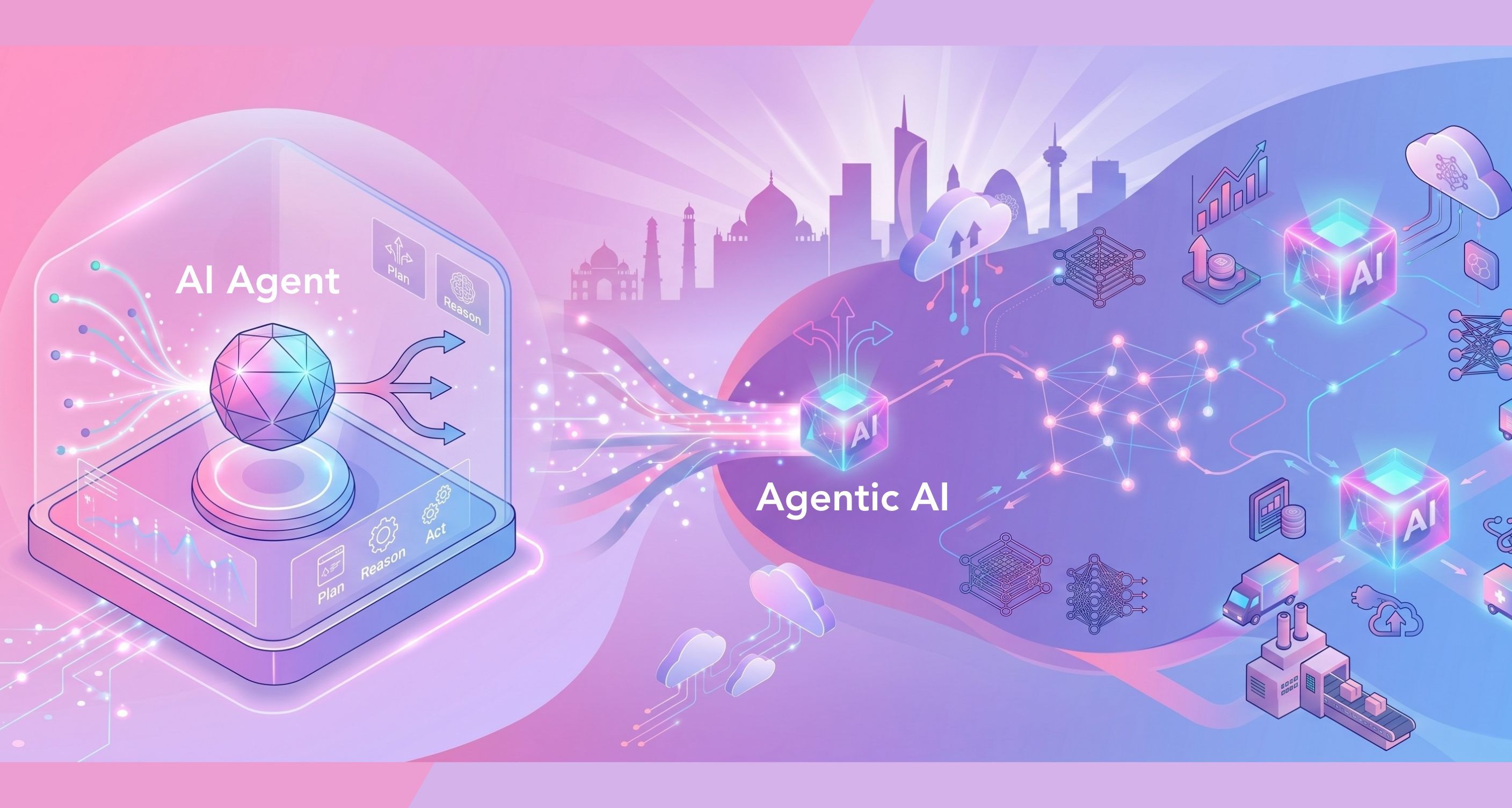
- 23% of businesses are now leveraging at least some agentic AI moderately expected to rapidly increase to 74% in two years.
- 40% of enterprise applications will feature task specific AI agents by the end of 2026, up from under 5% in 2025.
- 60% of workers now have access to sanctioned AI tools, up from less than 40% a year ago, but less than 60% of it is utilized by those who have access in their day-to-day work routines.
Six AI Trends, and What the Data Actually Says About
Trends follow a similar pattern every time in that the claim you'll hear at conferences or other trendy roundups this time is followed by the name of a research firm that tells the true story and finally the practical implication for a business that must make investment decisions.
Trend 1: Agentic AI
The Buzz: By the end of this year, whole categories of knowledge tasks are expected to be replaced by autonomous AI agents.
Data Reveals: that 74% of companies are using agentic AI at least moderately, which will increase to 74% in two years, a truly fast pace of growth. However, Gartner's governance research indicates that adoption is well ahead of the identity management and oversight infrastructure which the autonomous agents of governance need – and more is growing than businesses can safely govern.
What this means for your business: Agentic AI is not a trick or a fad, it is a trend that is here now and it is a trend that is moving quickly – and the companies that are succeeding with AI agents are investing in oversight, audit trails, future escalation processes and clear guidelines on what this new tool can do on its own, not just deploying agents and adding governance later.
Trend 2: Generative AI beyond the Chatbot.
The Buzz: One of the most over-hyped generative AI trends is that it can affect every aspect of your business from marketing copy to your core product engineering all at once, seemingly overnight.
Data Reveals: that 84% of companies are investing more in GenAI, with code generation, content generation, and customer service identified as the most promising use cases by leaders. However, just 34% of organizations are adopting AI, whether generative or otherwise, to pursue deep transformation; most are just using GenAI to tackle specific tasks without rethinking processes.
What it means for your business: The companies that are seeing disproportionate returns from generative AI are not the ones who have the most AI tools implemented, they are the ones who rethought an existing process around what generative AI has made possible.
Trend 3: Enterprise-Wide AI Transformation.
The Buzz: Most businesses are already using AI to work in a new way and companies that do not have a company-wide AI strategy are heading down a path that is impossible to reverse.
Data Reveals: 25% of organizations now say that AI is making an impact on their company, more than double the percentage of 12% a year ago measurable progress indeed. However, three in four businesses haven’t yet gotten there either, and the AI skills gap is the top challenge mentioned for increased integration.
What this means for your business: Enterprise AI transformation is gaining momentum but is not yet the norm. A business which has yet to reach that point is not behind the 25% of businesses that have reached it, only half that number, so the urgency is significantly different.
Trend 4: Multimodal AI
The Buzz: An AI system exists that will soon be capable of understanding and creating any mix of text, image, audio, and video without any specific tools.
Data Reveals: Multimodal AI is growing at a fast pace and is expected to experience substantial growth until 2034. Meanwhile, there is a countertrend in how it is used: instead of a single, all-purpose model doing all, providers are starting to provide libraries of small models that are optimized for particular use cases; one visible example is Microsoft's Model-as-a-Service approach.
What this means for your business: The practical multimodal AI trend in 2026 won't be one AI model that will replace all the specialized tools it will be picking the right smaller, specialized AI model for each specific use case, not waiting for or over-investing in an AI model that does everything well.
Trend 5: AI-powered workforce automation
The Buzz: With universal access to the tools, manual labor is getting replaced by AI automation all across the organization.
Data Reveals: In one year, the number of workers using sanctioned AI tools jumped from less than 40% to approximately 60%. That's a legitimate and rapid increase. Of those who do have access, however, less than 60% use the tools in their daily workflow and this share is relatively consistent from year to year. Access is growing much faster than adoption.
What it means for your business: Rolling out AI automation tools organization-wide solves the access problem, not the adoption problem. Those companies that report real productivity improvements are pairing the introduction of tools with workflow reengineering and training – seeing implementation as a separate issue, not just an extension of distribution.
Trend 6: AI Governance and Sovereignty.
The Buzz: AI governance is a legal or compliance task box and only applicable in highly regulated sectors.
Data Reveals: This isn't a regulatory issue it's not, it's an agreement among nearly all executives that taking artificial intelligence sovereignty into business strategy will be critical in 2026, whether it comes to data residency, model accountability, or management of how autonomous systems operate. This further adds to the agency AI governance gap mentioned in Trend 1.
What it means for your business: AI governance is no longer a compliance checkbox, it's now part of your business strategy, and there's a chasm between the percentage of executives who believe it's relevant and the percentage of companies who've successfully implemented it – that's where the accountability risk from agentic AI will focus.
The Pattern Underneath All Six Trends
All the trends in this guide have one thing in common: They develop in the same way – a real, documented technological momentum is combined with a gap between adoption and value which is not mentioned in most trend coverage. Agentic AI is rapidly evolving and out pacing itself in governance. Deep transformation remains a minority endeavor, but generative AI investment is growing. The scale of access to tools is increasing, but their use is not keeping pace.
It is that pattern that’s the actual lesson to be learned by any business that is considering organization business AI solutions and is formulating its 2026 business ai strategy around these trends: the technology curve and the value-capture curve are not the same curve, and the businesses in Deloitte's 34% deep-transformation group are the ones that made closing that specific gap their main business strategy, not a footnote to technology adoption.
How Chirpn Builds For The Data And Not The Hype
Each trend in this guide comes with a hype version and a data version, and it's the gap between them that is where most AI investments sink. Chirpn IT Solutions is built in a way that ensures that client engagements are on the data side of that divide, on all six trends not just the ones that are "easy to pitch.
On agentic AI: Chirpn's Google Cloud Partner infrastructure, such as Agent Assist and Vertex AI, is designed from the ground up to address the governance gap in Trend 1 the Governance Gap is never an afterthought, but rather a core component of the product. On enterprise transformation and generative AI: AutoPATH was created because Chirpn's AI-enabled SDLC process is not just using AI as an add-on to the same SDLC process, but is transforming the process itself to work with AI.
The adoption-versus-usage gap that has been identified throughout trends 4, 5 and 6 is the same pattern that Deloitte identified with workforce AI access and that Chirpn's Core-Flex model is aiming to tackle. So every engagement will be designed and scoped to include post launch support, for the client's AI system to be adopted and upgraded, rather than deployed and just left to sit at the industry average 60% underutilization rate indicated by the workforce data.
Need some guidance on which side of the hype/mistake divide is your AI strategy on? Talk to Chirpn.
Conclusion
So concluding top ai trends every business should know we understood that the AI trends for 2026 are not the ones with the most happening names: They're the ones that have a noticeable difference between the hype and hard facts, because it's where competition or wasted investments are won or lost. Agentic AI, generative AI, enterprise transformation, multimodal AI, the changing of the guard, and governance are all well-established trends. While all these AI technology trends have the potential to bring value to a business, they do not do so by default.
The 34% deep-transformation figure by Deloitte does the best possible job of summarizing the state of the world: real momentum, but still a minority success, and a huge opportunity for the businesses willing to bridge the gap between adoption and value on any trend from this guide, not just the next buzzword.
Frequently Asked Questions
What are the most important AI trends for companies to be aware of in 2026?
The top 6 AI trends with the most supporting data for 2026 are:
1. Agentic AI (growing, to become 74% of enterprises using AI in two years or less),
2. Generative AI beyond Chatbots and into core work flows,
3. Enterprise-wide AI transformation (still a minority success at 25%),
4. Multimodal AI (moving toward smaller, more specialized models),
5. AI workforce automation: Access vs Usage, and
6. AI Governance – it's a near-universal executive priority.
All these machine learning trends and AI trends demonstrate genuine movement and a natural adoption gap that should be understood prior to investment.
What's the difference between adoption of AI and transformation of AI?
Adopting AI is when a business has implemented some AI within their business somewhere. According to the Deloitte 2026 Study, AI transformation involves reimagining the core product, process, or business model with the power of AI. As adoption statistics do not tell the whole story when it comes to business impact, only 34% of organizations are in genuine transformation; 66% have surface level AI adoption without a fundamental change in working processes.
Is agentic AI already in use in production?
Yes, and it's picking up speed; 23% of enterprises are currently using agentic AI at least moderately, 74% will be by the end of 2026 and Gartner predicts that by the end of 2026, 40% of enterprise applications will feature task-specific AI agents. But in many organizations, production usage is not always accompanied by identity management and oversight controls that autonomous agents need, with adoption outpacing the governance infrastructure.
What is the future of artificial intelligence for enterprise?
For enterprise, where current trends suggest the future of artificial intelligence for enterprise is more about adoption and transformation than proliferation of tools, here are the key takeaways. The research conducted by Deloitte demonstrates that AI reporting is already having a transformative impact on businesses, more than doubling year over year (from 12% to 25%), pointing to the path of increased integration; however, most enterprises have yet to reach that level of impact, and the next few years represent a genuine competitive window.
What are the key differences between generative AI and AI automation?
Generative AI produces new content, code or output (such as text or image, analysis) based on what it has learned. AI automation uses AI, generative or otherwise, to automate work and tasks that are currently paper-based. In good practice, the two are now overlapping, but these trends figures indicate that the highest-value businesses are applying generative AI to reimagine a workflow, rather than simply to automate the steps of an existing workflow faster.
What to expect in AI Governance Trends for Businesses?
The vast majority of executives (93%) now agree that AI sovereignty and governance should be a direct consideration in business strategy, including data residency, model accountability and autonomous systems oversight. The trend is accelerating; in 2026, businesses that deploy AI agents should expect agentic AI to outpace governance infrastructure, making identity management, audit trails, and escalation processes must-haves rather than nice-to-haves.