




Gartner anticipates that AI tools and autonomous agents will account for over 30% of API demand growth through 2026, driven by the fact that AI tools and agents are not humans, but instead are computer programs that enhance and automate various aspects of the API lifecycle. That one projection changes the brief for all the businesses that still consider API integration as a background technical task. The infrastructure that most companies develop to link two applications, most were never developed to work when the calling application is not a human clicking a button, but rather another piece of application software, in this case an AI bot making its own decision.
Imagine a retail company that created their stock API five years ago to update their website with the latest stock in their warehouses every few hours. That API is still in place and is still functioning just as it was supposed to. It was never meant to respond to a real-time query by an AI shopping agent if a specific size is available now at a specific store since that shopping agent did not exist when the API was created. This is the silent failure mode that's pervading enterprise IT: infrastructure that's not broken but built for a world that has passed.
Now this becomes important as the API strategy is lagging far behind what it should be. 82% say they take an API-first approach, but only 25% are actually doing so. This blog discusses the future trends in API integration for modern businesses that are narrowing that divide, the changes that they call for in a modern business, and why it is already cheaper to move now than to put off.
Why API Integration Strategy is in need of a reset, not a refresh.
For 10 years, the majority of enterprise API integration was about how to reliably talk to System B from System A. That shoreline issue remains; it's just not all that. APIs are increasingly the control layer of AI driven decisions; they're not just the plumbing between databases, and that's what API management is going to be responsible for.
The stakes are clearly laid out in the numbers. 99% of organizations have seen major disruption to their businesses due to API vulnerabilities, and the number will only increase as more of the traffic hitting those APIs is from autonomous systems that operate much faster than any man would be able to catch a mistake.
Data that reveals the direction of API integration:
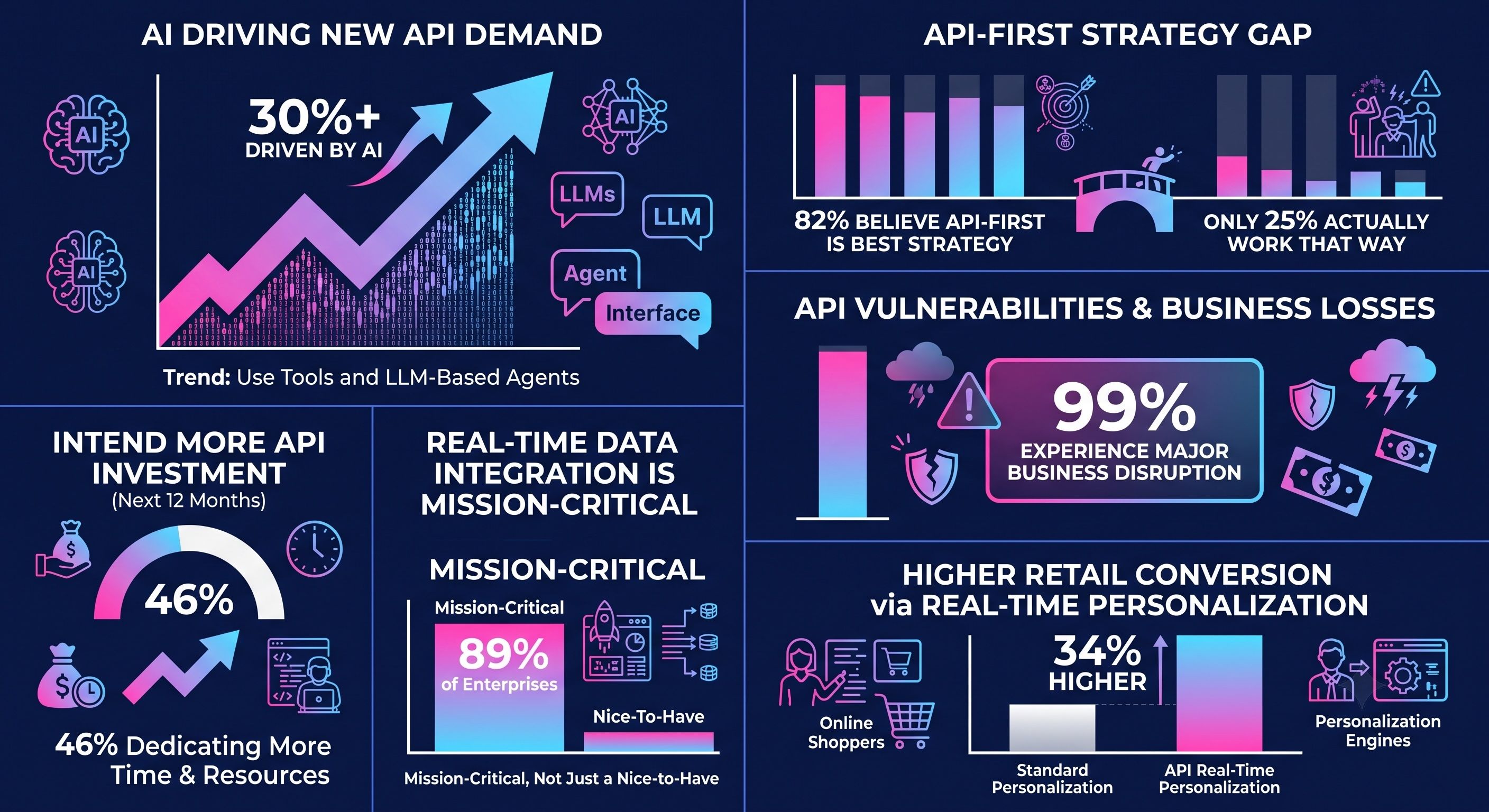
30%+ of the total new API demand is expected to be driven by AI. There is a growing trend toward using tools and LLM-based agents.
82% of organizations say that an API-first approach is the best strategy for achieving their business objectives, but only 25% actually work that way.
46% intend to dedicate more time and resources to their API initiatives over the next 12 months.
99% of organizations experienced major business losses disruption associated with API vulnerabilities.
89% of enterprises say real-time data integration is now mission-critical.
34% higher conversion rates for web services-based retailers using API real-time personalization.
A review of the costs associated with waiting.
There is no abstract risk that resides somewhere down the road. In fact, IBM research already revealed that 53% of executives admitted their AI efforts have been stalled, due to a specific reason not the models themselves, but the fact that they have struggled with API integration.
As to why that gap is so difficult to fill later as opposed to sooner, McKinsey's research provides a number: At present, technical debt is taking up 20-40% of the value of a typical enterprise's entire technology estate and it's accruing at a rate of 1% for every 1% year that passes without action. This isn't a neutral, costless option; it is only going to become more expensive with the passage of time if you are not going to upgrade to bring them into the 21st century.
Three Trends Reshaping API Integration and What Each One Requires
The description for each trend below is provided in a signal format, the hard data that supports the idea that it's already happening, and the specific need it has on any business that's still building an API integration services for the last 10 years.
Trend 1: AI Agents are now a key API consumer.
The signal: More than 30% of new API demand growth through 2026 will be attributable to AI tools built with the help of large language models, rather than human-driven applications, according to Gartner. This transition has been institutionalized via the Model Context Protocol (MCP), which provides APIs directly to AI agents instead of having to scour documentation for the APIs, or use fragile custom connectors.
What it needs now: APIs need typed, machine-readable contracts and identity models that differentiate between a human user, service account, and an independent agent. Only static keys and coarse gateway checks can be safely used to authorize agents to make decisions on your behalf, not just requests. In practice, it means that instead of a customer service agent being able to read an order status, he or she can now actually reissue a refund, a model that was never required in the days when only humans with human judgment possessed it.
Trend 2: API Management Emerging as a Portfolio Governance, rather than Point-to-Point Fixes
The signal: 82% of organizations report that they have embraced an API-First approach, with only 25% strictly embracing it and 46% say they will expand API investment in the coming year, whether they choose to follow an API-first approach ornot. The space between what is said and what is done is where enterprise API integration failures focus.
What it needs now: Greater attention to the fact that each integration is a project in and of itself is no longer scalable. APIs must have clear ownership, versioned contracts and business-wide lifecycle management (a portfolio). Fifteen integrations but no shared ownership model is not 15 times the ability of one integration with a well-governed shared model; it is 15 points of failure; no one is responsible for them as a single entity.
Trend 3: Real-Time, Cloud-Native Integration Is Now the Baseline Expectation
The reality: 89% of businesses view real-time data integration as mission-critical and API-driven retailers that implement real-time personalization experience with a 34% boost in conversion rates. Overnight batch syncs are no longer considered a standard option in customer-facing workflows.
What it needs now: This is what pushes cloud API integration and API automation from optional upgrades to baseline requirements: event driven architectures which immediately push the data out to the cloud when it changes when it changes, not when they scheduled it to change infrastructure that scales automatically rather than crashing when it gets too many data pushes. The retail inventory example that opened this guide is the most obvious form of this requirement: a nightly batch sync can't solve a live question, even if it was constructed to be the best possible answer to the world in which it was created.
What This Means for Any Businesses Evaluating API Development Services
None of these three trends are any "add-on" a business can implement after-the-fact. An API development services provider who is still creating only point-to-point connections for human-triggered workflows, meaning that there's no API automation layer that is creating and delivering data in real-time, is working for a world that is shrinking. The companies that are already seeing 30-34% of these benefits are the businesses that are already making API a true part of their infrastructure and not just a technology afterthought that gets dealt with after it's finished.
It's not about panic: for businesses already in the game with AI features, agent-readiness is key; for those with multiple live integrations, portfolio governance is paramount; and for any business with a customer-facing presence, real-time cloud API integration reigns supreme. It may not be necessary that all three are solved on Day 1 for every business but for every business building new integrations today, it's important to build towards all three, not away from them.
That math should play as big a role as urgency in the sequencing decision from earlier. Technical debt that is already eating up 20-40% of an enterprise's technology estate isn't waiting for a convenient time to simply keep mounting up, so businesses that have already made a move on these three trends are getting further ahead of those still wondering when to begin.
How Chirpn is Building for Where APIs are Heading, Not Where They've Been.
Consider any approach that Chirpn suggests to be tested on those three trends, since it's the only way to determine if any API integration services provider is forward-looking. On agent readiness: Chirpn's Google Cloud Partner status provides direct access to Vertex AI, Google AgentSpace, and Agent Assist a new infrastructure designed for the identity and authorization models that agent-driven API traffic demands as opposed to static keys slapped onto an API gateway that's been around a decade.
On portfolio governance: AutoPATH sees each API connection as a versioned, documented element of the build starting from the requirement stage and does not treat it as a script that needs to be written to a deadline. The difference is in the structure of an integration that can stay as part of an evolving system, and one that has to be rebuilt each time a sixth system joins the mix. For real-time, cloud-native integration: AutoPATH-built systems are deployed natively in Google's cloud infrastructure, and the event-driven data flow is the natural way to do things, not an add-on charge you only discover after the fact.
Businesses that are best positioned for where API integration is going are the ones that had an integration layer that was designed agent aware, governed, and real-time from the beginning.
That is one of the reasons why the timing argument in this guide has nothing to do with Chirpn and is one of the reasons why AutoPATH exists in its current form. If agent readiness, governance, and real-time architecture were not designed from the very first sprint, knowing that they will be required 45-60 days into the project, then this “model” does not work. By the numbers in this guide, it is the more costly alternative each time to wait for a future project to close the gap on today's integration challenges.
Conclusion
The trends in API integration for modern businesses are not simply one technology change, it's three that are going on at the same time: AI agents are now direct API consumers; integration management moves from "one team" to "portfolio governance" and real-time cloud-native architecture is the norm, not the upgrade. Companies that wait until “someday” to worry about such issues will continue to find out the hard way that 99% of companies have already suffered disruption because of API vulnerabilities.
The businesses achieving 30-34% performance improvements mentioned in this guide did not do so reactively when these trends first became mainstream; they did it in anticipation of these trends. In fact, the decision in front of any business that is considering a new API integration project is between building where APIs have been or where they are demonstrably going.
Frequently Asked Questions
What are the biggest trends in API integration in the future?
The three biggest trends are that AI agents are no longer just consuming APIs but are now the main API consumers, API management is no longer a point-to-point fix but an application of portfolio governance, and real-time cloud-native integration is becoming the standard, expected application mode, instead of batch-based syncing. Specifically, Gartner predicts that more than 30% of all new API demand growth through 2026 will be driven by AI tools and agents, the first being the most pressing for enterprises already testing AI capabilities. The stakes are high, and IBM data confirms it: 53% of executives say that AI projects have already been derailed by such a legacy integration challenge.
What impact are AI agents having on API integration and API management?
Without any human interaction with an application interface, the AI agents interact directly with APIs to take specific actions. This has been formalized with the Model Context Protocol (MCP), which enables AI agents to interact with APIs without needing to present its documentation. API management requires more sophisticated identity models to differentiate human, service, and agent traffic, as well as authorization that is context-aware and not merely based on static keys orsimple gateway checks.
What is the difference between traditional API integration and enterprise API integration?
Usually, traditional integration of APIs links two systems for a particular purpose. Enterprise API integration makes all APIs a part of a governed portfolio, assigns clear ownership, defines clear contracts for each version, and manages the lifecycle of APIs within the organization. The difference is significant since 82% of organizations are pursuing an API-first approach, but only 25% have that degree of governance; the other 57% are dealing with enterprise-scale API sprawl using the traditional integration-by-integration approach.
What makes cloud API integration a better option than on-premises middleware?
Real-time data integration is mission critical, with 89% of businesses finding that cloud API integration provides the speed at scale that on-premises middleware simply could not deliver without custom engineering. Eighty-nine percent of businesses say that real-time data integration is mission critical, and cloud API integration is what makes that speed possible at scale: auto-scaling infrastructure, event-driven data flow, and managed services on-premises middleware was never designed to offer. Pairing that infrastructure with API automation combined with real-time data, not scheduled batch jobs makes real-time data available in real time. Personalization businesses that are driven by APIs have seen a 34% improvement in their conversion rate when compared to static, batch-updated personalization systems.
What's the best approach for companies to develop API strategies for the future?
Begin with an audit of where your business stands in regards to the three trends in this guide: Any existing or intended functionality with AI will require access to your data via an agent-aware API, and whether your integrations are still being developed as individual projects or as a managed portfolio, and whether customer facing data still requires batch update. A legitimate API development services provider is able to evaluate your situation on all three fronts rather than just promise a build date. As technical debt rises 20-40% of the total value of the technology estate for every year that goes by, the audit should be commissioned before not after the next integration project begins.