



Legacy Modernization: ESBs to Microservices
Most companies are now moving towards cloud-native environments. According to the CNCF Cloud Native Survey published in January 2026, 98 percent of businesses responded that they were using cloud-native approaches to build applications in some way, while 82 percent of container users and organizations said that they used Kubernetes in production, an increase from 66 percent in 2023. Although most of these companies are moving forward with cloud-native technologies, they continue to rely on a monolithic enterprise service bus developed several years ago to manage their most important business functions.
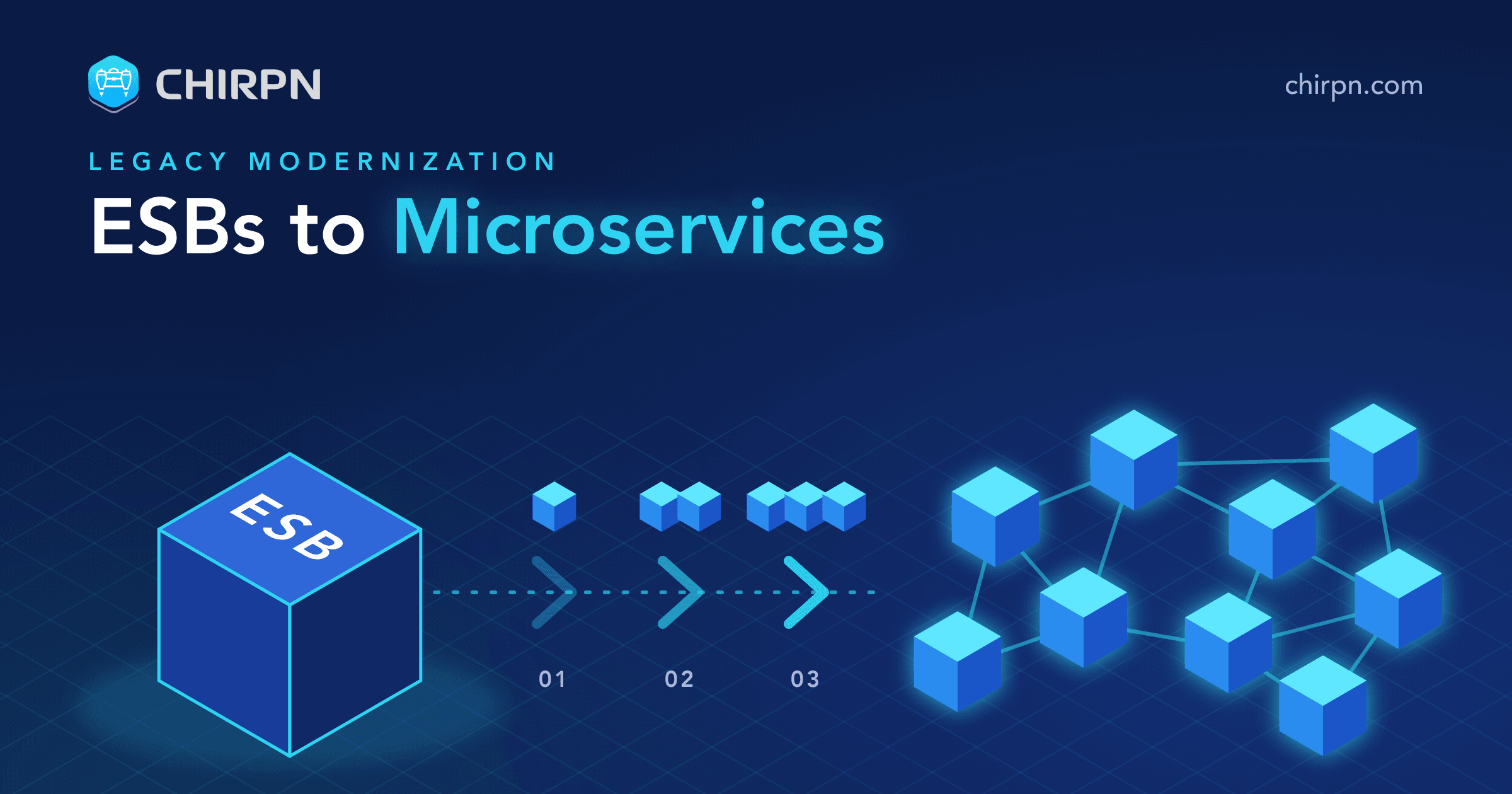
Legacy Modernization: ESB to Microservice Architectures, is where the gap exists. Even though the ESB functions properly, it is now the slowest, highest-risk portion of your technology stack to alter. This document will explain when it makes sense to replace an ESB, how you can migrate away from an ESB without interrupting your organization's business operations, and what sets apart those organizations who are able to go for legacy system modernization successfully from those organizations who struggle to make progress on such projects.
What Is an ESB and Why Did Enterprises Adopt It?
An ESB provides an architectural model for connecting applications through a single centralized software platform. The primary advantage of using an ESB over point-to-point connections among systems is that the ESB allows each application to be connected to the bus, which will handle the task of routing messages, transforming them if necessary, converting protocols, and coordinating the flow of messages between those applications.
In the years 2000 through the beginning of 2010, this was an important advance. ESBs replaced unreliable point-to-point connections with one, central, managed hub. ESBs also allowed for easier legacy system integration such as ERP, mainframe, CRM, and database which had no previous capability to communicate with each other. For numerous enterprises, the ESB continues to be the foundation for enabling orders, claims, payments, and customer records to flow smoothly.
Why ESBs Struggle with Modern Microservices Architecture
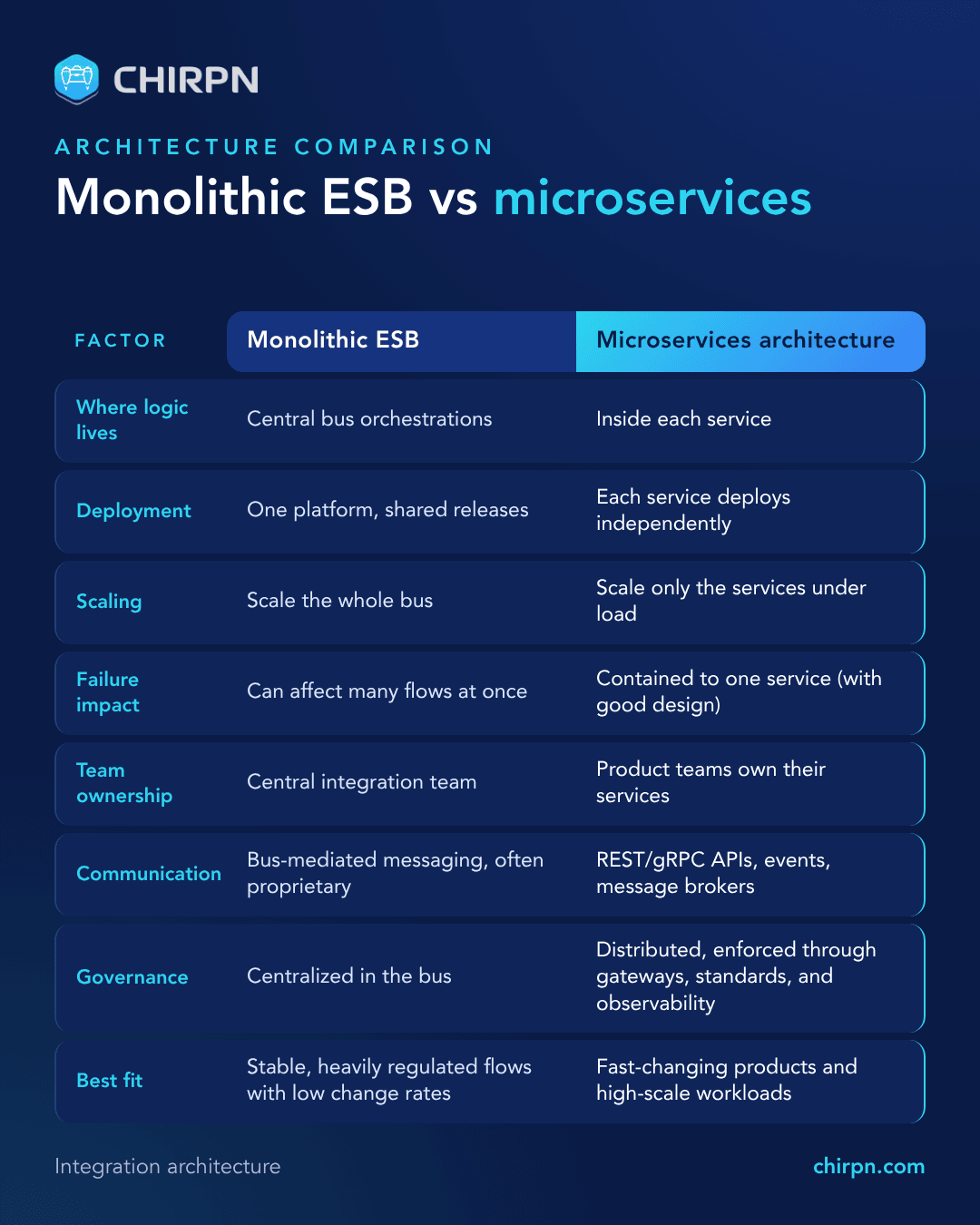
ESBs did not stop functioning but the way building and releasing software evolved beyond what a centralized bus was designed to support. Enterprises are currently developing smaller increments of functionality more frequently throughout each week, deploying those increments into containers and Kubernetes, and requiring that integrations can be scaled independently of one another. An ESB which is monolithic in nature, was created with a completely different operational paradigm in mind:
- One central bottleneck exists for every integration change made; all integration changes must pass through a single platform, and in many instances, a single team of experts.
- In a shared runtime setting, when there is a fault or excessive demand on an individual flow, it can impact other unrelated flows that use the same bus.
- Over time, rules that should reside within applications are being moved into ESB orchestrations, which makes testing those rules difficult and moving them even more challenging.
- Scaling as an all-or-nothing approach: You will be scaling your entire bus system rather than just one specific flow that requires additional capacity.
- The number of qualified individuals to fill positions is declining, making it more difficult to recruit employees to work with proprietary ESB platform and outdated protocols.
ESB vs. Microservices Architecture: What's the Difference?
Microservices architecture is a way of developing applications by creating many small, individual services. Each service owns only one piece of the business, its own data, and communicates with other services using either lightweight APIs or event streams. An ESB is an integration platform used for integrating different types of systems, whereas microservices is a type of application development. Therefore, when people talk about moving from "ESB to microservices" they are really talking about moving both the integration functionality of the ESB and the business logic of the application from a centralized location (the ESB) to several separate services, APIs, and event streams.
Is the enterprise service bus obsolete?
The answer to whether an ESB is obsolete is "Not completely." If an organization wants to integrate with older systems that do not change frequently and there are significant costs or risks associated with rewriting those older systems, then an ESB may be appropriate. Organizations that have transitioned to a modern architecture often maintain a "skinny" integration layer for legacy system integration to microservice based applications. Legacy modernization should not be focused on eliminating the ESB because it is bad; instead, it should focus on preventing the ESB from becoming the obstacle to every change.
When Should You Move Off the ESB?
Not every enterprise needs to migrate now. These signals suggest it's time:
- Release delays are directly related to the Bus. Product teams have to wait for integration teams, and changes to the ESB require lengthy regression testing periods.
- Failure of one component can bring down multiple unrelated systems. Accidents on the bus system create an extensive "blast" zone.
- You cannot increase the amount of data flowing through the most critical parts of your system. When you experience high demand (peak load) in only a small number of your data flows, this forces an increase in capacity for your entire platform.
- Business rules are confined to the business process. There is no certainty as to what orchestration contains each business rule, and if you alter one you may damage another.
- The platform is about to be discontinued, and finding people with the knowledge to continue maintaining it is becoming difficult.
- As you move to cloud and Kubernetes, the ESB is what will be out of place with your new way of working.
If you meet one or more of these criteria, then a structured legacy system modernization strategy is likely to provide a quicker return on investment (ROI) than simply continuing with patches.
How to Migrate from an ESB to Microservices: Six Steps
Incremental approach is the most reliable way to go. A 2024 survey of 53 industry professionals found that 50.9% reported that they were moving to microservices gradually; 34% stated that they were creating entirely new systems from the ground up; and only 9.4% said that they would immediately make the move (Nogueira et al., arXiv, 2024). This was a relatively small group of respondents and primarily based in one geographic region; therefore, this should be considered an estimate. However, this is representative of what many modernization groups have observed: big-bang rewrites are by far the riskiest option.
Step 1: Map every flow on the bus
Each integration should be documented with: the source system and the target system, the format of messages being exchanged, what types of transformations are occurring on those messages, any business rules that apply to the process, how many transactions occur daily, how much time is allowed for processing of transactions (SLA), and who owns the integration. Many Enterprise Service Buses contain processes that no one recalls creating. Reverse engineering the bus is typically the most difficult and potentially valuable portion of the project. Chirpn’s Guide to Reverse Engineering Legacy Systems provides methods to accomplish this task.
Step 2: Rank flows by value and risk
Assign scores to each flow for its business importance, frequency of changes, history of failures, and technical complexity. Begin with flows that are frequently modified and cause problems for users; however, do not select flows which have high business criticality, such that a disruption of these flows could lead to the complete stoppage of operations. Successful initial implementations of automation will provide your team with confidence and a model for future projects.
Step 3: Define service boundaries around business capabilities
Domain-Driven Design (DDD) allows us to break down our system's functionalities based upon business capabilities such as ordering, billing and customer profiles. This approach is in contrast to breaking down a system's functionalities based upon technical layers. The practitioner study showed that 52.8% of the participants used DDD as their method for decomposing their systems into business capabilities. Each microservice should ideally control its own data. If we share databases among multiple microservices then we have recreated the dependencies that we were attempting to eliminate.
Step 4: Put an API gateway and event layer in front
An API Gateway will provide consumers with access to the stable APIs available via the Gateway rather than accessing the ESB directly. Event Brokers can then be added to facilitate asynchronous flow. By providing these two components, you have created a "seam" where traffic can be directed towards either the original ESB flows or toward the new services being developed, and consumers will not perceive any changes.
Step 5: Strangle the ESB one flow at a time
Use the Strangler Fig pattern; create a new service while still using your current flow, move some of your traffic to the new flow, compare what happens between the two flows, and gradually shift more traffic. After you have verified that the new flow is working properly, shut down the old ESB flow. Do this again and again. Your ESB will continue to get smaller and smaller over time rather than having to be shut down all at once in a weekend.
Step 6: Build observability and governance in from day one
Microservices distribute logic over several components; therefore, you will require distributed tracing, centralized logging, health checks, and a standardized API model at the beginning. If not provided, you have traded a monolithic architecture for a distributed architecture that is impossible to debug. The responsibility of governing microservices has transitioned from the bus to gateways, service templates, and automated policy checking.
Common Mistakes in ESB-to-Microservices Programs
- The big-bang migration strategy is a high-risk approach to migrating systems that delays potential benefits from the beginning of the project to the end.
- Building a distributed monolith. All of the services which are dependent upon each other through sharing databases or needing to be deployed simultaneously will have as much coupling as the ESB, but with the added cost of networking.
- If you move logic without understanding it and copy ESB orchestrations into services without validation of the business rules, then you will carry old defects forward.
- Underestimating the amount of effort needed for data migration. When migrating from a single shared data store to multiple stores requires careful consideration to ensure consistency and to be able to report on the status of each service.
- The cultural transformation of development teams is the biggest challenge (47 percent) for companies to overcome when adopting CNCF projects, according to the organization's survey. Companies need to create new ways to own code, establish on-call procedures and train their staff in new areas rather than simply providing them with new platforms.
- Skipping testing and monitoring, which prevents safe parallel running a safeguard that is dependent on contract testing, integration testing and automated monitoring.
Choosing Legacy Modernization Services
Most companies don't have extra resources to perform a migration and still maintain their current business operations. As a result, many turn to legacy modernization services, application modernization services, or specialists in microservices consulting to assist with some of the initial stages. To help select a vendor, consider asking:
- How will you inventory and document the flows on our current ESB?
- Do you migrate incrementally, and how do you run old and new paths in parallel?
- How do you define service boundaries and handle shared data?
- What observability, testing, and governance do you put in place before go-live?
- How do you transfer knowledge so our teams can own the services afterward?
- Could you provide examples of similar studies with results that have been independently validated, rather than based upon self-reports?
A partner that provides specific answers to the questions you have about your systems, and clearly states what its case studies do and do not demonstrate, is much more trustworthy than a partner that has a well-developed framework but lacks detail.
Why Chirpn
Chirpn views legacy modernization as a series of steps in a staged process rather than as a complete rewrite. Chirpn's method for modernizing legacy systems has six distinct steps which use AI; assessment, planning (rehost, refactor, or rebuild), generative-AI based code conversion, AI based quality assurance, intelligent data migration and continuous monitoring. These six components address the most challenging aspects of migrating an ESB — determining exactly how the bus functions and migrating it while ensuring that everything relying upon it continues to function properly. Additionally, Chirpn's API and integration services create the gateway/API layer that allows for incremental migration to take place.
An Australian health insurance company's enterprise data warehouse was migrated by Chirpn from Cognos and SQL Server to Snowflake, Talend, and Tableau. Additionally, Chirpn implemented a custom ETL framework and provided 24/7 batch support. The client stated that the migration has resulted in increased processing efficiency and decreased reporting latency (case study; vendor-reported).
If your ESB has become the slow-moving component of your system architecture, book a legacy integration assessment with Chirpn to develop a visual representation of all of your flows, along with an organized and prioritized migration strategy.
Conclusion
The shift from ESBs to microservices is not just about following the latest trend. This shift is about aligning your integration with the "cloud-native" architecture, which includes things like containers and Kubernetes. As such, the ESB is usually the last component in a company's technology stack that continues to use outdated methods. If a company finds themselves experiencing long delays in releasing software updates, has large scale outages that affect many users at once, and is unable to extract valuable information from its data due to the complexity of the ESB architecture, then moving toward modernizing the ESB would be the logical next step.
The successful programs have a common theme - they each start by mapping each flow, then migrate each service through an API gateway, then create each service based on what business capability it provides, and lastly, build in observability and governance from the beginning. Additionally, these programs are treated as changes to the way that teams interact with technology, not just as changes to the technology itself. When undergoing legacy modernization: ESBs to microservices that follows this approach, the risk associated with the transition is reduced at all levels rather than concentrated at the end.
Frequently Asked Questions
How does an ESB differ from microservices?
An ESB provides a centralized integration platform to route and transform messages among applications. On the other hand, microservices architecture refers to a methodology of developing applications using small, independently deployable services, which provide a single business capability. Transitioning from an ESB to Microservices Architecture involves shifting application logic away from the centralized integration platform into multiple distributed services and APIs.
Has the Enterprise Service Bus become obsolete?
Not completely. An Enterprise Service Bus can be used for stable, low-change integration with legacy systems. Many of today's architectural models use a smaller integration layer for these while creating new functions as Microservices. Legacy modernization is about preventing an ESB from impeding change; not removing it because of a philosophical stance.
How long will it take to migrate from ESB to microservices?
The time it will take to complete the migration from ESB to microservices will vary based upon several factors including: the number of flows that need to be migrated; the quality of documentation for those flows; the complexity of the data associated with those flows; and the availability of resources (i.e., your team) to complete the migration process. An incremental program will allow you to realize value quickly since each flow can be moved into production individually as it is completed as opposed to being delayed until all flows have been migrated. The only way to accurately assess how much time will be required to successfully migrate from ESB to microservices is to create an inventory of all flows that need to be migrated during the initial phase of the migration effort.
Do you need to replace the ESB all at the same time?
No, and in most cases it's better not to do so. The "strangler fig" model is designed to allow you to transition your flows to a new API gateway gradually, one flow at a time. This allows you to run both the old and new flows in parallel until you're confident that the new flow works correctly. Only then do you retire the old flow. Because of this, many people choose to move their flows incrementally.
What are some of the key capabilities required for migrating an ESB to microservices?
Microservices migration requires that teams possess a thorough understanding of their legacy systems and enterprise service bus in order to comprehend how existing flows operate. Additionally, the team will require knowledge regarding domain driven design, API/event design, containers/Kubernetes, continuous integration/continuous delivery (CI/CD), observability, and data migration. Many companies utilize a combination of internal knowledge about their own systems and external microservices consulting during the initial stages.